

The most expensive handoff in your funnel
Think about how carefully you'd handle a warm inbound lead.
You'd route it to your best rep. Someone who knows the product, reads the room, adjusts the pitch to whoever is actually on the call, and knows when to push and when to back off.
You would not hand that meeting to the person who joined last week and reads from a script.
And yet: someone types a specific problem into Google, sees your ad, clicks, and you're charged real money for thirty seconds of purchased intent. Or a prospect gets a carefully researched LinkedIn message and decides you might be worth a look.
Where do most companies send them? To a homepage. Fifteen navigation links, three audiences addressed at once, a hero banner about the company, and no direct answer to the question that person just asked.
That's not routing a lead to your best rep. That's routing your highest-intent traffic to your worst one.
Only about 20% of paid traffic reaches a landing page built for the campaign that produced it. 77% of pages counted as "landing pages" are actually home pages. Among B2B companies using landing pages at all, 62% have six or fewer live.
Six pages. For an entire go-to-market motion.
Companies spend millions generating intent through ads, outbound, content, and demand gen - and then route that intent into generic pages that were never designed for the person clicking. The leak isn't in the campaign. It's at the handoff.
Today we're launching GenPage 3.0 - one of the biggest release since we started the company, and our most direct attempt at closing that gap.
Landing pages deserve to be treated like product
Your landing pages are where the first impression happens. Where trust is established or lost. Where prospects qualify themselves in or out. Where the promise your ad or your SDR made either gets kept or quietly broken.
Functionally it's your first sales conversation, running at a scale no human team could cover. Your pages take more meetings in a day than your entire sales org takes in a quarter.
And almost every company treats them as static, one-time projects. Built once, signed off, forgotten.
If a landing page were a person on your team: a good rep adapts to who's in the room, but most pages say the same thing to a founder at a ten-person startup and a director at a five-thousand-person enterprise. A good rep gets coached constantly - when was the last time anyone improved your highest-spend page? A good rep knows the current pitch, but when you change pricing or shift positioning, your reps know within a day and your landing pages find out whenever someone finds a free afternoon.
Pages don't fail loudly. They go stale. Marketing has campaigns to run, engineering has a roadmap, and updating a few dozen variants by hand is nobody's favorite task. So they sit there drifting out of date while spend keeps flowing to them.
The cost of landing pages was never the build. It was the ownership.
Software teams solved this a long time ago. Nobody ships a product once and walks away - you ship, measure, learn, ship again. Landing pages sit at the exact point where your entire GTM spend converts or doesn't, and they're still run like a 2010 website redesign.
Everything in 3.0 is aimed at making them agile: fast to create, grounded in real context, and continuously improved by teams who don't have a spare designer, developer, and CRO analyst sitting around.
Since we started, teams have generated 200,000+ landing pages on GenPage, and 3,200+ teams now use it - up from 150,000 pages and 2,800 teams when we shipped 2.0 five months ago.
See GenPage 3.0 in action
We recorded a full walkthrough of everything in this release - the new agent, brand knowledge bases, Concierge, the MCP, Google Ads, and the rest:
Prefer reading? Everything is broken down below.
What's new in GenPage 3.0
Meet the new GenPage Agent
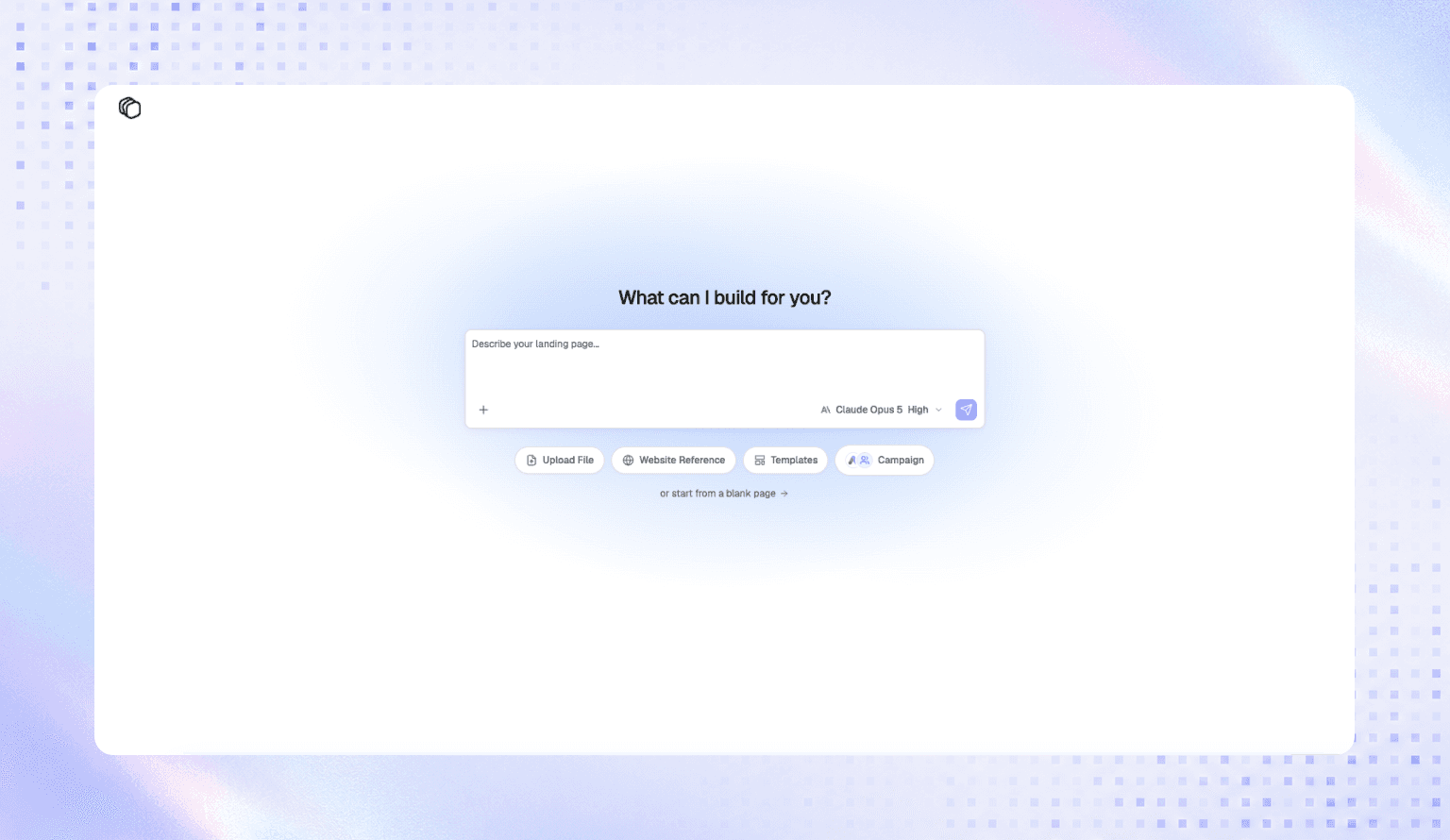
Creating a landing page used to start with configuration - pick a template, choose a campaign type, set up variables, decide how personalization should work. A series of decisions you had to make before you'd even worked out what the page should say.
Now it starts with a conversation.
Describe what you want in plain language and the agent plans the page, determines how it should be personalized, gathers the right context from your brand and enrichments, and guides you through creation. Underneath it sits a completely rebuilt AI system prompt that gives the builder a much deeper understanding of page structure, messaging, design, and conversion - plus automatic prompt optimization that improves your instructions before they reach the generation model.
You don't have to be good at prompting. That's our job, not yours.
A completely rebuilt Brand Knowledge Base
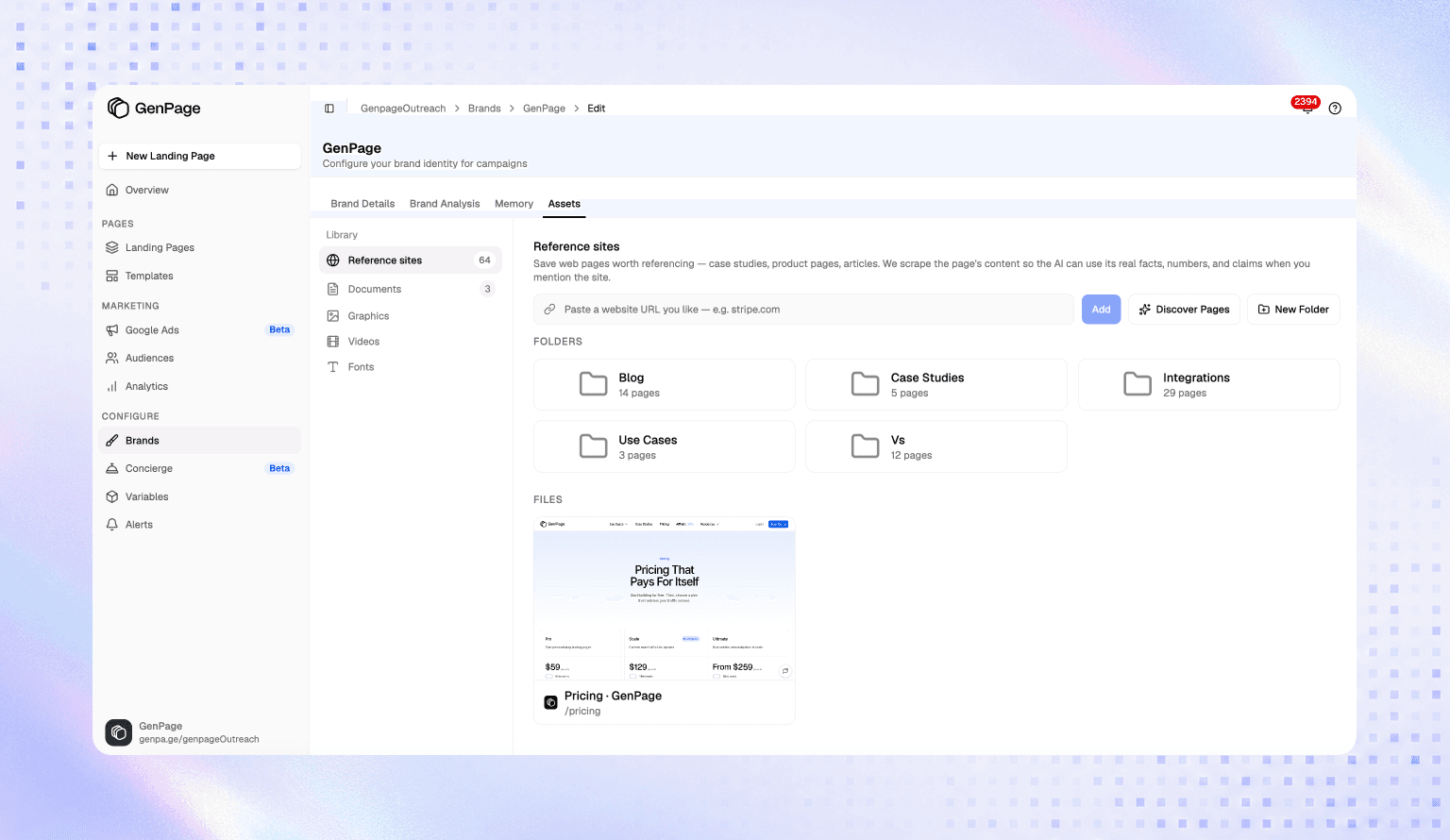
AI-generated pages are only as good as what the AI knows about you, and most tools only read your website - which is your broadest, most committee-reviewed, least specific pitch.
Brands now live directly in your sidebar and act as the source of truth for everything GenPage creates. Add your domain and GenPage automatically crawls your design system, positioning, products, case studies, blog content, and key pages. Then enrich it with internal documents, images, videos, and other company knowledge - sales decks, battlecards, product documentation, positioning frameworks.
This matters more than it sounds. Your website describes your product; your sales deck describes how you actually sell it, and the language your best rep uses in a live deal is almost always sharper than what's on your homepage. Feeding the AI that material is the difference between pages that summarize your marketing site and pages that sound like your strongest seller wrote them.
Automatic knowledge retrieval means the agent pulls the most relevant material for each specific page, rather than treating everything as equally relevant.
Brand Memories and AI guidelines
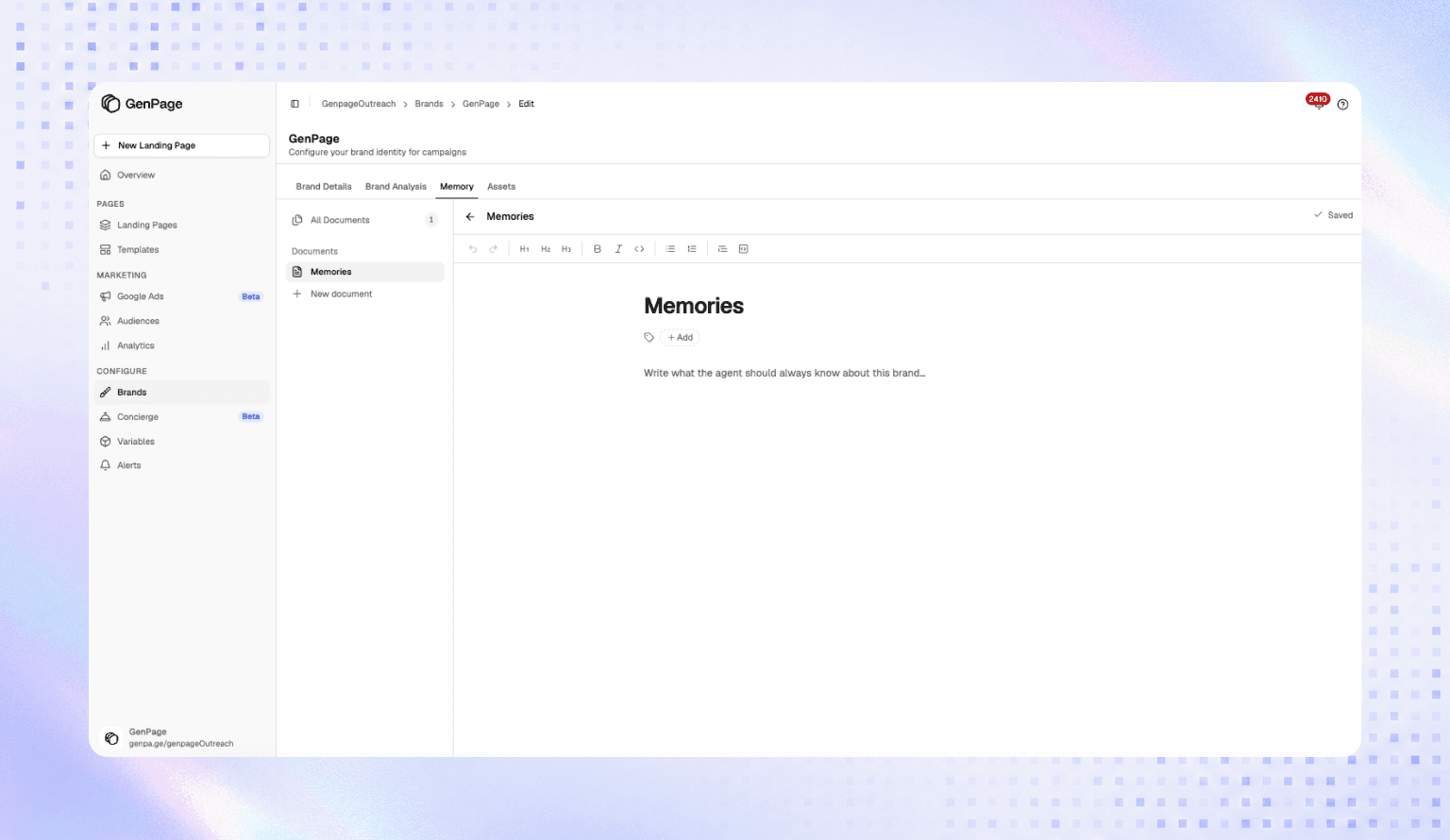
GenPage now remembers what it learns while working with you - messaging preferences, how you like pages structured, the phrasing you keep steering it toward. You can also define persistent guidelines the AI follows whenever it creates content for your brand.
Set the rule once instead of restating it in every prompt. The platform gets better at being your brand the longer you use it.
GenPage Concierge
A static page can only answer the questions you anticipated when you built it. Everything else becomes a bounce, a form fill, or a wait for someone to reply.
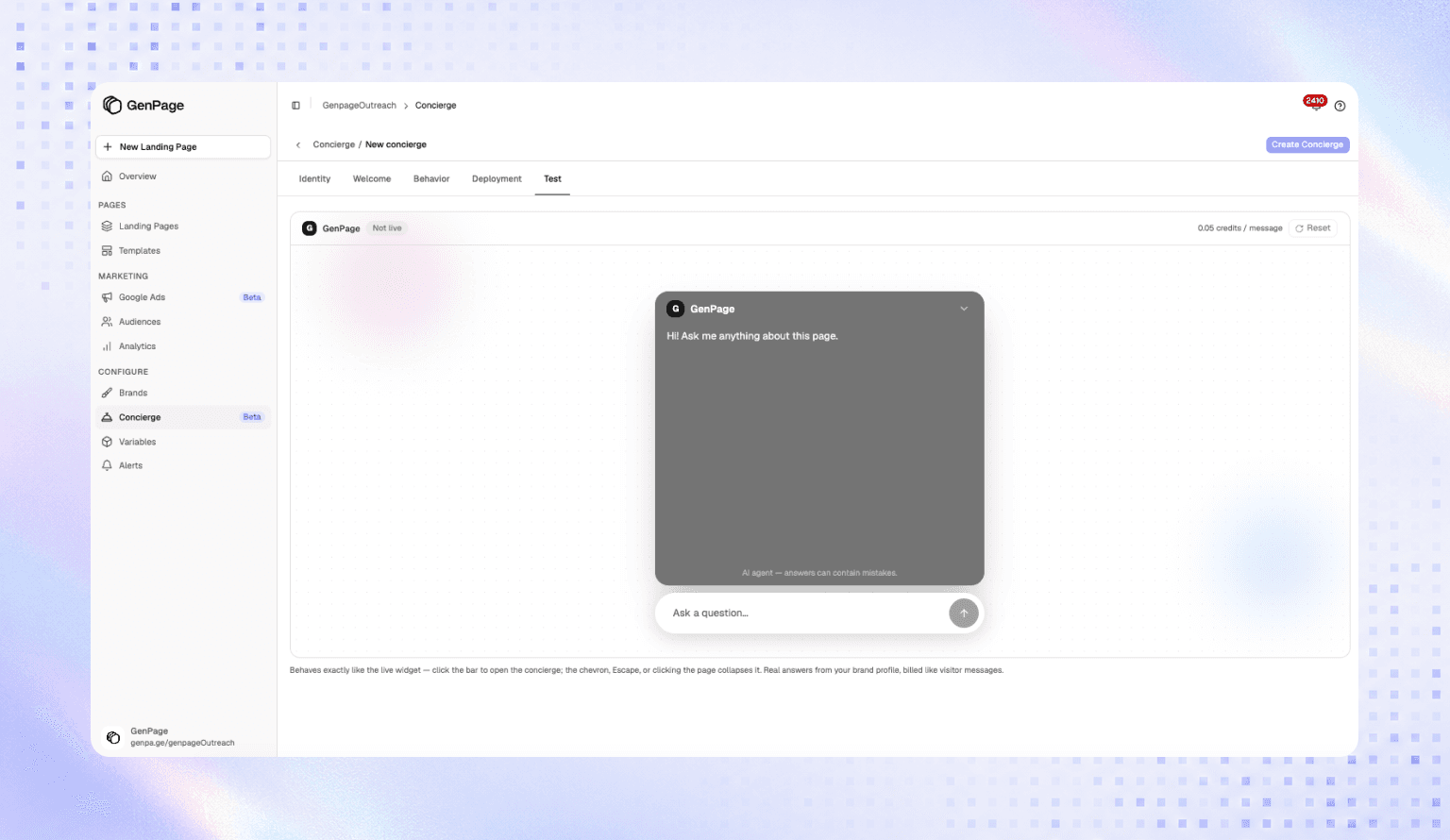
You can now add an AI agent directly to your landing pages. Concierge understands your brand and the specific page a visitor is looking at - it answers their questions, surfaces relevant information, and helps qualify inbound prospects 24 hours a day, on every page.
This changes what a landing page is. The conversation used to start after the form. Now it starts on the page, in context, at the moment the visitor actually has the question.
Our most powerful AI system yet
Most AI-generated pages look like AI-generated pages: generic layouts, default typography, and personalization that amounts to inserting a company name. 3.0 brings together everything we've shipped over recent months into one engine built to clear a much higher bar.
Model selection and BYOK. Choose from leading Anthropic, OpenAI, and Gemini models, control reasoning depth, and connect your own API keys to substantially reduce AI credit usage. Different jobs want different models, and teams running at volume should control that cost directly.

Fable 5, now available in GenPage - producing stronger layouts, cleaner visual hierarchy, better copy, and more polished pages.
The Variables Agent, which removes the manual work of deciding where and how a page should be personalized. It analyzes your page, identifies the opportunities, and creates the dynamic variables for you. Most teams under-personalize because working out what to make dynamic is tedious - this solves that directly.

Design benchmarking using high-quality Mobbin examples to continuously evaluate and improve generation quality. The bar we hold ourselves to is that a generated page should be indistinguishable from one your design team built, because pages that look generated undermine every bit of relevance work that went into them.
Significantly deeper enrichments across brand, keyword, company, and person-level research - plus five new target account enrichments: LinkedIn Profile, Company Research, Prospect Research, LinkedIn Posts (Person), and LinkedIn Posts (Company). Running all five gives the AI a genuinely deep picture of both a person's professional presence and their company, which is what separates real personalization from mail merge.
Plus brand-aware knowledge retrieval and improved design intelligence across the entire generation pipeline.

GenPage for Google Ads is out of beta
Search is where intent is most explicit: someone typing a query is telling you exactly what they want, which makes sending them to a generic destination especially expensive.
After months of iteration we're genuinely happy with the quality of the pages being generated, and it's ready for everyone. Connect Google Ads, import your campaigns, keywords, and ad groups, generate matching landing pages, publish at scale, and track performance down to each individual variant.

The GenPage MCP is live
Our API has been completely rebuilt, and GenPage now works in both directions.
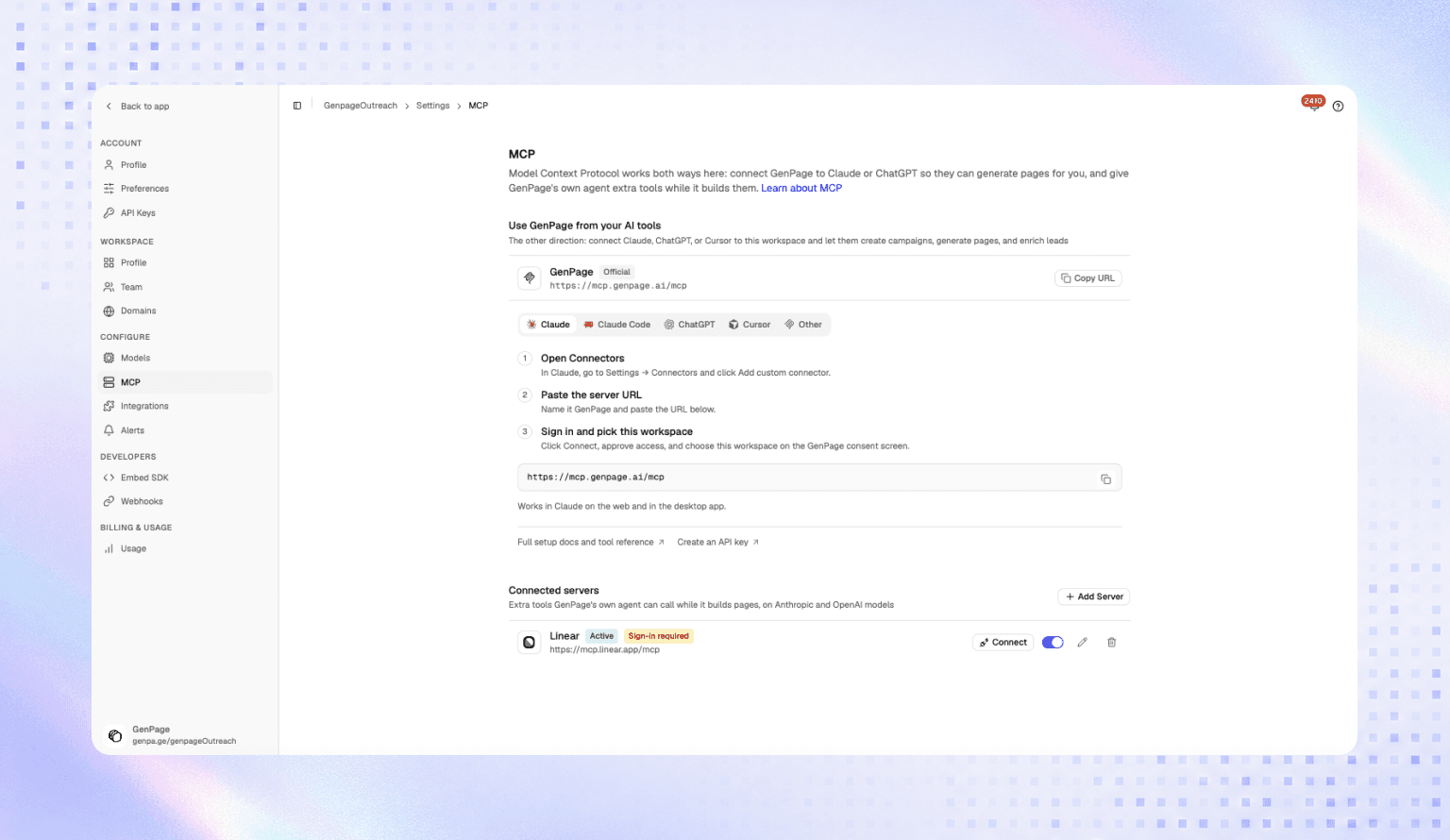
Connect external MCPs into GenPage so the agent can access more context and capability - pull designs from Figma, company knowledge from Notion, generate on-brand assets with tools like Higgsfield.
Or connect the GenPage MCP to Claude and other AI tools and create landing pages from virtually any workflow. Turn a sales call transcript into a personalized follow-up page after a demo. Generate a proposal page from a HubSpot record. Create campaign pages from an existing AI workflow without opening GenPage at all.
This is the piece I'm most excited about. GenPage stops being a destination you have to visit, and page generation becomes something that happens wherever your work already happens.
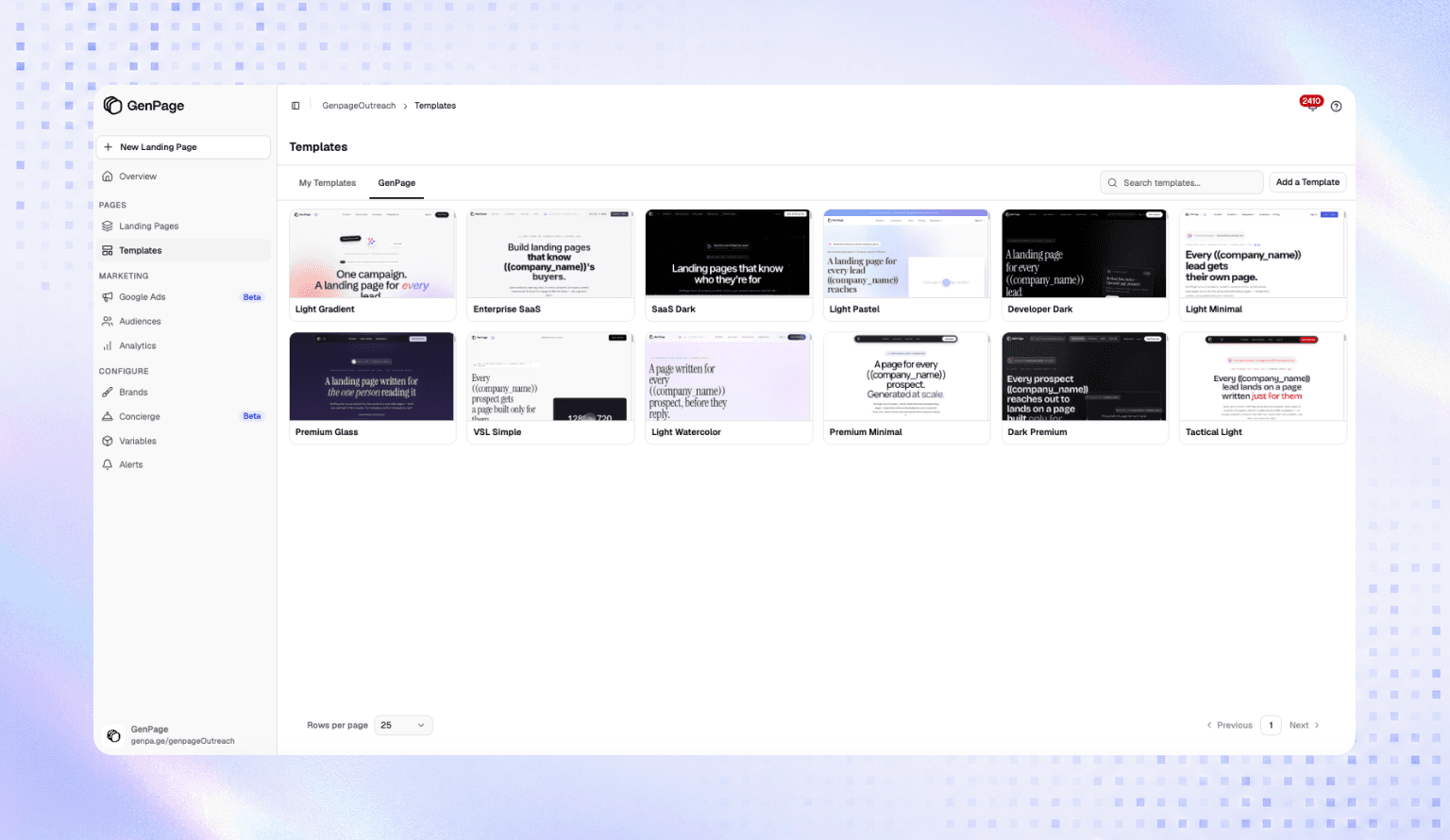
12 Completely new templates
We replaced the older library with 12 new designs built around the quality and flexibility of the latest builder. Better starting points produce better pages — every variant you generate inherits the quality of what it started from.
A better operating system for your pages
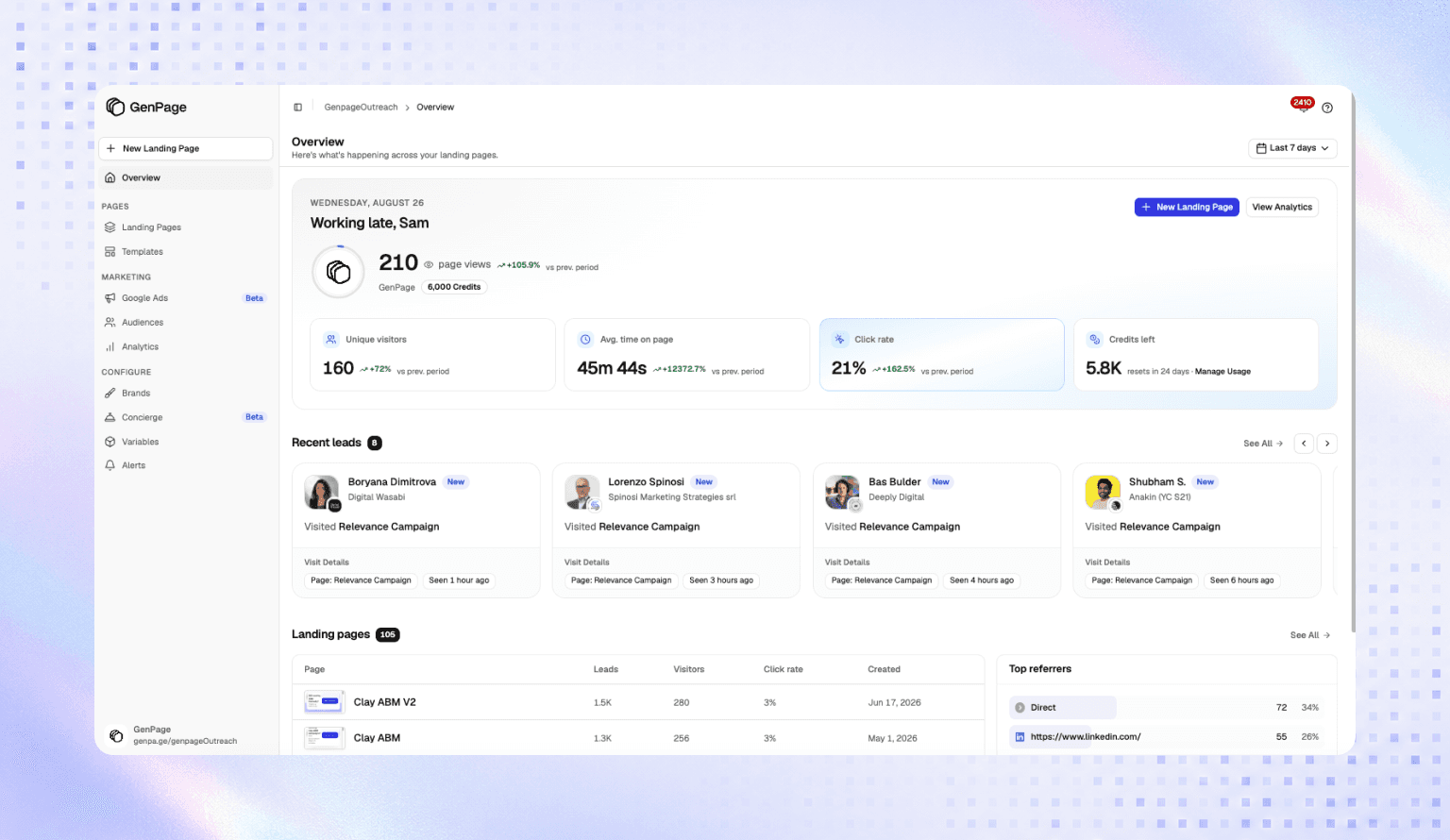
The new overview gives you immediate visibility into visitors, conversions, and page performance the moment you log in - the numbers you actually check, without hunting for them.
Alongside it: a faster editor with better drag and drop, new hotkeys, and improved navigation; a redesigned onboarding flow; new interfaces for Leads and Google Ads; a more stable LinkedIn leads import API; and dozens of quality-of-life improvements across the platform. Individually small, collectively the difference between a tool you can use and one you can operate at scale every day.
And if you need extra capacity without changing plans, you can now buy additional credits instantly from your workspace.
Ads as a module, and credit top-ups
Two changes to how GenPage is packaged.
Ads is now a module, priced on the ad spend GenPage optimizes. If GenPage is generating and optimizing the landing pages behind a paid budget, what it's worth scales with that budget - so pricing it as a flat fee made it expensive for small teams and dramatically underpriced for large ones. Tying it to optimized spend means our incentives point in the same direction as yours: we only earn more when we're making more of your spend convert.
Credit top-ups. If you go a little over your limit, you can now buy additional credits instantly from your workspace - no plan change, no sales conversation, no campaign stalling mid-launch. If you're consistently going over, upgrading your plan is cheaper than topping up repeatedly, and we'd rather tell you that than quietly collect overage revenue.
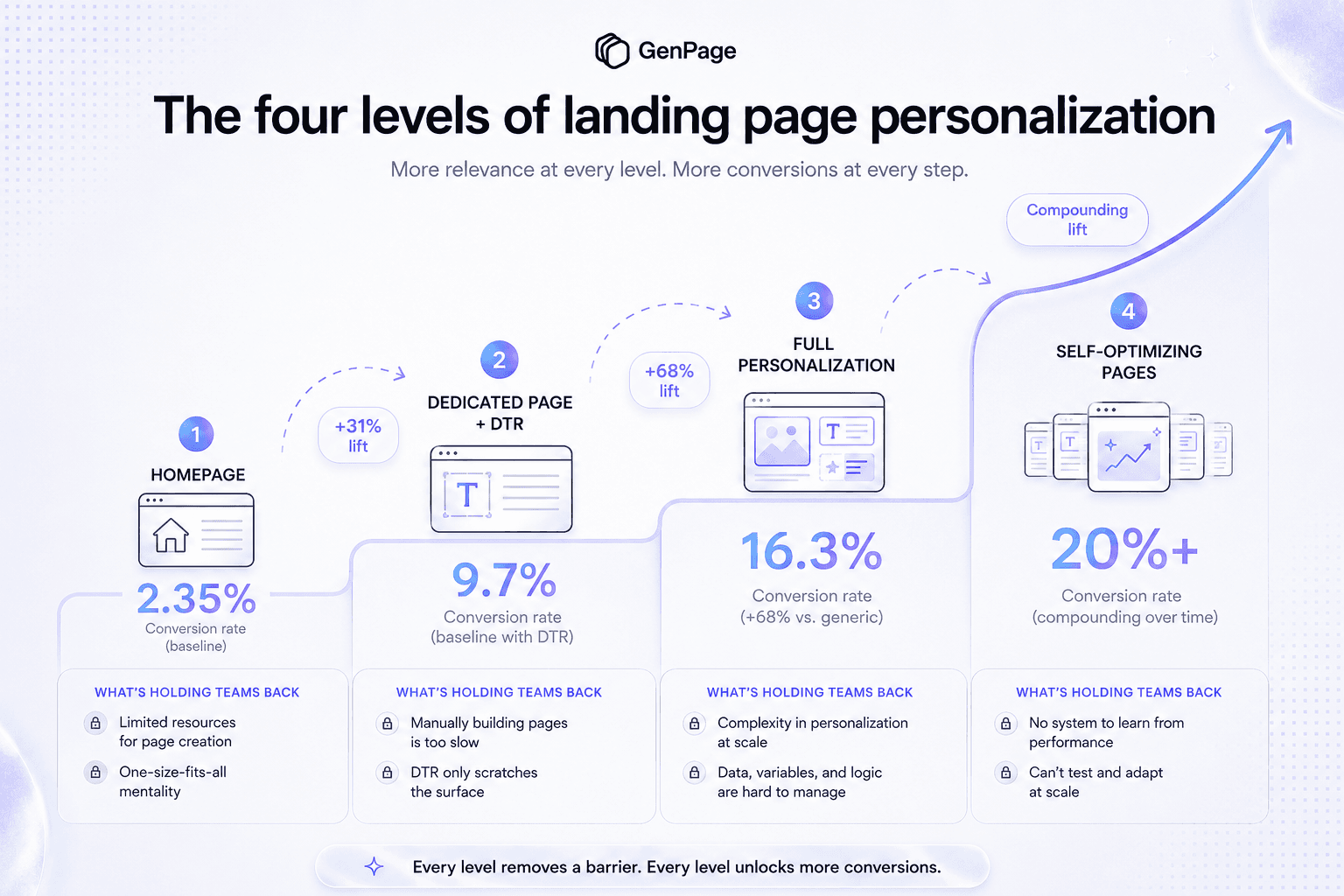
The four levels of landing page personalization
It helps to be precise about what "personalized" actually means, because the word covers four very different things.
Level 1 - everyone sees the same page. A homepage, or one generic landing page serving every campaign. This is where most companies still are, and it's expensive: dedicated landing pages convert at 9.7% on average versus 2.35% for homepages.
Level 2 - swap a word. Dynamic text replacement pulls the keyword or company name into the headline and leaves the rest of the page untouched. It works - one well-known test lifted signups 31.4% by matching a single verb to the search query - and it's what most of the market means when it says "personalization." It's also a ceiling. A string is not an intent. Someone searching for a competitor alternative and someone searching for a category explainer can be shown the same page with their own words at the top, and they still need completely different arguments.
Level 3 - a genuinely different experience per person. Not the same page with a name inserted, but different framing, different proof, different offer, built from real research about who this person is and what they're dealing with. Fully customized pages have produced conversion lifts around 68% - roughly double what text replacement delivers.
Level 4 - pages that improve themselves. Levels 1 through 3 all describe how good a page is on the day you launch it. Every page you ship is a hypothesis, and none of the first three levels ever tests it.
GenPage 3.0 is the release that makes Level 3 practical at scale. Level 4 is what comes next.
From Account Based to Person Based Marketing
When we announced 2.0 we introduced a framing we still believe in: the move from Account Based Marketing to Person Based Marketing.
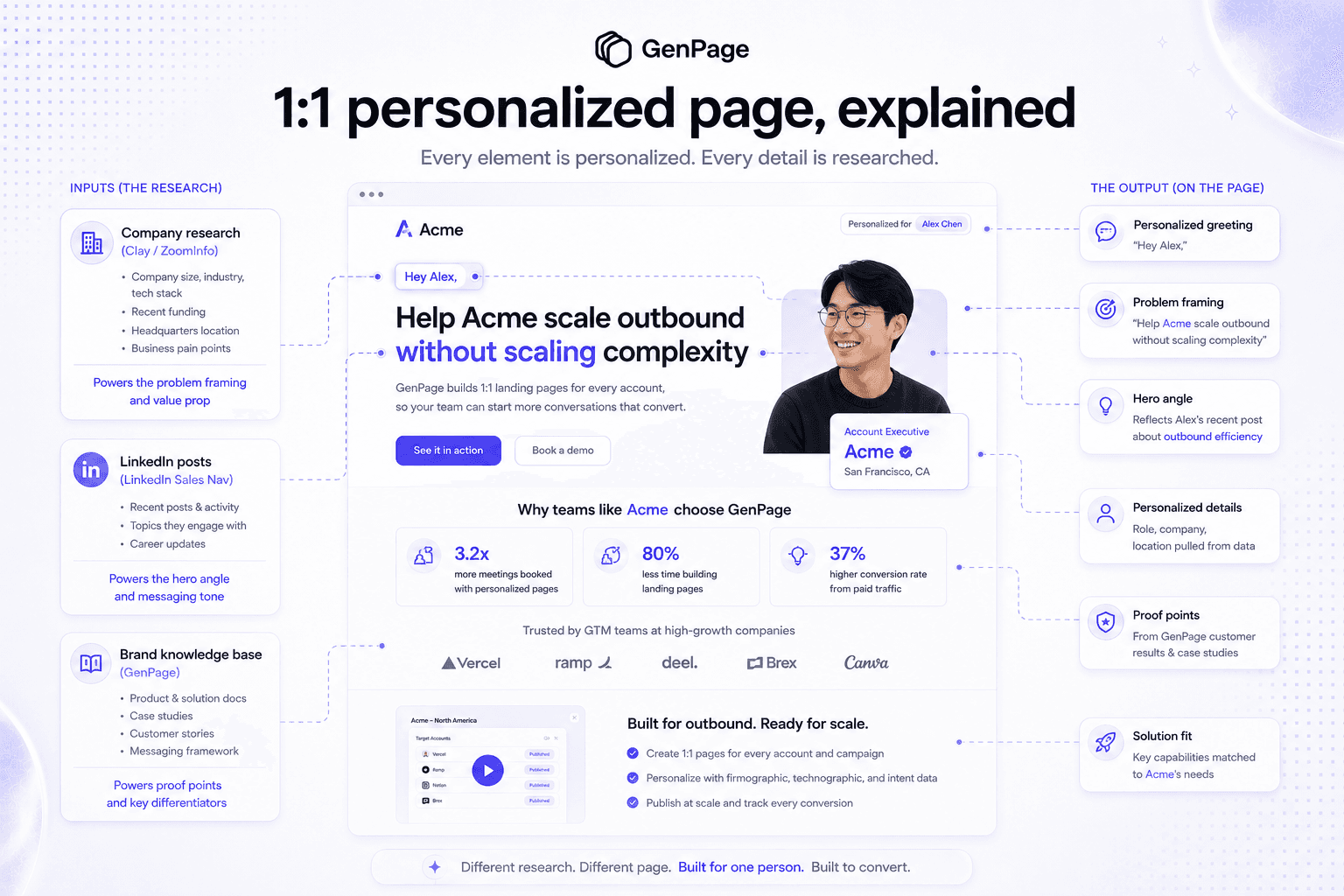
ABM changed B2B by focusing on target accounts. The bigger opportunity goes one step further - targeting a specific person inside that company with an experience built for them. Not "a landing page for fintech companies," but "a landing page for Sarah, Head of Growth at Stripe."
That's Level 3, and in March it was a direction more than a capability. Getting there required rebuilding almost every layer of how GenPage works.
The research got deeper. Five target account enrichments - LinkedIn Profile, Company Research, Prospect Research, and LinkedIn Posts for both the person and the company - give the AI a genuinely deep picture of who someone is, what their company is doing right now, and what they've been publicly thinking about. Personalization is capped by input quality. Shallow data produces mail merge no matter how good the model is.
The engine got substantially stronger. New generation architecture. Model selection across Anthropic, OpenAI, and Gemini with control over reasoning depth, so the right model runs the right job. Fable 5 producing markedly better layouts, hierarchy, and copy. A completely rebuilt system prompt that understands page structure, messaging, design, and conversion rather than treating a landing page as a generic document. Automatic prompt optimization so quality doesn't depend on how well you write instructions. And a design benchmarking system built on high-quality Mobbin examples that continuously evaluates and pushes generation quality upward.
The tooling got smarter. The Variables Agent removes the manual work of deciding what to personalize - it reads the page, finds the opportunities, and builds the dynamic variables. Brand Knowledge Bases with automatic retrieval mean generated copy carries your real positioning, your actual sales language, your genuine proof points, rather than a summary of your homepage. Brand Memories mean it holds onto what it learns about how you work.
Any one of these alone produces something that looks personalized. Together - deep research, a much more capable generation engine, automatic variable creation, and real brand context feeding every page - they produce something that reads as though a person researched this prospect and wrote the page by hand.
That's the bar. 3.0 is the first version where we think we're consistently clearing it.
What's next
GenPage Autopilot - Level 4 - is currently in private beta with a small group of customers alongside heavy internal testing. It generates new variants of a page, splits sessions across them, measures conversion performance, and converges on a winner over a defined number of rounds. Continuous optimization without anyone designing a test, building a variant, or interpreting significance.
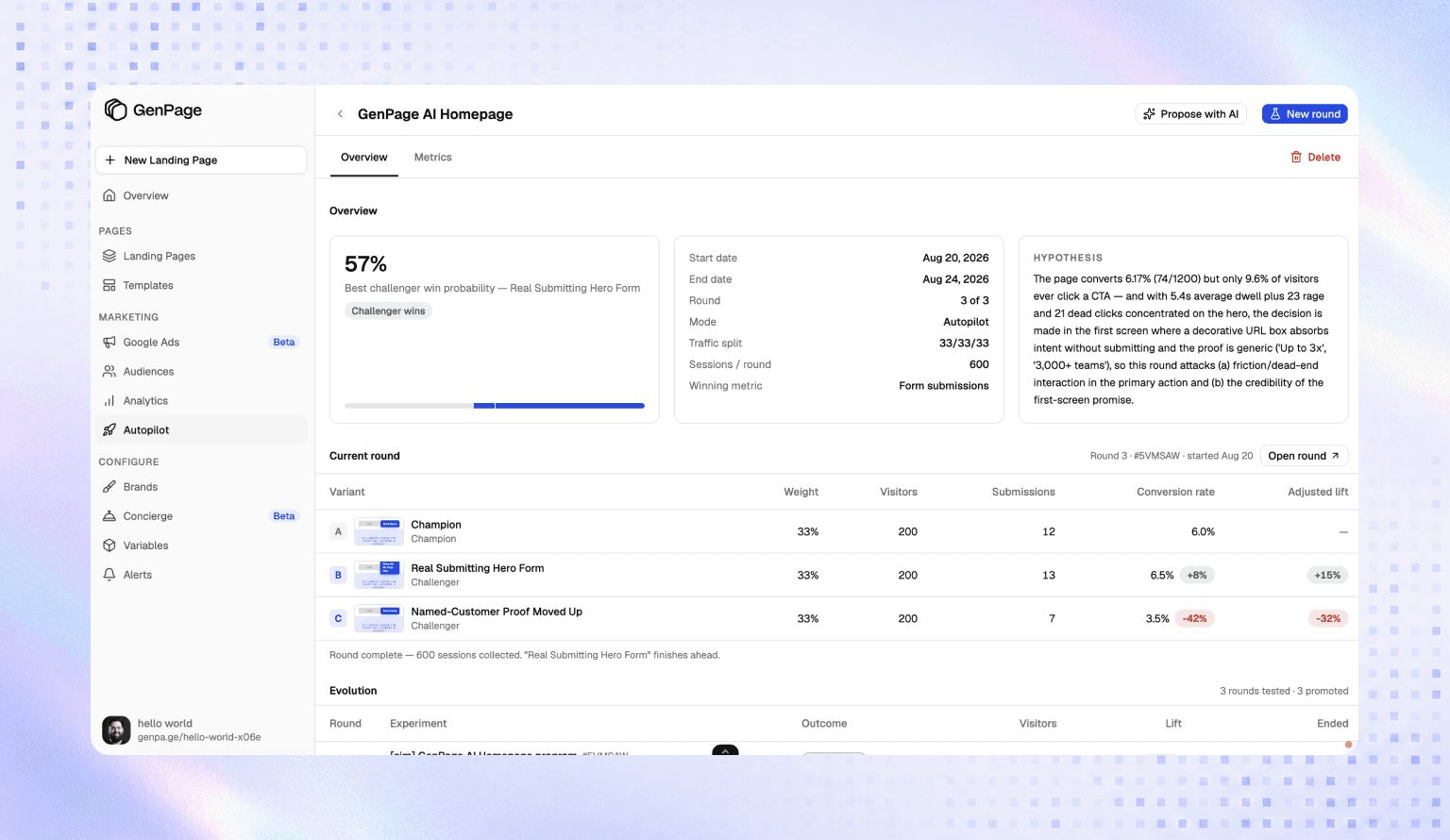
We're excited about what we're seeing, and will share performance numbers as we got closer to a public release. Autopilot runs on pages carrying serious marketing budgets, and we'd rather take longer and ship something bulletproof than ship early and be directionally right.
There's a structural reason it matters beyond convenience. Personalization fragments traffic by design - that's the point of a page per segment, per keyword, per account. But traditional A/B testing needs volume per variant to reach significance. The more precisely you personalize, the less able you are to test what you built. Most teams resolve that tension by quietly abandoning testing. Autopilot resolves it properly: your pages get more relevant and keep improving.
It's also the only level that doesn't decay. Levels 1 through 3 all perform at their launch-day level and drift downward as the market moves. A page on Autopilot treats launch day as its worst performance.
LinkedIn and Meta Ads integrations come next - same core capability as Google Ads, different intent profiles. Both before the end of 2026.
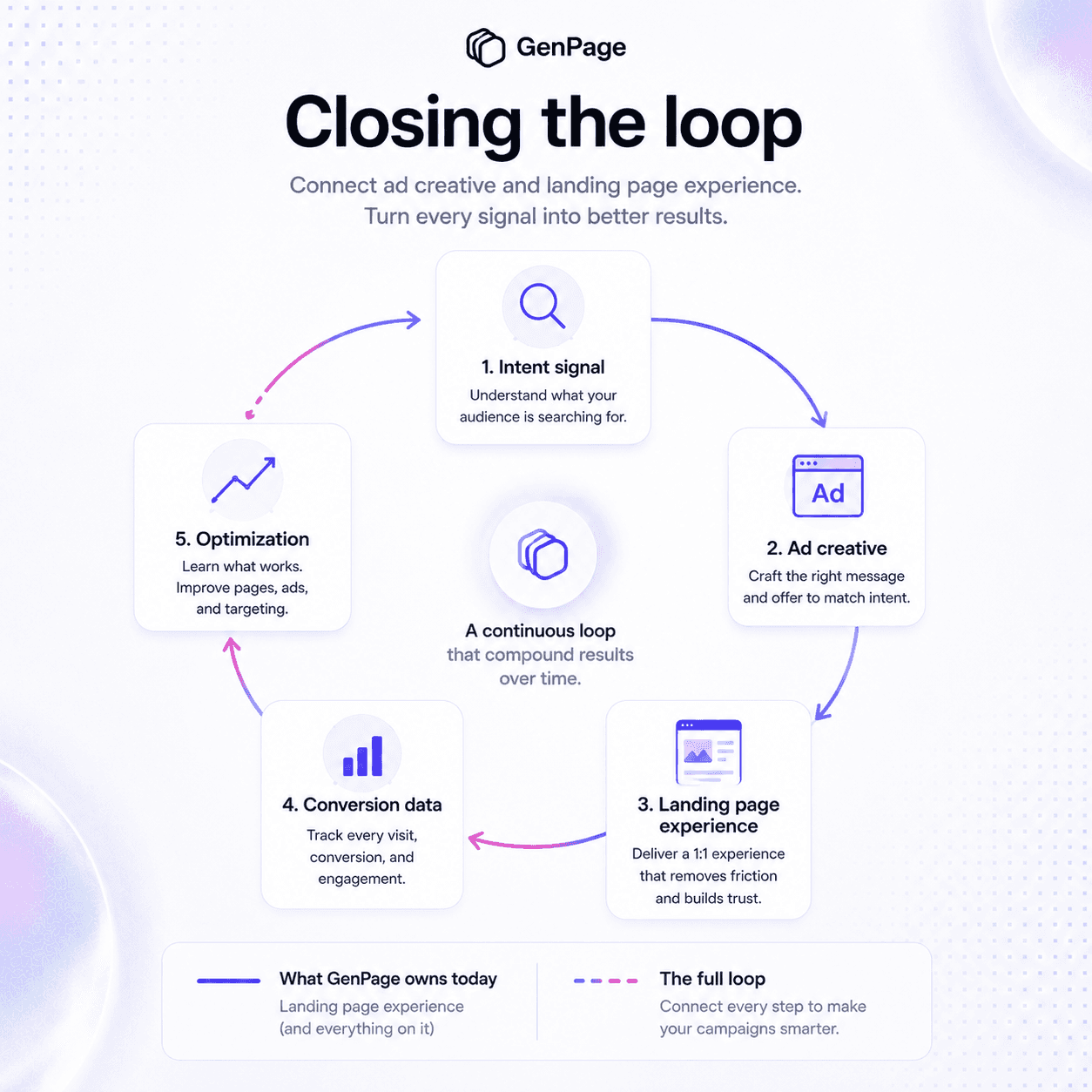
Then ad creative and landing page, generated together. Right now the ad and the page are usually built by different people, in different tools, at different times, and measured separately. The ad's job is to earn the click, the page's job is to earn the conversion, and nobody owns the seam between them, which is exactly where most of the loss happens. When creative and destination come from the same brand context, the same audience research, and the same intent signal, and get optimized against the same conversion goal, that seam disappears. Also before the end of 2026.
We've had plenty of chances to expand sideways into video, decks, and every other format a GTM team touches. We'd rather be the best in the world at the one surface that decides whether your GTM spend converts.
From click intent to conversion - one continuously improving system.
The future we're building toward
Companies spend millions generating intent. That intent still mostly lands somewhere generic.
That's going to look increasingly outdated - the same way a website that didn't work on mobile looked outdated a decade ago. Not wrong exactly. Just clearly from a previous era.
The future we're building toward is one where every campaign has a landing experience designed around its audience and intent, where AI continuously learns what converts, and where those experiences improve automatically without anyone finding a free afternoon.
Your landing pages are your highest-volume salespeople. They form the first impression for nearly every prospect you'll ever have, they run continuously, and in most companies they're the least managed asset on the balance sheet.
They deserve to be treated like your best rep. GenPage 3.0 is what that looks like.
👉 Book a demo - we'll walk through GenPage 3.0 against your actual campaigns, show you what your pages could look like, and map out where the biggest conversion gains are hiding in your funnel.
With 💙,
Sam & the GenPage Team
Frequently Asked Questions
What is GenPage 3.0?
GenPage 3.0 is the latest major release of the GenPage platform, positioning it as the landing page revenue engine for GTM teams. It introduces the GenPage Agent for conversational page creation, a rebuilt Brand Knowledge Base, Brand Memories and AI guidelines, GenPage Concierge, a bidirectional MCP, 12 new templates, general availability for Google Ads, and the most capable AI generation system we've shipped - including model selection with BYOK, the Variables Agent, and significantly deeper enrichments.
What is the GenPage Agent?
The GenPage Agent lets you create landing pages through conversation rather than configuration screens. Describe what you want in plain language and it plans the page, determines how it should be personalized, gathers relevant context from your brand knowledge base and enrichments, and guides you through creation. Automatic prompt optimization improves your instructions before they reach the generation model.
What is GenPage Concierge?
Concierge is an AI agent you can add directly to your landing pages. It understands your brand and the specific page a visitor is viewing, answers questions, surfaces relevant information, and helps qualify inbound prospects 24/7. It turns a static page into one that can answer the question a visitor actually has, rather than only the questions you anticipated when you built it.
What is the GenPage MCP?
The GenPage MCP works in both directions. Connect external MCPs into GenPage so the agent can pull designs from Figma, company knowledge from Notion, or generate assets with tools like Higgsfield. Or connect the GenPage MCP to Claude and other AI tools to create landing pages from any workflow - turning a sales call transcript into a follow-up page, generating proposals from HubSpot records, or creating campaign pages without opening GenPage.
Which AI models does GenPage support?
GenPage 3.0 supports leading models from Anthropic, OpenAI, and Gemini, including Fable 5. You can select which model powers generation, control reasoning depth, and connect your own API keys to substantially reduce AI credit usage.
Is GenPage Autopilot available?
Autopilot is currently in private beta with a select group of customers alongside internal testing. It automatically generates page variants, splits sessions across them, and converges on a winning variant over a defined number of rounds. Because it runs on pages carrying significant marketing budgets, we're prioritizing reliability over speed to general availability, and we'll share performance data once we have results worth standing behind.
When are LinkedIn and Meta Ads integrations coming?
Both are planned before the end of 2026, alongside the ability to generate and optimize ad creative together with the post-click landing page experience.
What are the four levels of landing page personalization?
Level 1 is no personalization - everyone sees the same page, typically a homepage. Level 2 is dynamic text replacement, swapping a keyword or company name into the headline while the rest of the page stays identical. Level 3 is full personalization: a genuinely different experience per person or segment, with different framing, proof, and offer built from real research. Level 4 is self-optimizing pages that continuously test their own variants and improve after launch. GenPage 3.0 makes Level 3 practical at scale; Autopilot, currently in private beta, is Level 4.
What is Person Based Marketing?
Person Based Marketing (PBM) extends Account Based Marketing from targeting companies to targeting specific individuals within them - building an experience for Sarah, Head of Growth at Stripe, rather than a page for fintech companies generally. GenPage 3.0 makes this practical through five target account enrichments (LinkedIn Profile, Company Research, Prospect Research, and LinkedIn Posts for both person and company), the Variables Agent that automatically identifies personalization opportunities, and Brand Knowledge Bases that ground generated copy in your real positioning.