

ABM landing pages work. The problem is building them.
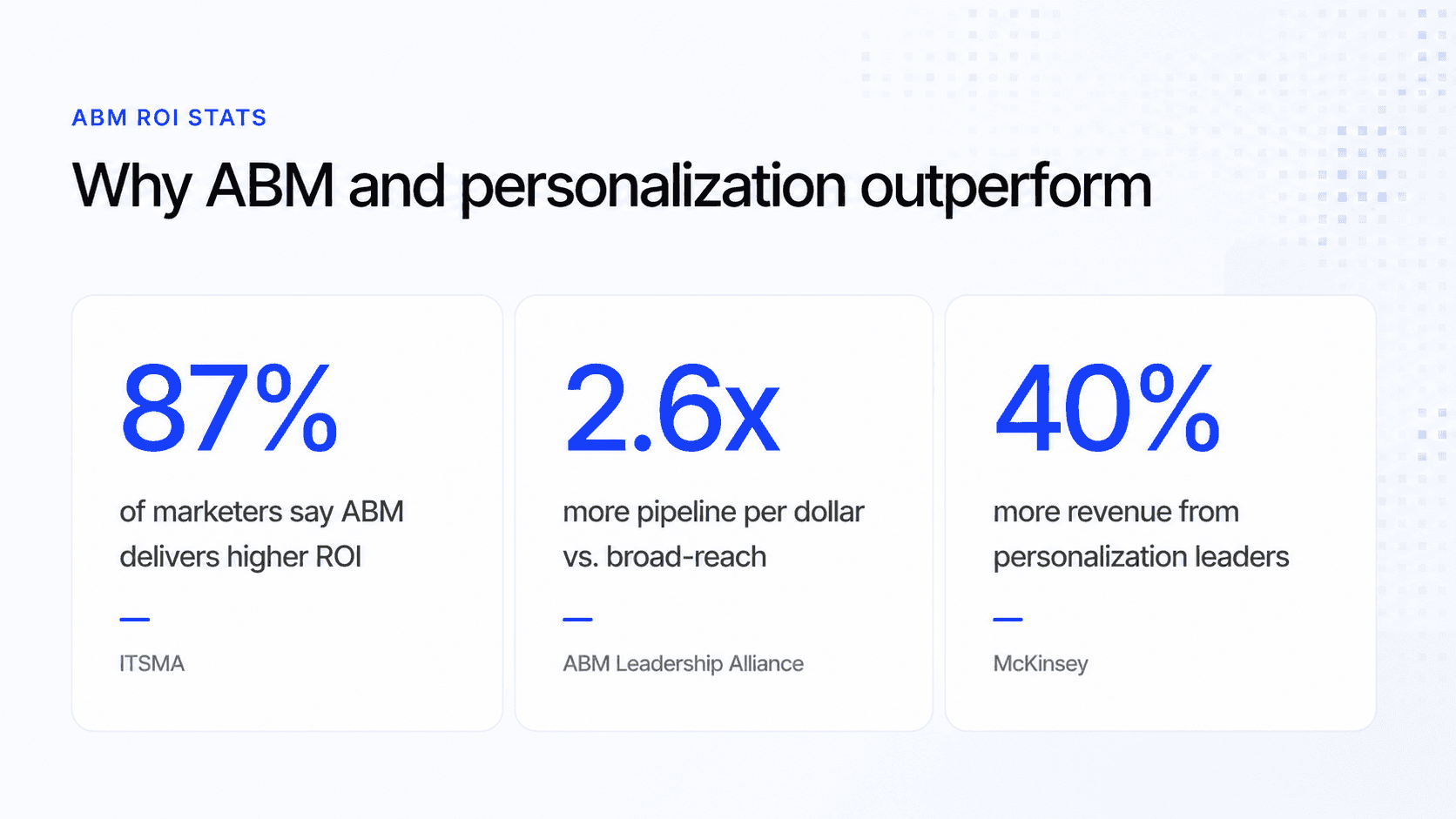
87% of marketers report ABM delivers higher ROI than any other marketing strategy - and the reason is straightforward: personalization works. When your message matches the target account's specific context, challenges, and buying stage, conversion rates improve materially.
Most experienced ABM teams already know this. They're not sending generic homepages to target accounts. They're building dedicated landing pages, account-specific microsites, and personalized campaign destinations. The strategy is sound.
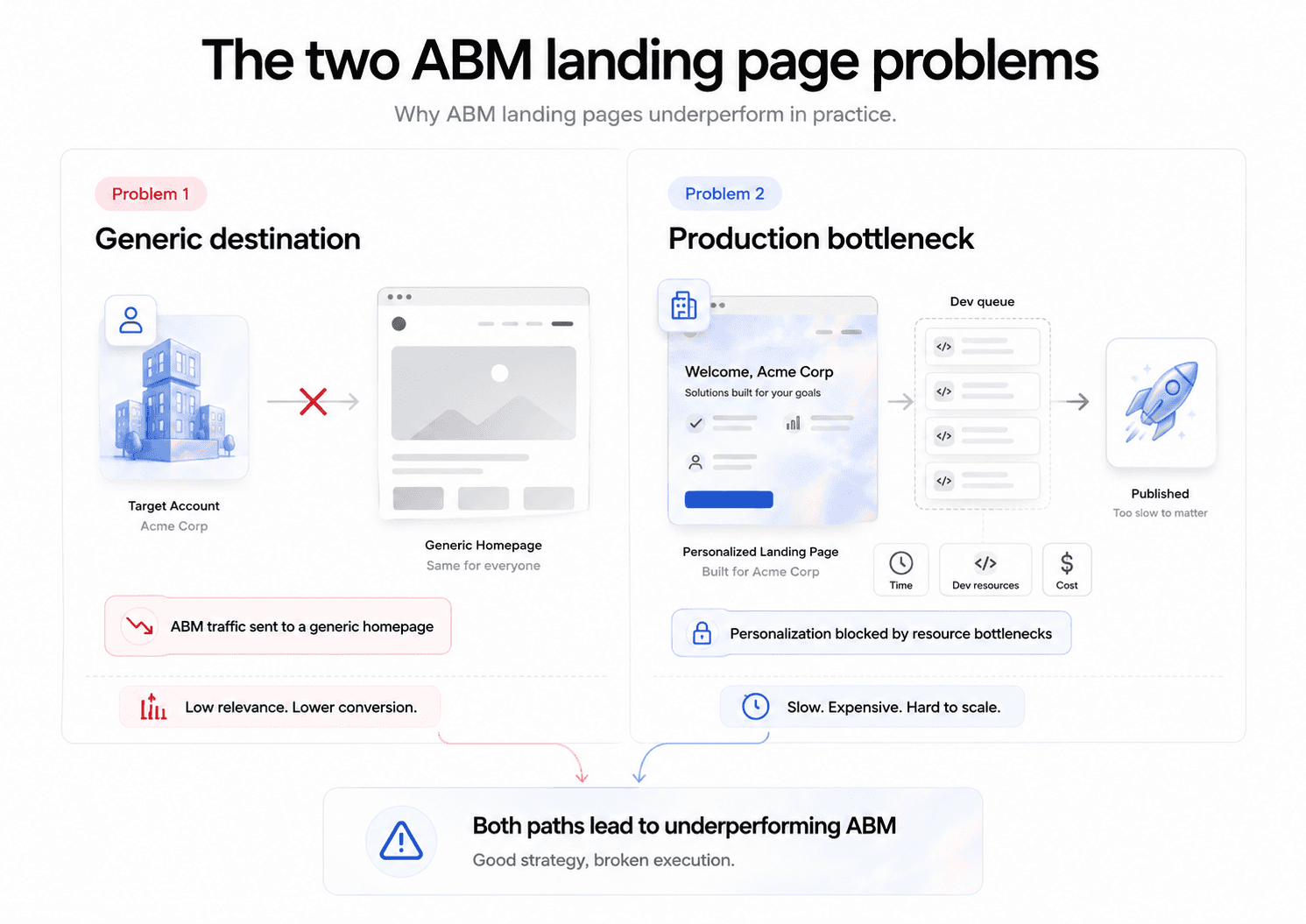
The problem isn't the strategy. It's the production.
Building a personalized landing page for a target account means a wireframe, a designer, a developer, a round of QA, and a deployment cycle. For one page. Multiply that by a target account list of 50, 100, or 500 companies - across multiple campaigns, multiple industries, and multiple buying committee roles - and you have a program that is slow, expensive, and permanently backlogged behind engineering priorities.
This is why ABM programs stall. Not because the concept fails, but because the operational cost of doing it properly is unsustainable at scale. Teams build pages for their top ten accounts, compromise on the rest, and watch their broader ABM investment underperform. When renewal time comes, the ROI numbers don't justify the effort, and the program gets cut or scaled back.
Two things need to change for ABM landing pages to actually work at scale:
First, teams that are still routing ABM traffic to generic product pages need to understand what they're leaving on the table - the data on this is unambiguous.
Second, teams already trying to personalize need a production workflow that doesn't require a full design-dev sprint for every new account or campaign variant.
This guide covers both. What ABM landing pages should contain, how to tier your personalization approach, how to build and deploy them with AI at a fraction of the traditional cost and time, real examples from teams doing it well, and how to measure what's actually working.
What is an ABM landing page?
An ABM landing page is a dedicated web page built for a specific account, industry segment, or buying committee - not for general inbound traffic.
Where a standard landing page tries to speak to a broad audience with a generic message, an ABM landing page is sent directly to named decision-makers at companies you're already pursuing. It speaks their language, reflects their industry, references their specific challenges, and presents your solution in the context of their world - not the world of a fictional average customer.
The difference is structural. A standard landing page is a billboard on a busy road. An ABM landing page is a letter addressed to the right person at the right company at the right moment.
In practice, ABM landing pages are used across several motions:
Outbound sales - personalized pages sent to prospects in cold email or LinkedIn sequences, giving the pitch a dedicated destination that continues the context from the message and makes the offer feel tailored rather than automated.
Account-based marketing campaigns - pages built for named accounts or industry segments, used as destinations for targeted LinkedIn ads, email nurture sequences, or direct sales outreach.
Event and trade show follow-up - pages built for specific attendees or companies before or after an event, replacing the generic "thanks for stopping by" follow-up with something that speaks directly to the conversation that was had.
Google Ads and paid search - intent-matched pages for specific keyword groups or audience segments, where the page content reflects the exact search intent rather than sending all traffic to a generic destination.
What unites all of these is the same principle: every visitor should feel like the page was built specifically for them. Because it was.
Why ABM landing pages matter more in 2026
The B2B buying environment has become structurally more complex - in ways that make both generic pages and slow production cycles more costly than ever.
Buying committees now average 11.2 stakeholders for deals over $50K, up from 9.7 in 2024 (Forrester/6sense 2026). A single landing page needs to resonate across multiple roles, seniority levels, and departments - each with different priorities, objections, and definitions of value. A page optimized for the VP of Sales may actively fail to convert the CFO reviewing the same link. ABM landing pages solve this by enabling role-specific and account-specific experiences for each stakeholder - but only if your team can produce them fast enough to stay current with live deals.
The bar for relevance has also risen sharply. 87% of marketers say ABM delivers higher ROI than other strategies (ITSMA), which means the strategy has gone mainstream. Your competitors are running ABM programs too. Generic messaging gets ignored because it looks like everything else. Standing out now requires genuine specificity - not just a company name in the subject line, but a page that clearly reflects the account's world.
McKinsey research shows that companies excelling at personalization generate 40% more revenue from those activities. And ABM-led programs generate 2.6x more pipeline per marketing dollar than broad-reach demand generation (ABM Leadership Alliance 2026). Those numbers reflect what happens when personalization is executed properly - not just planned for.
The problem is that the teams seeing those numbers have figured out the production side. They've removed the design-dev dependency from their personalization workflow. The teams still struggling are the ones where every new page variant means another sprint, another backlog item, another three-week wait.
The four levels of ABM landing page personalization
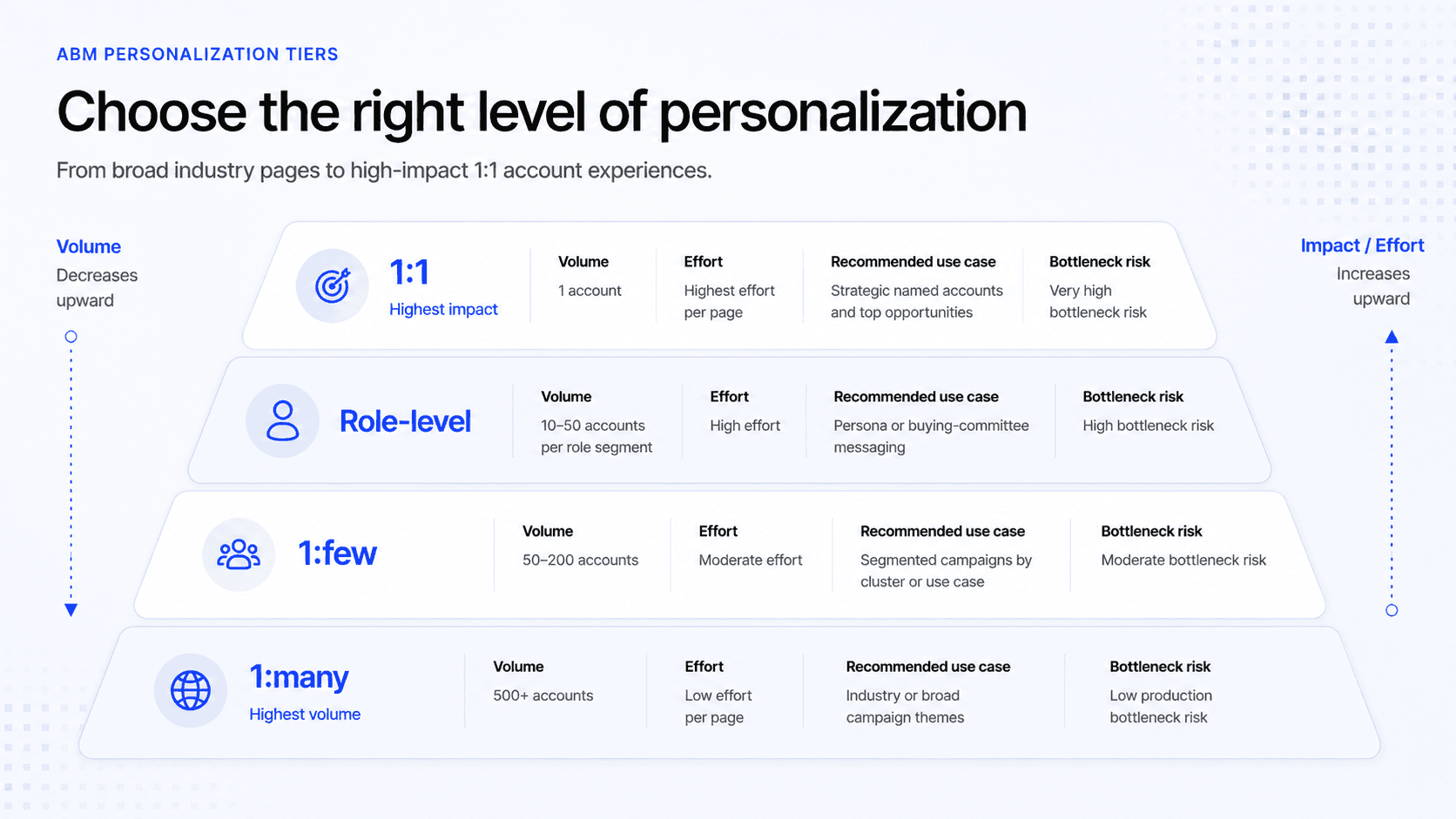
Not every account deserves the same level of investment. The right personalization tier depends on the account's potential deal size, the buying stage, and - critically - what your team can realistically produce without grinding to a halt.
Level 1: Industry or segment personalization (1:many)
The lightest touch and the most scalable. Three to five page variants segmented by vertical - financial services, healthcare, SaaS, agency. The headline, proof points, use cases, and social proof change to reflect each industry, but the page is not account-specific.
This is where most teams should start. It's achievable without a significant production investment, covers the majority of your keyword and ad campaign traffic, and outperforms a generic page by a meaningful margin. For teams with constrained resources, this tier delivers the best ROI on production time.
Best for: broad paid search campaigns, LinkedIn audience targeting by industry, large ICP lists where 1:1 personalization isn't viable.
Level 2: Account-level personalization (1:few)
The page is built for a named company or a small cluster of accounts with similar characteristics. The headline references the company's known challenges. Case studies and testimonials are filtered to peers they'd recognize. The value proposition is framed around their specific situation.
This is the tier with the best effort-to-impact ratio - and the tier where the production bottleneck most commonly shows up. Personalizing the headline, value proposition, and social proof alone captures roughly 80% of the conversion lift. The question is how quickly your team can produce and publish those variants. With a traditional CMS workflow, each page variant takes days. With an AI-native tool like GenPage, it takes minutes.
Best for: mid-tier ABM target lists, outbound sequences for high-value prospects, event follow-up for specific attendee lists.
Level 3: Role-level personalization
Multiple versions of the same account page, each tailored to a different stakeholder. The VP of Sales sees a page centered on pipeline and revenue metrics. The Head of IT sees integration, security, and implementation. The CFO sees ROI and cost efficiency.
This tier is critical for multi-threaded enterprise deals where a single page can't serve the full buying committee. It's also the tier where production costs multiply fastest in a traditional workflow - three stakeholders per account means three pages per account, each requiring its own design and development cycle. This is where most teams compromise, defaulting to one page per account and hoping the VP of Sales forwards it to the right people.
Best for: enterprise accounts with complex buying committees, strategic accounts where any one stakeholder can veto the deal.
Level 4: Individual prospect personalization (1:1)
A page built for a specific individual, referencing their public statements, recent LinkedIn activity, company news, or known priorities. Reserved for your highest-value targets where a single deal justifies significant investment.
This is the tier where GenPage's AI workflow produces the most dramatic results - because the AI draws on a prospect's company context, role, industry, and intent signals to generate copy that reads as if it was researched and written by hand. The production barrier that historically made 1:1 pages impossible to scale no longer applies.
Best for: top-tier strategic accounts, high-value outbound targets, trade show VIP outreach.
What a high-converting ABM landing page should contain
Structure matters as much as personalization. The best ABM landing pages follow a consistent anatomy regardless of tier - each section earning the reader's attention before asking for the next commitment.
The hero section: establish relevance in five seconds
The headline is the most important real estate on the page. It should speak directly to the visitor's specific problem or situation - not your product's general value proposition.
Before: "The modern B2B personalization platform" After: "How [Company Name] can turn cold outbound into qualified pipeline without increasing headcount"
The information content is similar. The relevance signal is completely different. One requires the visitor to translate your positioning into their context. The other meets them there directly.
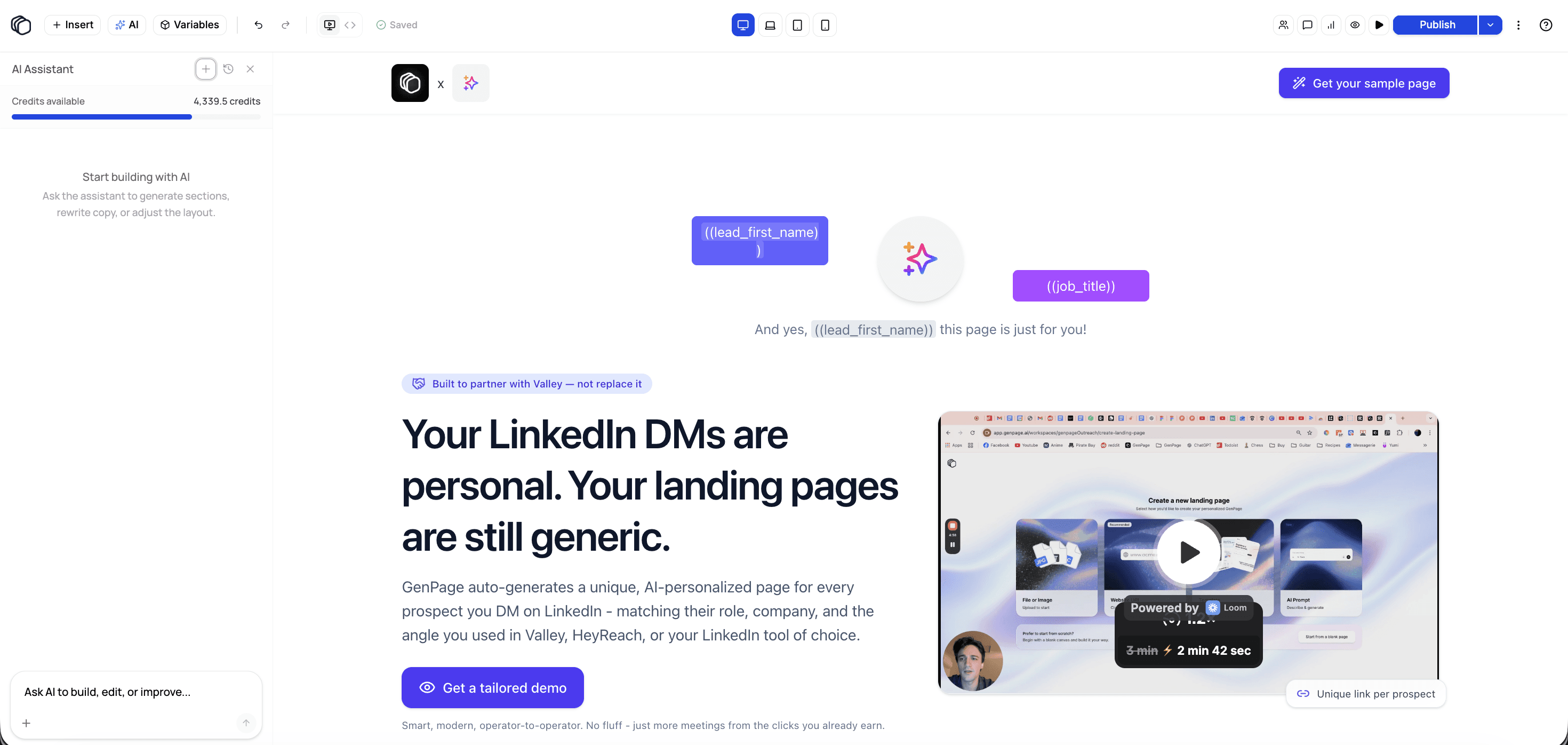
The hero should include a clear subheading with one more layer of specificity, a primary CTA above the fold, and a visual relevant to this audience - their logo alongside yours, an industry-specific screenshot, or a short video that references their context.
Critically: remove the main navigation. ABM landing pages are not website pages. Every additional link is a potential exit. The visitor should have two options: convert or leave.
Social proof: filtered and specific
Generic logo walls don't convert. What converts is proof that companies genuinely similar to the prospect have solved the exact problem being addressed on the page.
A Series B SaaS company should see case studies from other Series B SaaS companies. A healthcare prospect should see healthcare logos and healthcare-specific results. An agency should see agency outcomes.
Showing the wrong social proof isn't neutral - it actively signals that you don't know your audience. Showing the right social proof removes the prospect's biggest objection: "does this actually work for companies like mine?"
Testimonials perform even better when they come from someone in a similar role. A VP of Sales testimonial lands differently for a VP of Sales than a generic "our customers love us" quote. Match the social proof to the persona wherever possible.
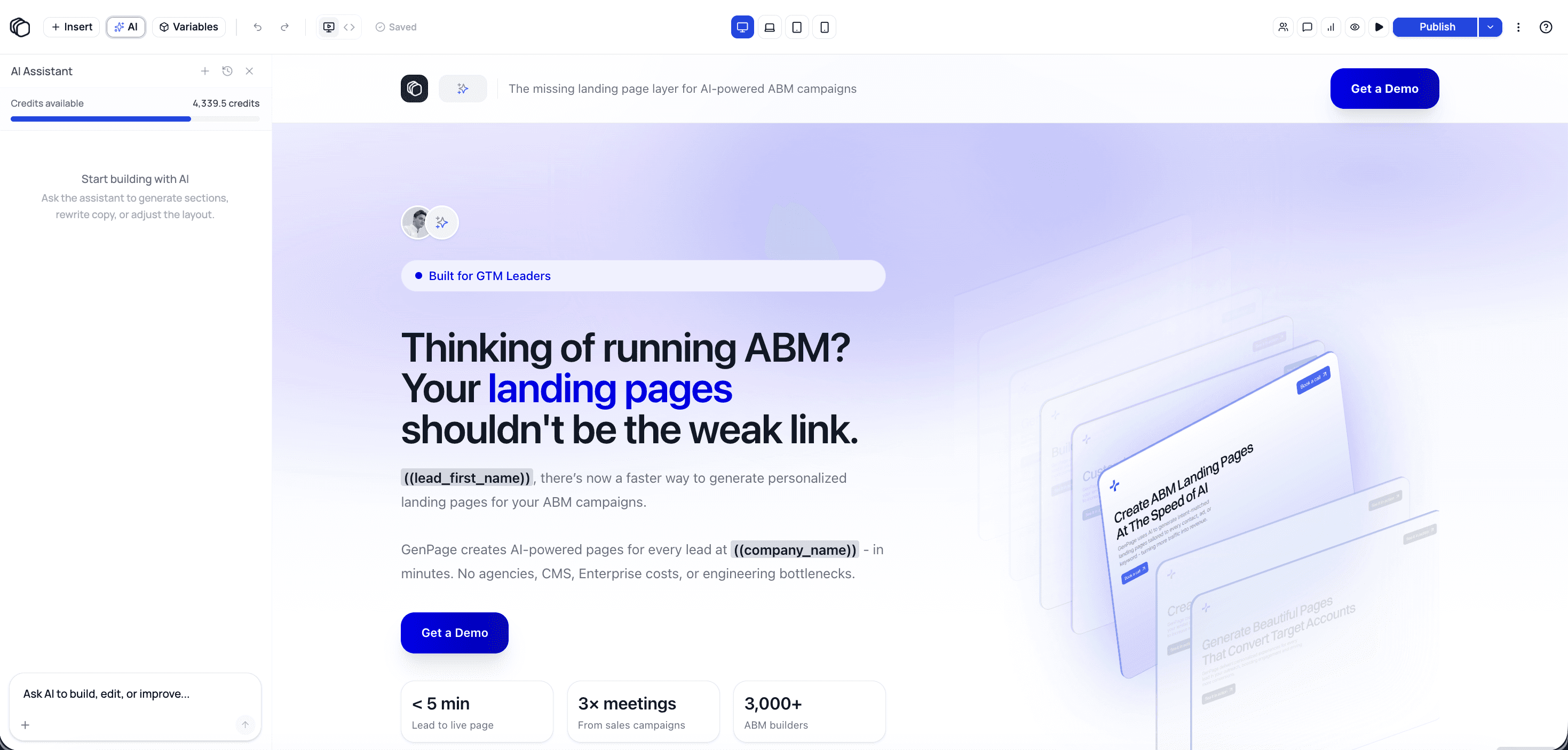
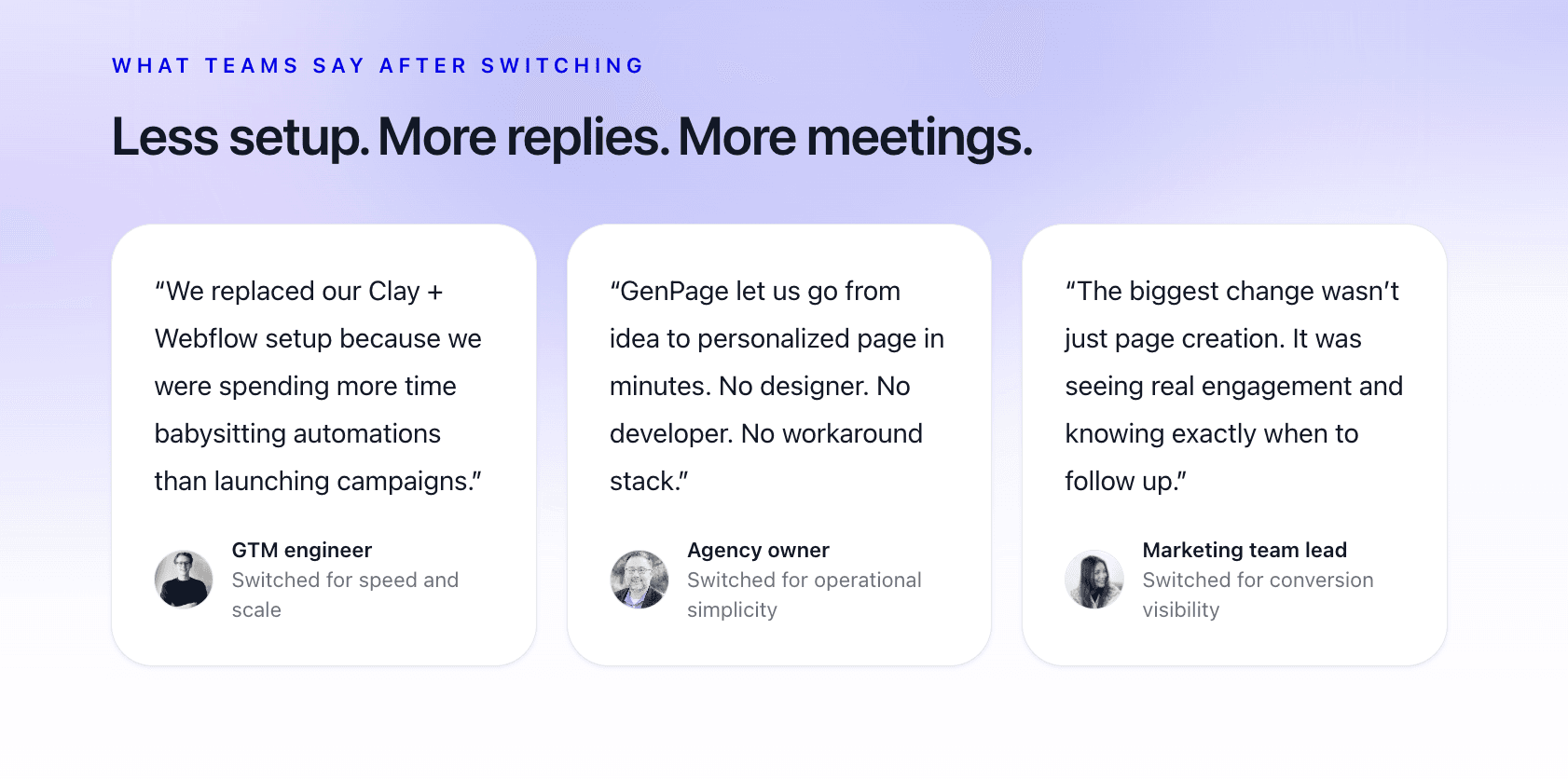
In this campaign, we're targeting users of a popular Clay integration. Here, we've dedicated our social proof section to showcase why GenPage is a stronger alternative to Clay + Webflow for personalized landing pages, emphasizing common pain points users experience with the workflow.
The problem statement: show you understand before you sell
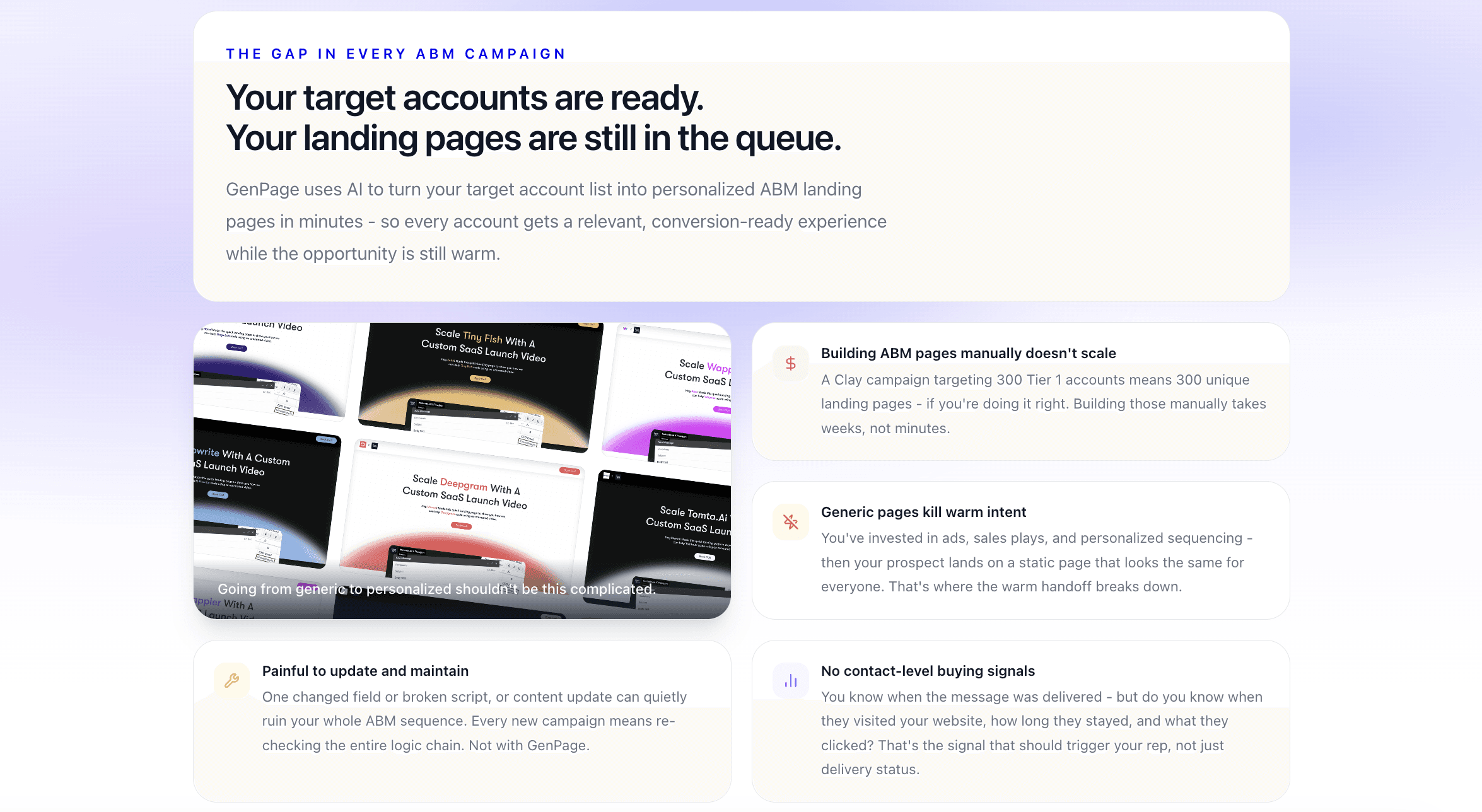
Two to three sentences describing the prospect's pain the way they would describe it - not the way you would describe your solution. This section exists to build trust. When a visitor reads a page that accurately articulates the specific challenge they're dealing with, everything that follows is more credible.
Don't pitch here. Demonstrate understanding. The sell comes after.
The solution section: connect features to outcomes
Three to four clear points connecting what your product does to the specific outcomes this account cares about. Lead with the outcome, then the feature that delivers it. Show only the features relevant to this account - a page that shows five relevant capabilities converts better than one showing twenty.
For role-specific pages, the solution section is where personalization does its most important work. A VP of Sales and a Head of Operations may both buy your product, but they need to see completely different outcomes highlighted to convert.
The CTA: specific, low-friction, and contextual
Generic CTAs underperform. "Sign Up" is a commitment many mid-funnel visitors aren't ready for. More specific alternatives perform better:
"See how this works for [Company Name]"
"Book a 20-minute call tailored to [industry] teams"
"Get your personalized walkthrough"
Keep the CTA singular. One primary action, repeated no more than twice on the page.
A personal note or video (optional but effective for top-tier accounts)
A short paragraph or 60-second video from the SDR or AE that directly references the prospect's context - their recent LinkedIn post, their company news, a specific challenge relevant to their role - adds a human layer that no automated system replicates at scale. Used selectively for highest-value accounts, it's the element that takes a very good page and makes it feel genuinely 1:1.
Real results: what ABM landing pages produce in practice
The data on ABM landing page performance is consistent across implementations.
Industry benchmarks
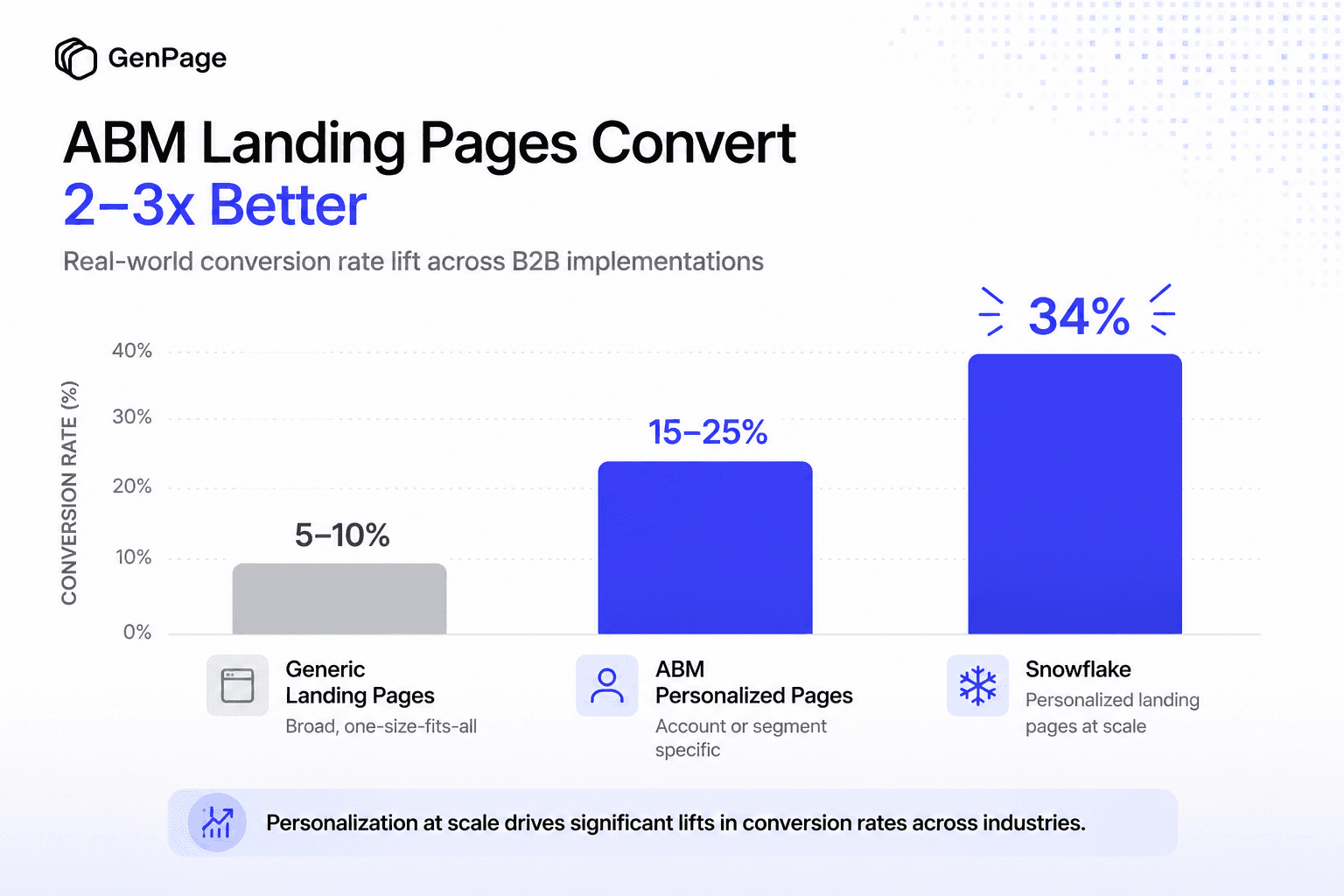
ABM-personalized landing pages convert at 15–25% on average, compared to 5–10% for generic pages - a 2–3x lift that shows up consistently across B2B implementations.
Snowflake, using Mutiny for page personalization at scale, reported personalized pages converting at 34% compared to 11% for generic pages - a 3x lift - alongside 80% higher ACV and 150%+ increase in sales-qualified pipeline.
Despite this, only 13% of teams currently hyper-personalize their marketing - which means the teams that do implement ABM landing pages properly are competing against a large majority who either don't personalize at all or are bottlenecked by production and doing it for only a handful of accounts.
GenPage customer results
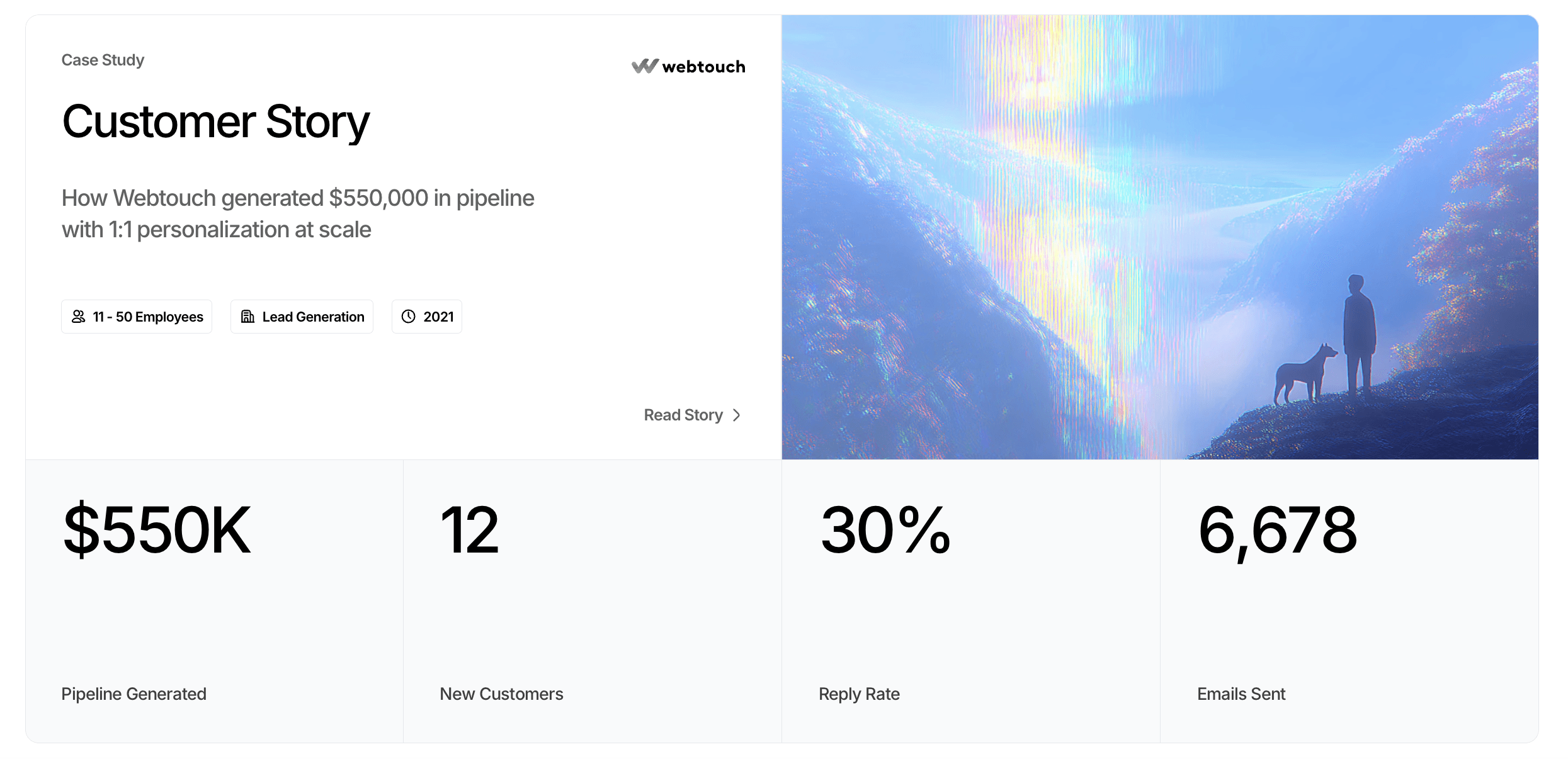
Webtouch: $550K pipeline generated
Webtouch, a Swiss B2B lead generation agency, used GenPage to build a personalized landing page for every prospect on their outreach list. Each page featured a company-specific video presentation, personalized messaging, and a dedicated landing experience that replaced the standard pitch email.
The workflow: build and enrich the prospect list in Clay → generate a personalized GenPage page per company → embed a company-specific video → send via Instantly → track engagement in real time → call engaged prospects within one day.
The results: $550,000 in new business pipeline, 12 new customers, and a 30% reply rate across 6,678 emails.
The key was the combination of the personalized page and the real-time engagement tracking. When a prospect visited their page, the team called within one day while the context was still fresh. The conversation shifted from "did you see my email?" to "I saw you checked out the presentation we prepared for your company" - a fundamentally different opening that only works when you know exactly when someone engaged.
Adriel - 30% meeting booking rate before VivaTech
Adriel, a marketing analytics SaaS platform, needed to book meetings at VivaTech against a flood of generic trade show outreach. Instead of sending a standard pitch email, they ran an ABM play: a dedicated landing page for each target attendee, personalized with the prospect's brand and details - at scale, using GenPage.
The workflow: extract VivaTech attendee list via Instant Data Scraper → enrich with Clay → generate personalized pages via GenPage → automate multi-channel outreach via La Growth Machine.
The results: 608 pages generated, 36% reply rate, 77% open rate, and a 30% meeting booking rate before the event even started. Adriel entered VivaTech with a calendar full of qualified conversations.
The page solved a problem that the email alone couldn't: explaining a complex product clearly. Prospects didn't have to "figure out" what Adriel does from a vague message. They could see it, in context, in under a minute. And critically - 608 pages were generated and deployed in the kind of timeframe that would have been impossible with a traditional design-dev workflow.
How to build ABM landing pages with AI: the GenPage workflow
The traditional ABM landing page workflow looks like this: brief the page concept → wireframe → design → developer implementation → QA → publish. For one page. When that cycle takes two to three weeks, a target account list of 100 companies is a six-month project - by which time half the accounts have moved on, the campaign is stale, and the ROI case for renewal has evaporated.
AI changes the economics entirely. Here's what the workflow looks like inside GenPage.
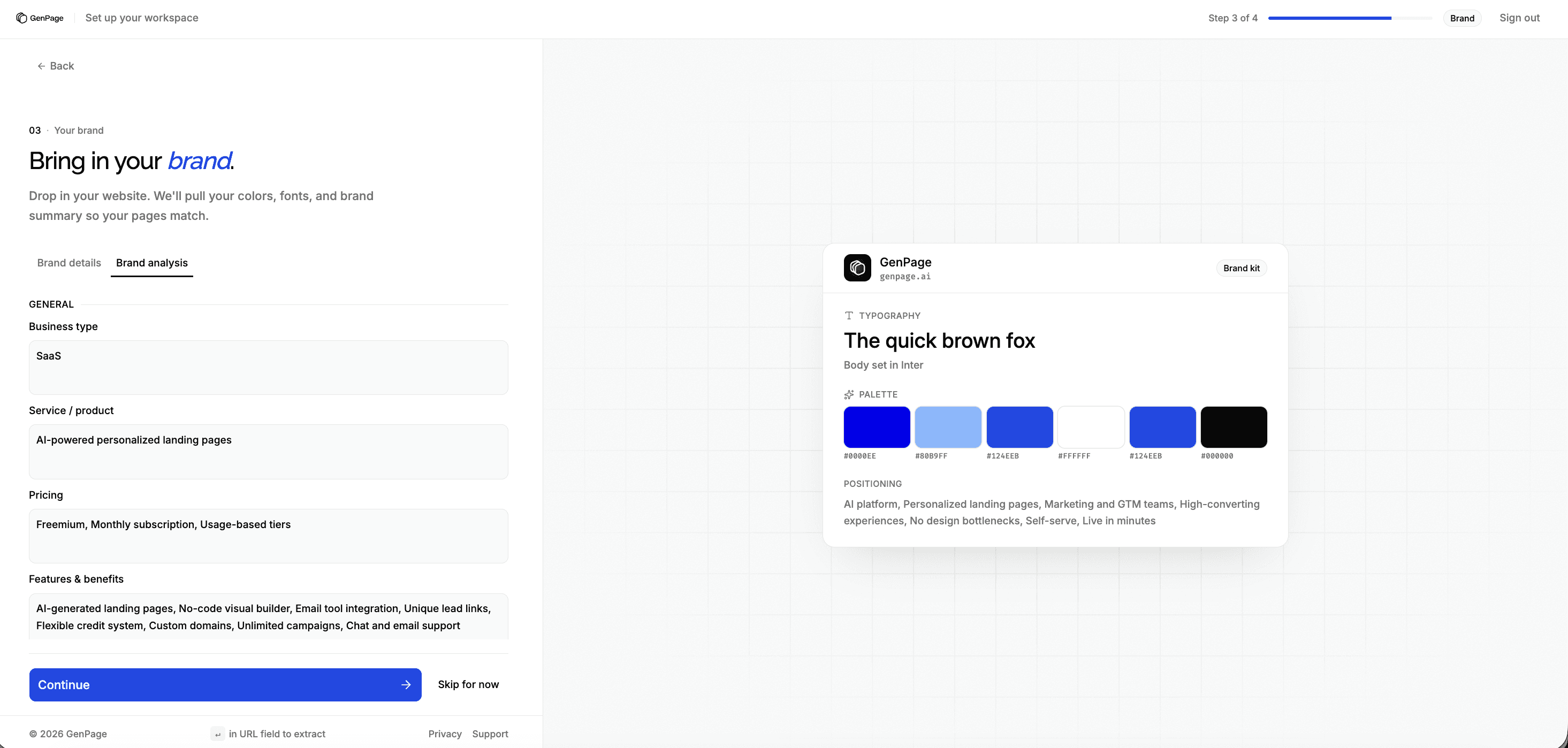
Step 1: Connect your domain and build your brand profile
Connect your domain and GenPage crawls your website to build an internal brand profile - your positioning, tone of voice, products, pricing structure, and key value propositions. This becomes the AI's permanent context layer. Every page it generates draws on this; you never re-explain your brand for each new campaign or account.
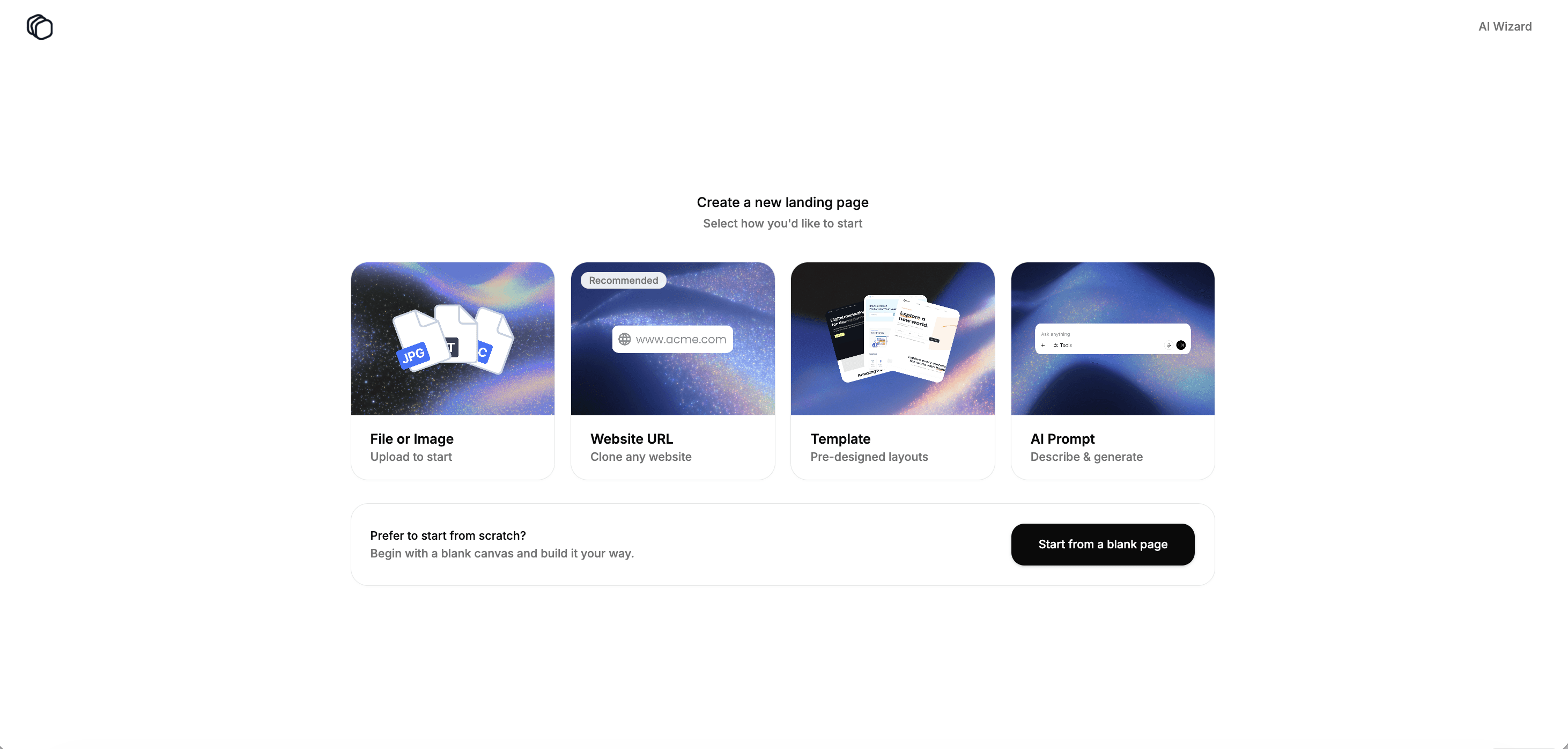
Step 2: Build your base page
Create a master landing page representing your strongest generic version. Build it from a prompt, replicate an existing page from a URL, upload a design file, or start from a template. Because the brand profile is already loaded, the output matches your brand design and voice from the first draft - no design rework required.
Step 3: Let the AI audit personalization opportunities
Run GenPage's AI agent on the base page. It analyzes the structure and flags the specific elements - headline, subheading, hero copy, case study selection, CTA - with the highest personalization potential. You can of course decide what to change. Or let the AI surface it, with suggested variants for each flagged element.
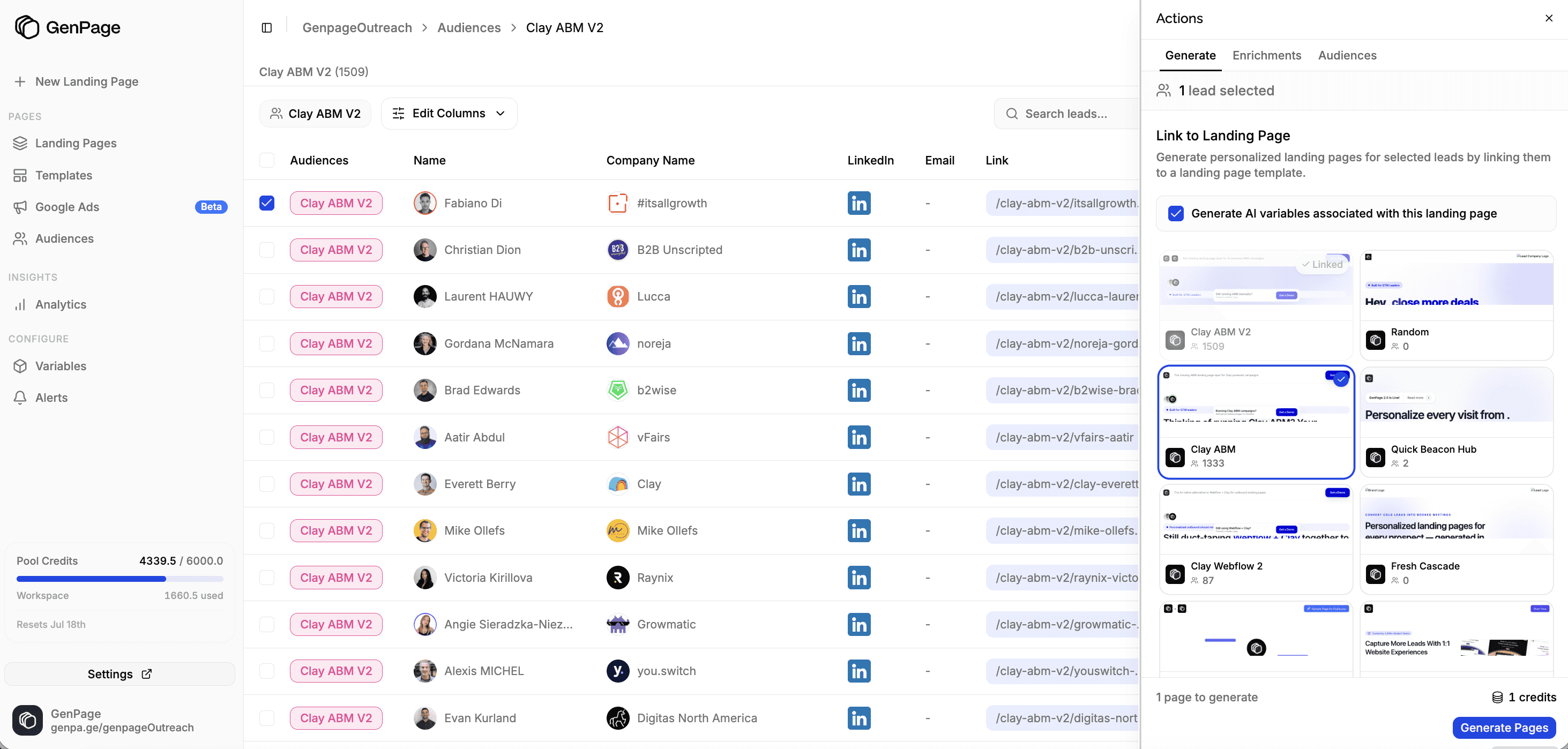
Step 4: Define your smart fields and generate pages at scale
Mark the flagged elements as dynamic variables. When GenPage generates a personalized variant for a specific account or prospect, it draws on three context layers simultaneously: your brand profile, the base page structure, and the account-specific data you provide - company name, industry, role, intent signals, or any other enrichment data from your lead source.
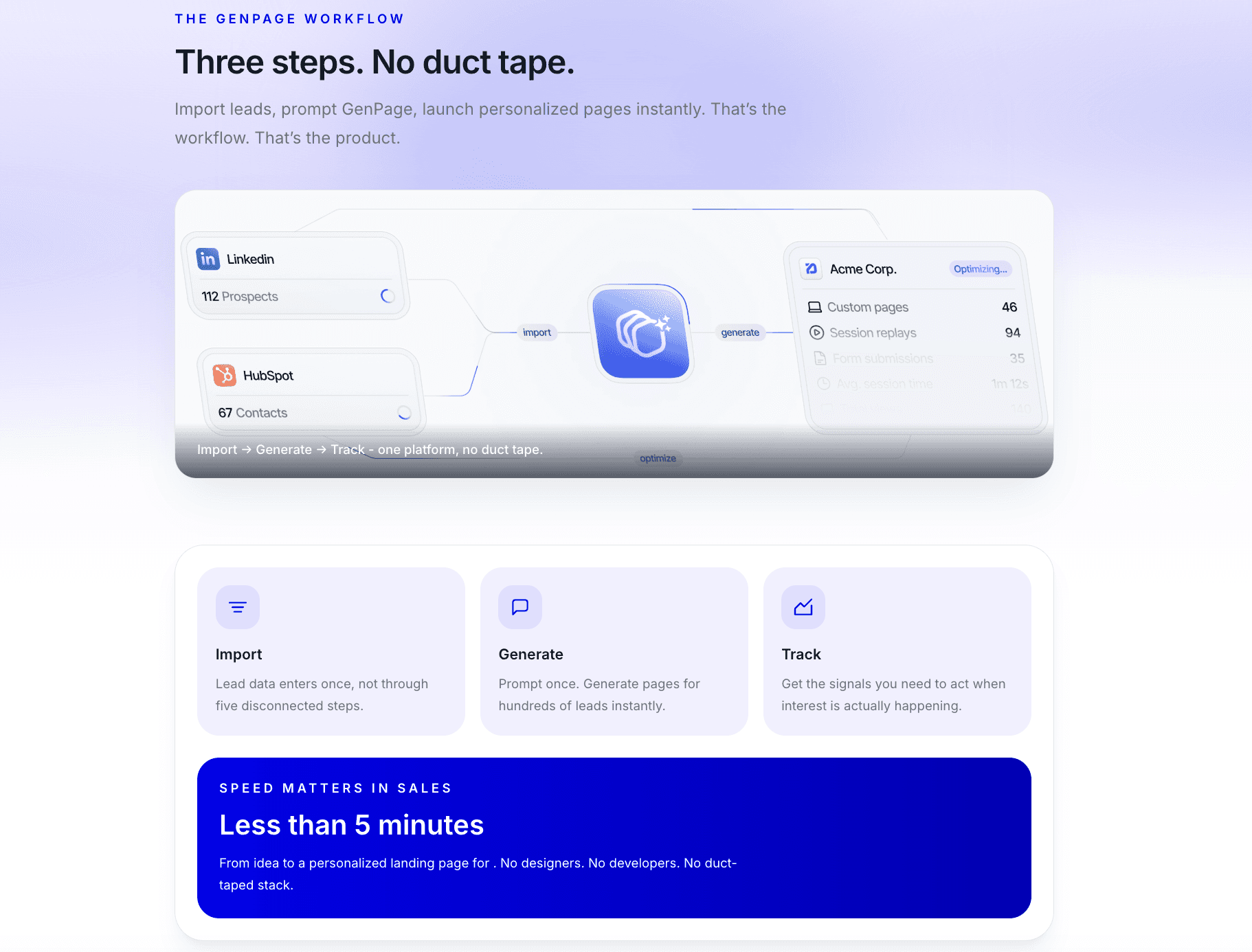
Feed your account list into GenPage from a CSV, CRM export, or directly from integrations with Clay, HubSpot, or LinkedIn Sales Navigator. GenPage generates a unique page for each account automatically. For a list of 100 target accounts, this takes minutes - not the weeks a traditional workflow requires.
Step 5: Publish and track
Deploy pages as a subfolder on your existing domain using the GenPage SDK (e.g., yourdomain.com/lp/account-name) or a dedicated subdomain (e.g., go.yourdomain.com). Pages match your brand design exactly and function as native pages from the visitor's perspective.
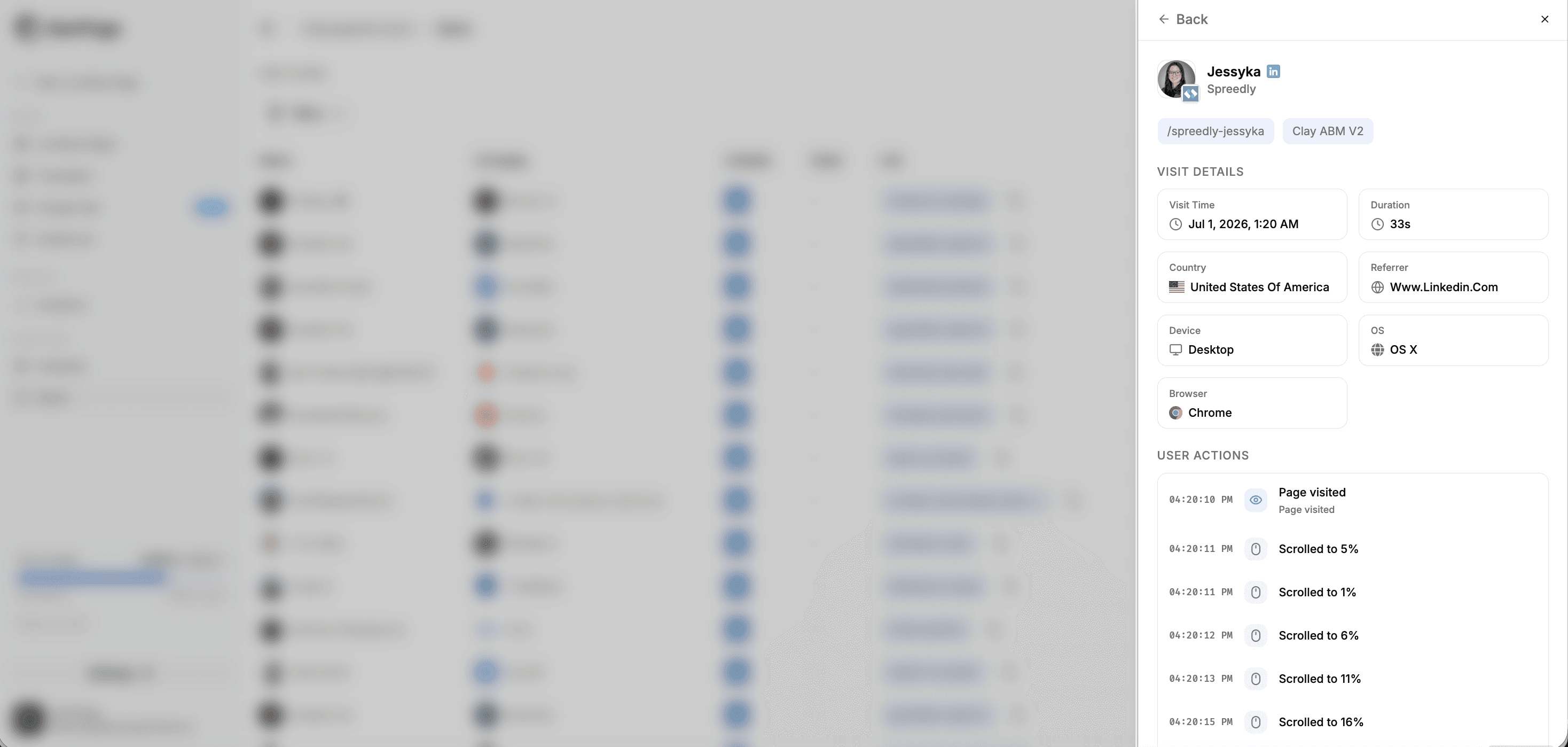
Track every visit with built-in heatmaps, session replays, and real-time engagement alerts. When a target account visits their page, you get notified immediately - giving you the signal to follow up while engagement is live.
ABM landing page tools: what to use and when
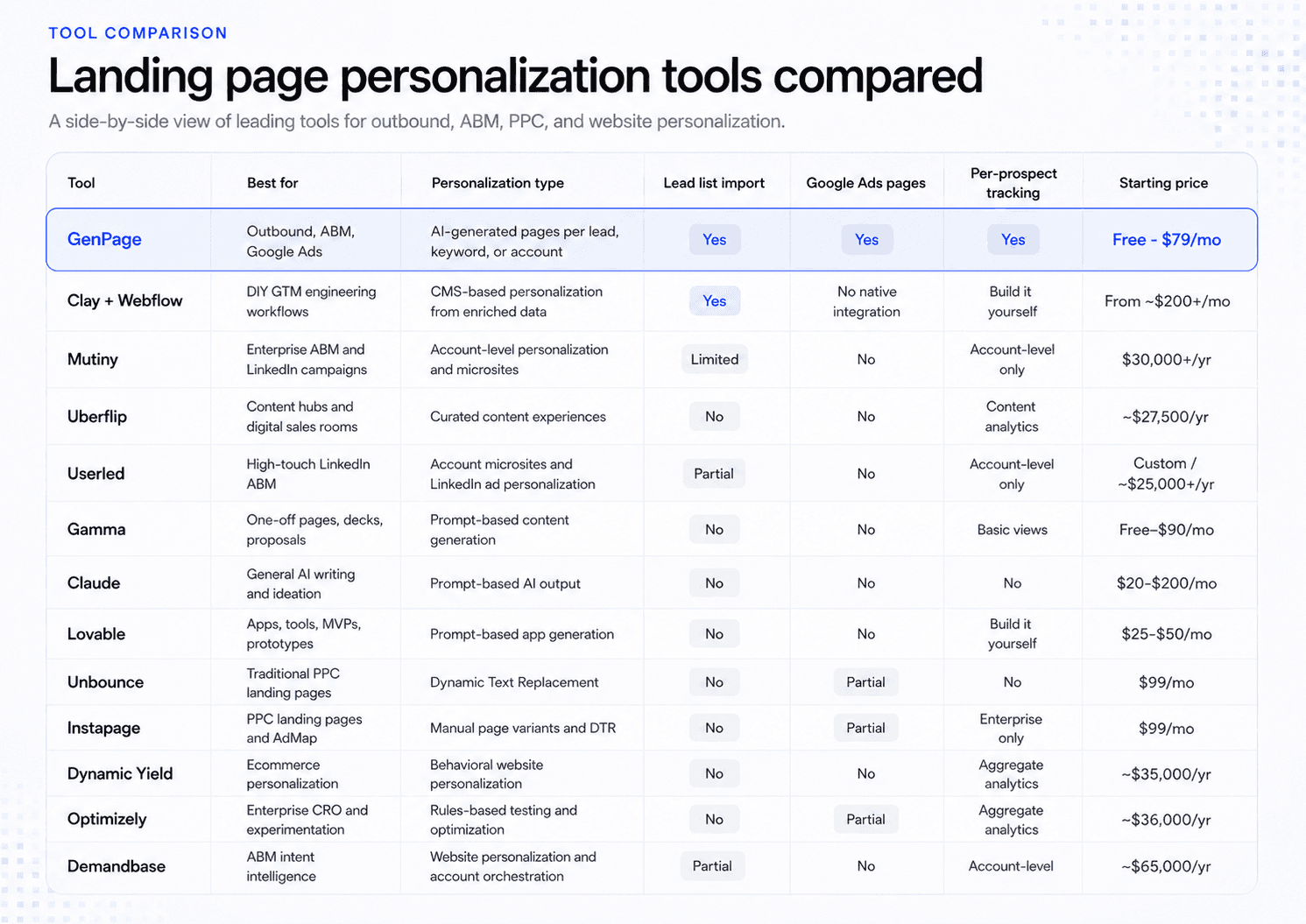
The tool you choose determines how much of the production bottleneck you eliminate. Here's a condensed comparison of the most relevant options.
GenPage - Best for AI-generated landing pages at scale for outbound, ABM campaigns, and Google Ads. Import leads from CSV, Clay, HubSpot, or connect your ad account. GenPage generates unique personalized pages per prospect, account, or keyword group automatically - removing the design-dev dependency entirely. Includes built-in heatmaps, session replays, real-time engagement alerts, and agency workspaces. Free plan, paid plans from $79/mo. Self-serve, no card required.
Mutiny - Best for enterprise LinkedIn-led ABM with a focused list of high-value accounts. Stronger for account-level microsites and LinkedIn ad personalization. Not built for high-volume page generation from a lead list, and the implementation timeline and contract size ($30,000+/year) make it inaccessible for most teams outside large enterprise programs.
Unbounce / Instapage - Best for traditional PPC landing pages and manual A/B testing. Support Dynamic Text Replacement for basic keyword-level personalization - but page variants still need to be built manually. Not built for outbound or ABM page generation from a lead list. Start at $99/month.
Clay + Webflow - A DIY workflow for GTM engineers who want full control. Enrich leads in Clay, push data into Webflow CMS, and generate dynamic pages. Powerful when maintained by a technical team but creates exactly the kind of ongoing engineering dependency that makes ABM programs slow and expensive to run.
Demandbase / 6sense - Best for enterprise ABM intent intelligence and account identification. Can personalize existing website experiences for identified visitors but does not generate unique landing pages per prospect or lead list. Custom pricing, typically $65,000+/year.
Read More: The Best Personalized Landing Page Software in 2026: 13 Tools Compared
The outreach sequences that make ABM landing pages work
A personalized page alone doesn't close the loop. The sequence around it determines whether the page translates into a booked meeting.
For outbound-led ABM (the approach behind our, Webtouch, and Adriel's results)
Touch 1: Intent signal or research-based connection: Reference something specific about the account - a LinkedIn post, a trigger event, a challenge common to their industry. No pitch. No link yet. Just a genuine reason to connect that demonstrates real research.
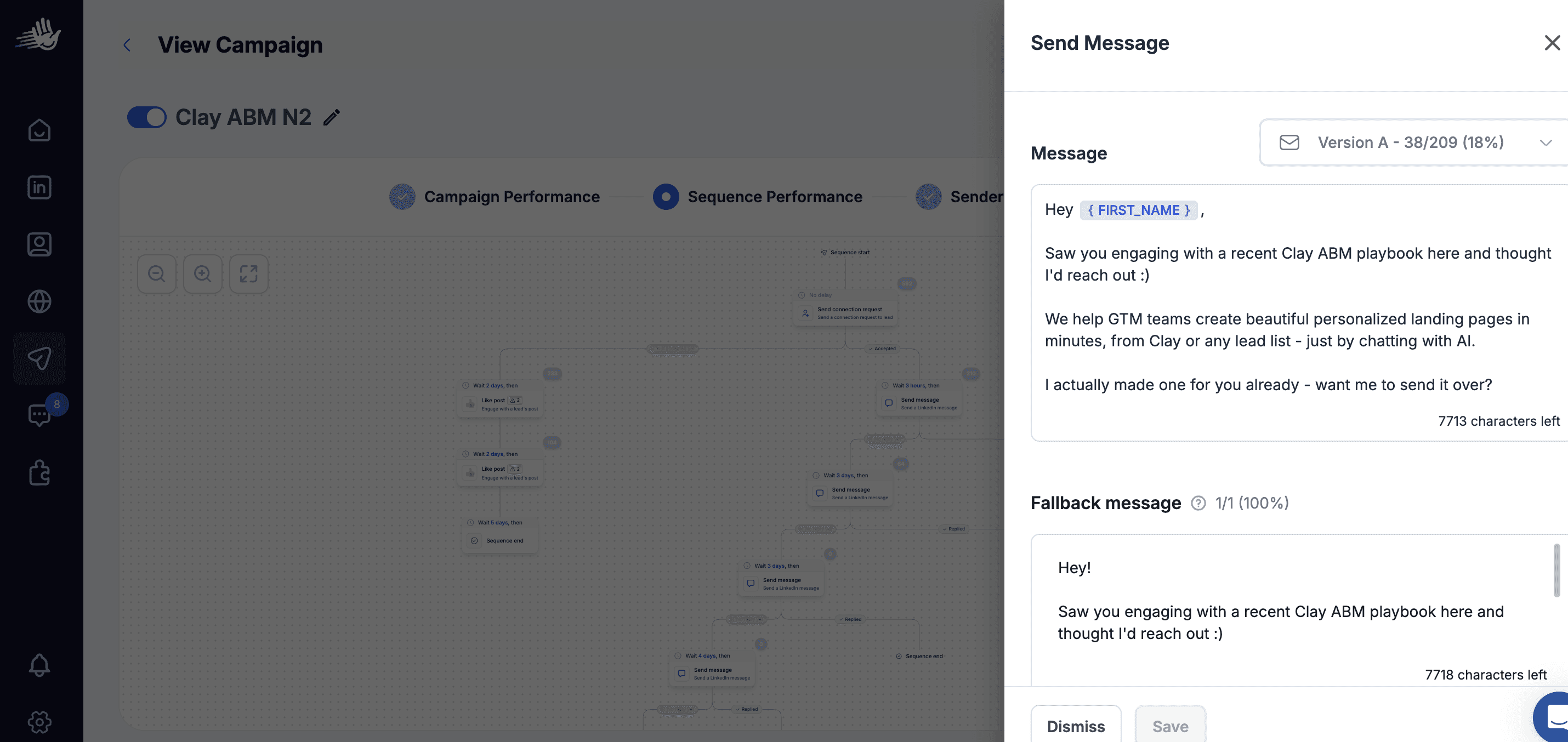
Touch 2: The personalized page as the offer: Once connected, send a short message offering the page as the substance of the pitch. "Based on [context], I put together a page specifically for [Company Name] — [link]. Curious whether it resonates." The message creates curiosity to click. The page does the rest.
Touch 3: Engagement-timed follow-up: When the prospect visits the page, follow up the same day. GenPage's real-time alerts make this possible. The follow-up lands as a responsive, human message rather than a scheduled drip. This is the step that converts visits into conversations.
Touch 4: Case study or proof point (if no response): Send a relevant result from a similar company rather than repeating the same ask. Adds social proof without re-pitching.
Touch 5: The no-loss offer: Remove all friction. "Happy to walk you through our full approach at no cost - worst case you walk away with new ideas." This consistently reactivates prospects who haven't responded to earlier touches.
The results speak for themselves
This isn't hypothetical. Running this exact sequence - intent signal, personalized page offer, engagement-timed follow-up - our own outreach consistently achieves 50%+ reply rates on LinkedIn. That's against an industry benchmark of 1–10% for cold outreach. The difference isn't the message. It's the combination of reaching people already thinking about your category, and giving them a destination that was built around that exact context. You can also read our blog about personalized LinkedIn outreach for a deep-dive into the full workflow.

For event and trade show ABM (the Adriel approach)
Build the page before the event, personalized to each target attendee's company and role. Send it as the substance of the pre-event outreach rather than a generic "let's meet at the booth" message. Enter the event with a calendar of pre-booked meetings.
During the event, use page visit data to identify which prospects engaged and prioritize accordingly - the sales team arrives at every conversation knowing what the prospect read, how long they engaged, and what they clicked.
How to measure ABM landing page performance
Standard web analytics are insufficient for ABM measurement. Aggregate conversion rates tell you how a page performs in general - not whether it's converting the accounts you actually care about.
Track at the account level, not the aggregate
The most important question is not "what's the conversion rate on this page?" It's "which target accounts visited this page, and did they convert?" Per-account visibility is what separates ABM measurement from demand generation metrics.
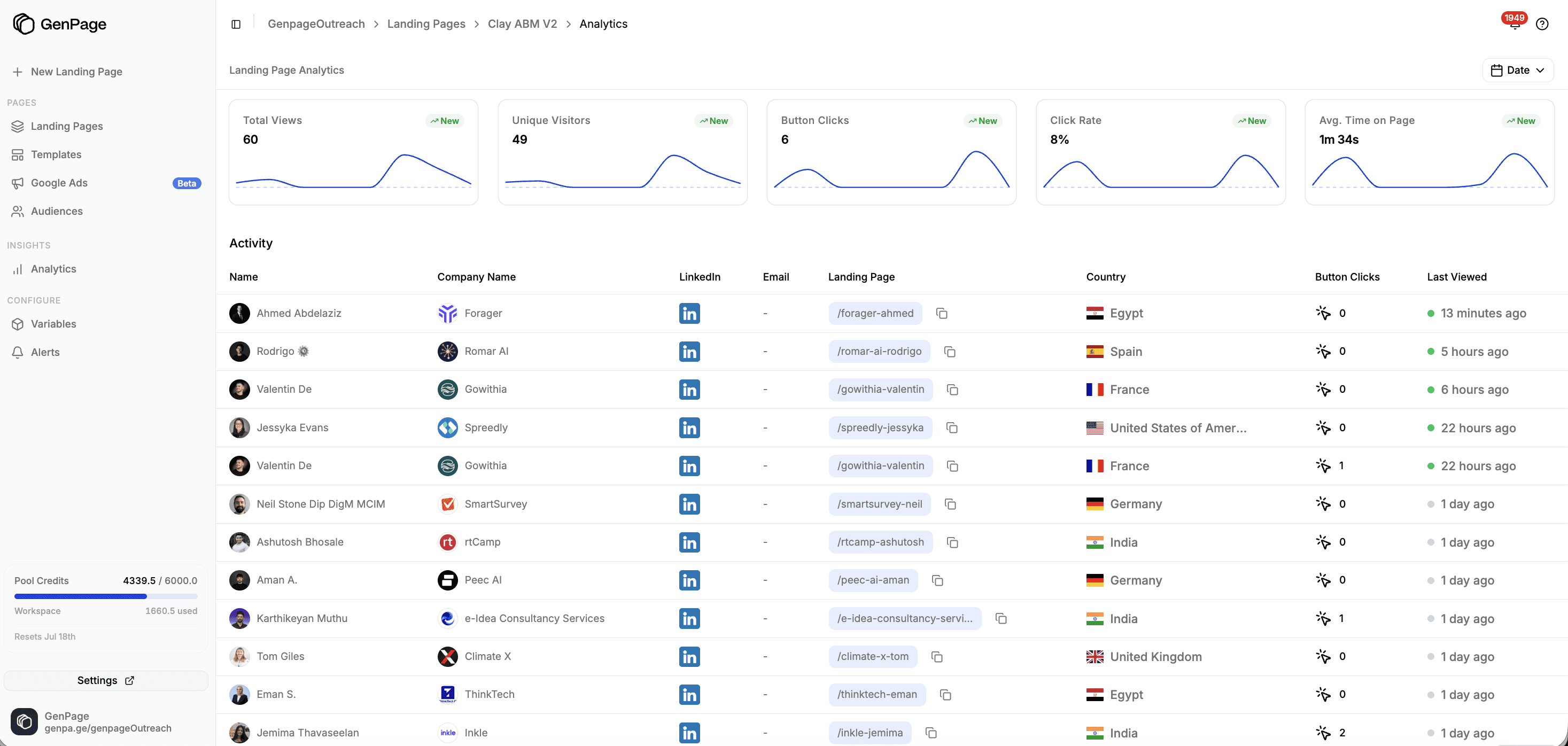
GenPage provides per-prospect tracking for every page - you can see exactly which accounts visited, how long they stayed, which sections they read, and whether they clicked the CTA. This is the data that makes the follow-up conversation relevant rather than generic.
The engagement metrics that matter
Named account visits - whether the right stakeholders at your target accounts actually opened the page. High visit rates from non-target traffic are noise, not signal.
Time on page - a strong proxy for genuine interest. A prospect spending four minutes on their page is in a completely different buying position from one who bounced in fifteen seconds. Use this to prioritize follow-up depth and urgency, not just timing.
Heatmaps and session replays - which sections attracted attention and which were skipped. If every prospect reads the hero and drops off before the social proof section, that section might as well not exist. If the pricing section consistently gets the most attention, that's a clear signal about where the real objection lives. Both are actionable.
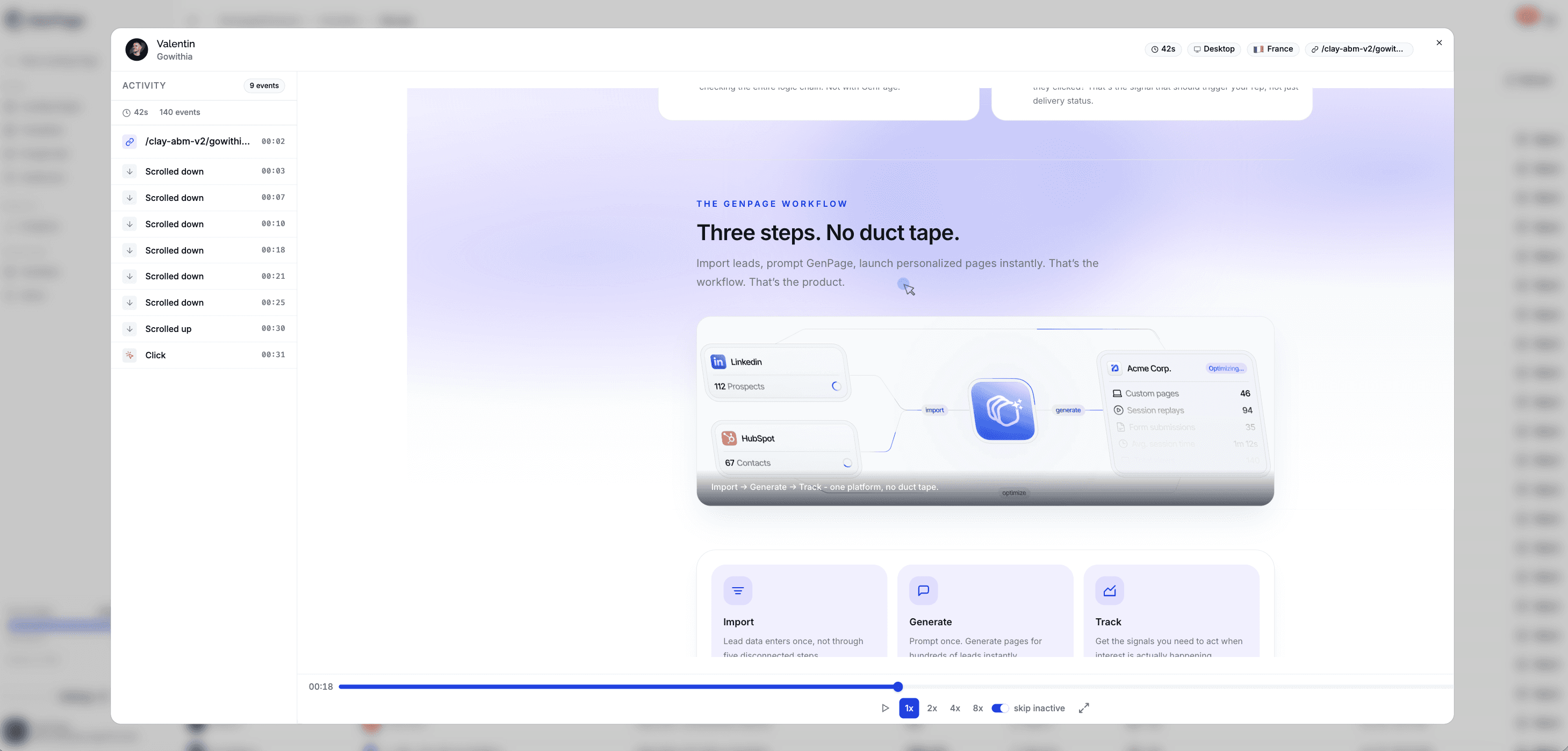
CTA click rate by segment - which page variants are driving clicks toward the primary conversion action. Track this by industry segment, company tier, and persona to understand which personalization approach is working.
Measure pipeline, not MQLs
ABM programs should be measured on meetings booked and opportunities created - not form fills. A form fill from a non-target account is worth less than a page visit from a named account that then responded to a follow-up call. Calibrate your success metrics to outcomes that move revenue, not metrics that look good in a dashboard.
This is also the measurement frame that makes ABM renewal defensible. When you can show that 23 of your 50 target accounts visited their personalized page, 11 of those engaged for more than 2 minutes, 7 replied to the follow-up, and 4 converted to opportunities - that's a program worth renewing. A generic "we generated 140 MQLs" doesn't tell that story.
Common ABM landing page mistakes to avoid
Treating a logo swap as personalization. If the page could work for any account with a different logo inserted, it isn't personalized. True personalization means the headline, the problem framing, the social proof, and the CTA all reflect the specific account's context - not just their branding applied to your template.
Letting production become the bottleneck. The most common reason ABM programs underperform is that teams can only build pages for a few of their top accounts - everything else gets a generic destination because there simply isn't bandwidth to build more. If your current workflow means every new page variant requires a design-dev cycle, the program will always be slower and more expensive than it should be. Solving the production problem is as important as solving the personalization strategy.
Building for one stakeholder when you need three. Enterprise deals involve multiple decision-makers. A page that speaks to the VP of Sales but not the CFO or Head of IT will stall at the buying committee level. For high-value accounts, build role-specific variants for the most important stakeholders rather than hoping the right person forwards the right page.
Sending pages without tracking. The behavioral data - who visited, for how long, what they read, whether they clicked - is often more valuable than the conversion itself. Without per-prospect tracking, you're following up on a fixed timer with no idea whether the page was even opened. Always ensure tracking is live before the page enters a sequence.
Forgetting to remove navigation. ABM landing pages are not website pages. Leaving in global navigation gives visitors fifteen ways to leave before converting. Strip it for every ABM page.
Over-segmenting before validating the model. Start with three to five segments, measure what works, and expand. Premature over-segmentation creates maintenance overhead before you understand which variants actually drive pipeline - and adds to the production burden that already causes programs to stall.
Ignoring mobile. A meaningful portion of LinkedIn and email traffic opens on mobile. Personalized pages that aren't optimized for mobile load speed and layout lose conversions before the relevance of the content has a chance to land.
Conclusion
ABM works. The ROI data is consistent and compelling. 87% of marketers report it outperforms every other strategy, 2.6x more pipeline per dollar than broad-reach demand gen, 40% more revenue for companies that execute personalization well.
The programs that don't deliver those numbers aren't failing because of strategy. They're failing because of production. Generic destinations that undermine carefully built campaigns. Resource-intensive page workflows that limit personalization to the top ten accounts. Programs that are slow to ship, expensive to maintain, and hard to renew because the effort-to-output ratio never quite justified itself.
Both problems are solvable - and AI-native tools like GenPage solve them at the same time. You get the personalization depth that drives 2–3x conversion lifts, without the design-dev dependency that makes ABM programs unsustainable at scale.
Don't spend more on targeting before you fix what happens after the click.
Ready to build your first ABM landing page? Start free today and have personalized pages running in your next campaign before the week is out.
Frequently Asked Questions
What is an ABM landing page?
An ABM landing page is a dedicated web page built for a specific target account, industry segment, or buying committee. Unlike standard landing pages designed for broad inbound traffic, ABM landing pages are sent directly to named decision-makers with messaging tailored to their company, industry, role, and known challenges. The goal is for every visitor to feel like the page was built specifically for them - because it was.
How are ABM landing pages different from regular landing pages?
Regular landing pages use one-to-many messaging designed to appeal to a broad audience. ABM landing pages use one-to-one or one-to-few messaging tailored to a specific account or segment. The headline references the visitor's specific problem. The social proof shows companies like theirs. The CTA speaks to where they are in their buying process. The result is a 2–3x higher conversion rate compared to generic pages.
What should an ABM landing page include?
A high-converting ABM landing page should include a personalized headline that speaks to the visitor's specific problem, a subheading with account or industry context, social proof filtered to peer companies, a problem statement demonstrating genuine understanding of their challenges, a solution section connecting your product to their specific outcomes, a single focused CTA, and no global navigation. For top-tier accounts, a personal note or short video from the SDR or AE significantly increases response rates.
How do you personalize ABM landing pages at scale without a developer?
The most scalable approach is to build one strong base page and use AI to generate personalized variants for each account automatically. Tools like GenPage allow you to import a lead list or connect your CRM and ad account, then generate unique pages per account drawing on your brand profile, the base page structure, and account-specific data. For a list of 100 target accounts, this takes minutes rather than weeks - with no design or development resources required.
What conversion rates should I expect from ABM landing pages?
ABM-personalized landing pages typically convert at 15–25%, compared to 5–10% for generic pages. Snowflake reported 34% vs. 11% for generic pages - a 3x lift.
Leadcat, a lead generation agency, ran an A/B test and reported 3x more conversions using personalized landing pages in their cold outreach as opposed to their traditional campaigns.
Results vary by industry, offer, and personalization depth, but the directional improvement is consistent.
Why do so many ABM programs fail to deliver ROI?
The most common reason is the production bottleneck. Teams can personalize the outreach sequence but can't produce personalized page destinations fast enough to match the volume of their target account list - so most traffic still lands on generic pages. The second most common reason is poor measurement: tracking MQLs instead of pipeline, and aggregate conversion rates instead of per-account engagement. Both problems are solvable with the right tooling.
What tools are best for building ABM landing pages?
The right tool depends on your use case and team resources. GenPage is best for AI-generated pages at scale for outbound, ABM campaigns, and Google Ads - Free plan, paid plans from $79/mo. Self-serve, no card required, and no developer required. Mutiny is great for enterprise LinkedIn-led ABM with a focused high-value account list and $30,000+/year budget. Unbounce and Instapage work for traditional PPC page building with manual A/B testing. Clay + Webflow is a DIY option for technical GTM teams. Demandbase and 6sense are best for enterprise account identification and intent intelligence.
How do I measure ABM landing page performance?
Focus on account-level engagement rather than aggregate metrics. Track which named target accounts visited the page, how long they engaged, which sections they read via heatmaps and session replays, and whether they clicked the CTA. At the program level, measure meetings booked and opportunities created - not MQLs or form fills. Per-account behavioral data is also what makes follow-up conversations relevant rather than generic.