

Personalized Landing Pages in 2026: The Complete Guide for Sales, ABM, Google Ads, and GTM Teams (13 Tools Compared)
Personalized landing pages are no longer just a PPC tactic.
Modern GTM teams use them across outbound sales, ABM campaigns, Google Ads, LinkedIn outreach, partner campaigns, event follow-up, and cold email sequences to make every visitor feel like the content was custom-built specifically for them.
But “personalized landing page” means very different things depending on the tool.
Some platforms only swap a keyword in the headline. Some personalize your existing website for anonymous visitors. Some curate content hubs for target accounts. Some help you build one page at a time. Others generate a unique landing page for every prospect, company, or Google Ads keyword group.
This guide breaks down the best personalized landing page software by use case - outbound, ABM, Google Ads, LinkedIn outreach, ecommerce personalization, and enterprise CRO - so you can choose the right platform for your GTM motion.
We built GenPage because we couldn't find a tool that did what we actually needed: generate a unique personalized landing page for every lead on an outbound list, at scale, without involving a developer.
So we know this space well. We've tested most of the tools on this list, researched the ones we haven't, and we'll give you our honest take on each - including who each tool is actually good for, what it costs in practice, and where it runs out of steam.
A quick note on bias: we obviously think GenPage is great for certain use cases. We'll say so clearly when that's the case, and we'll say just as clearly when another tool is genuinely the better choice for your situation.
Let's get into it.
What are personalized landing pages?
A personalized landing page is a page that changes based on who the visitor is, where they came from, or what they’re trying to do.
In B2B sales and marketing, that usually means one of four things:
A unique landing page for a named prospect in an outbound sequence
A keyword-matched landing page for a Google Ads campaign
An account-specific landing page for ABM
A personalized website or content experience for inbound visitors
Those are not the same problem.
A landing page personalized for a cold outbound prospect needs to feel 1:1. A landing page for Google Ads needs to match search intent. An ABM landing page needs to speak to a specific account. An ecommerce personalization engine needs to adapt a website experience for anonymous visitors based on behavior.
The tool you choose depends on which version of personalization you actually need.
The four types of personalized landing pages
1. Personalized landing pages for outbound sales
Outbound personalized landing pages are built for specific people or companies in your sales sequence.
Instead of sending a cold prospect to your generic homepage, pricing page, or demo form, you send them to a page written around their company, industry, pain points, and context.
A strong outbound landing page might include:
The prospect’s company name
Messaging tailored to their industry
Use cases relevant to their role
Pain points based on company research
A CTA tied to the outreach message
Proof points that match their segment
A direct booking link or next step
Best for:
Cold email campaigns
LinkedIn outreach
SDR sequences
Founder-led sales
Clay-enriched outbound workflows
High-value prospecting
Account-based sales
The goal is simple: make the cold message feel less cold.
A good outbound landing page turns “here’s our website” into “we made this for you.”
2. Personalized landing pages for Google Ads
Google Ads landing pages should match search intent.
That sounds obvious, but most teams still send different keyword groups to the same generic landing page. Or they rely on Dynamic Text Replacement, where the keyword changes in the headline but the rest of the page stays the same.
That is not real personalization.
A better Google Ads landing page changes the actual message, positioning, use case, proof, CTA, and page structure based on what the visitor searched for.
For example:
“AI landing page generator” should land on a page about AI page generation
“ABM landing page software” should land on a page about account-based campaigns
“Google Ads landing page builder” should land on a page about paid search conversion
“personalized landing pages for outbound” should land on a page about sales sequences
Best for:
Google Ads campaigns
Paid search
PPC landing pages
Keyword-level landing pages
Ad group personalization
High-intent search traffic
Improving message match and conversion rates
The best landing pages for Google Ads don’t just repeat the keyword.
They match the reason behind the search.
3. Personalized landing pages for ABM
ABM landing pages are built around target accounts.
That might mean one page per account, one page per vertical, one page per buying committee, or one page per strategic campaign.
A strong ABM landing page should adapt:
The value proposition
Industry-specific pain points
Account-specific messaging
Relevant case studies
Buyer role framing
CTA and next step
Sales rep or account owner context
Bad ABM landing pages just add a company logo to a generic page.
Good ABM landing pages make the account feel like the story was written for them.
Best for:
Account-based marketing
Named account campaigns
Enterprise sales
Target account lists
Industry-specific campaigns
Buying committee personalization
High-touch sales motions
4. Personalized landing pages for LinkedIn outreach
LinkedIn outreach is personal by nature.
Someone sees your name, your profile, your message, and maybe your company page before deciding whether to respond. Sending that person to a generic landing page breaks the 1:1 feeling.
A personalized landing page for LinkedIn outreach keeps the conversation going.
It can reference the prospect’s company, role, market, likely pain points, or reason you reached out. It gives the person a dedicated destination instead of forcing them to figure out why your product is relevant.
Best for:
LinkedIn outbound
Founder-led prospecting
SDR LinkedIn sequences
HeyReach campaigns
Event follow-up
Warm intro follow-ups
Relationship-based selling
LinkedIn outreach landing pages work best when the page continues the same personal context as the message.
First: what do people actually mean by "personalized landing pages"?
It's worth unpacking, because the term covers four genuinely different problems:
1. Outbound personalization - generating a unique landing page per named prospect in your outbound sequence or ABM campaign. Each page speaks directly to that company's context, pain points, and industry.
2. Paid ads personalization - creating landing pages that match the exact intent of your ads such as each Google Ads keyword group or audience segment, rather than sending all traffic to one generic page.
3. On-site personalization - detecting who's visiting your existing website (via IP, cookie, UTM parameter, or behavioral signals) and showing different content to different segments.
4. Content experience - building curated content destinations that package your existing assets (case studies, ebooks, whitepapers) into personalized buyer journeys for target accounts.
Most tools do one of these well. Some do two. Very few do more without significant tradeoffs. The right tool depends entirely on which of these problems you're trying to solve - so let's start there before getting into the comparison.
The tools covered in this guide
We're covering 13 tools across the full spectrum:
GenPage - AI-native outbound, ABM, and Google Ads page generation
Clay + Webflow - DIY personalized pages via enrichment workflow
Mutiny - Enterprise ABM microsites and LinkedIn campaigns
Uberflip - B2B content experience platform
Userled - Enterprise ABM with LinkedIn ad integration
Gamma - AI presentations and one-off page creation
Claude - AI coding agent for developers
Lovable - AI app and prototype builder
Unbounce - Inbound PPC optimization and landing page building
Instapage - PPC-focused landing page platform with AdMap
Dynamic Yield - Enterprise ecommerce behavioral personalization
Optimizely - Enterprise CRO and experimentation platform
Demandbase - Intent data and ABM intelligence platform
Best personalized landing page tools by use case
Use case | Best tool | Why |
|---|---|---|
Outbound sales landing pages | GenPage | Generates unique pages per prospect from CSV, Clay, CRM, HeyReach, Zapier, or API |
Google Ads landing pages | GenPage | Generates unique landing pages per keyword group, ad group, or audience |
ABM landing pages at scale | GenPage | Creates personalized pages per account, segment, or campaign audience |
LinkedIn-led enterprise ABM | Userled or Mutiny | Stronger if LinkedIn ads and high-touch account orchestration are the core motion |
Traditional PPC landing pages | Unbounce or Instapage | Better for manual page building, A/B testing, and paid traffic optimization |
Website personalization | Demandbase, Dynamic Yield, or Optimizely | Better for existing inbound traffic and account identification |
Content hubs and digital sales rooms | Uberflip | Better if you already have a deep content library |
DIY technical workflows | Clay + Webflow | Good for GTM engineers who want full control |
One-off AI pages and decks | Gamma | Useful for polished one-off assets, not campaign-scale personalization |
App and prototype building | Lovable | Better for building apps, tools, and prototypes |
General AI writing and ideation | Claude | Great for content creation, not campaign execution |
Quick comparison: personalized landing page tools
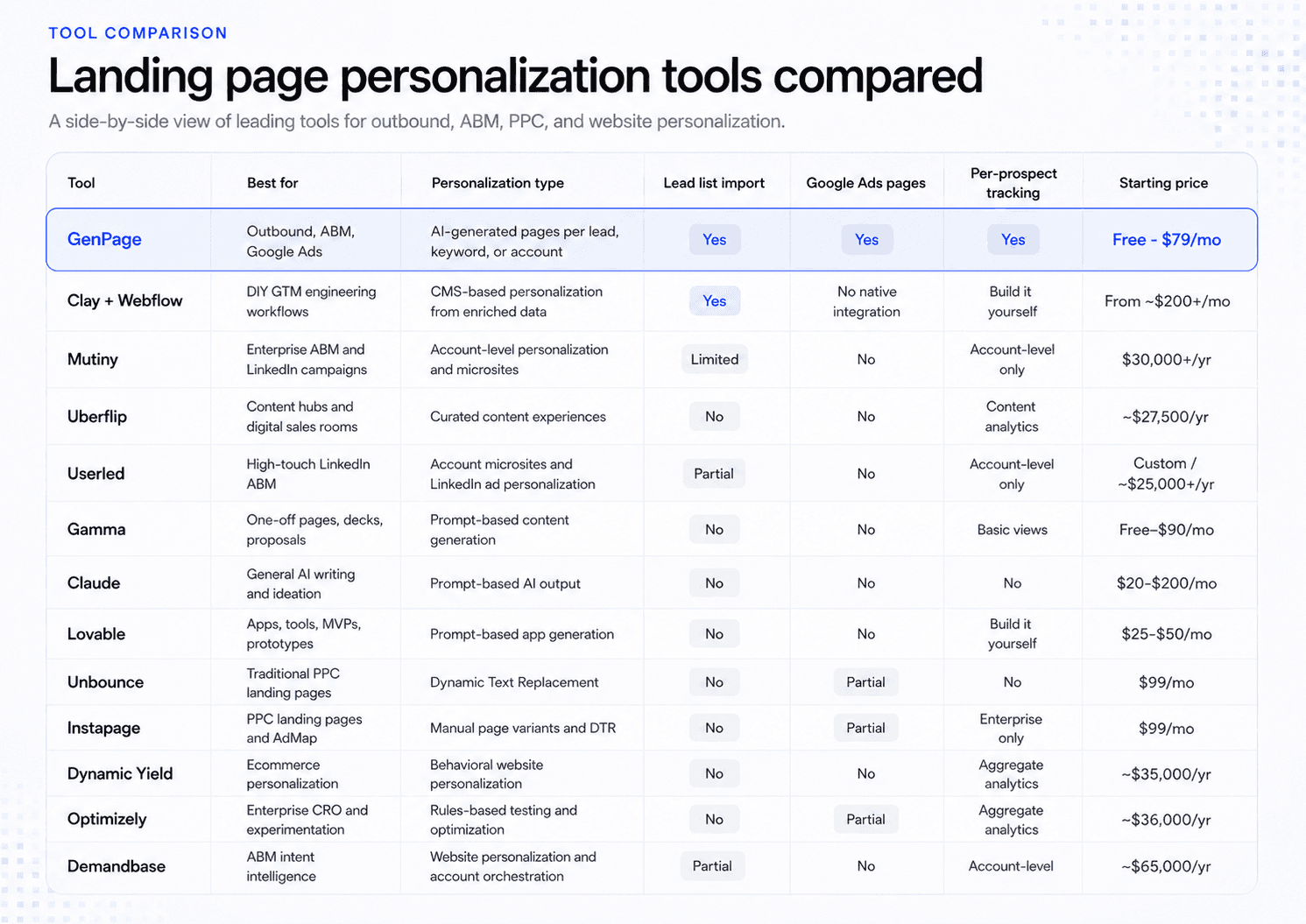
Tool | Best for | Personalization type | Lead list import | Google Ads pages | Per-prospect tracking | Starting price |
GenPage | Outbound, ABM, Google Ads | AI-generated pages per lead, keyword, or account | Yes | Yes | Yes | Start free, then from $79/mo |
Clay + Webflow | DIY GTM engineering workflows | CMS-based personalization from enriched data | Yes | No native integration | Build it yourself | From ~$200+/mo |
Mutiny | Enterprise ABM and LinkedIn campaigns | Account-level personalization and microsites | Limited | No | Account-level only | $30,000+/yr |
Uberflip | Content hubs and digital sales rooms | Curated content experiences | No | No | Content analytics | ~$27,500/yr |
Userled | High-touch LinkedIn ABM | Account microsites and LinkedIn ad personalization | Partial | No | Account-level only | Custom / ~$25,000+/yr |
Gamma | One-off pages, decks, proposals | Prompt-based content generation | No | No | Basic views | Free-$90/mo |
Claude | General AI writing and ideation | Prompt-based AI output | No | No | No | $20-$200/mo |
Lovable | Apps, tools, MVPs, prototypes | Prompt-based app generation | No | No | Build it yourself | $25-$50/mo |
Unbounce | Traditional PPC landing pages | Dynamic Text Replacement | No | Partial | No | $99/mo |
Instapage | PPC landing pages and AdMap | Manual page variants and DTR | No | Partial | Enterprise only | $99/mo |
Dynamic Yield | Ecommerce personalization | Behavioral website personalization | No | No | Aggregate analytics | ~$35,000+/yr |
Optimizely | Enterprise CRO and experimentation | Rules-based testing and optimization | No | Partial | Aggregate analytics | ~$36,000+/yr |
Demandbase | ABM intent intelligence | Website personalization and account orchestration | Partial | No | Account-level | ~$65,000/yr |
What to look for in personalized landing page software
Before choosing a tool, ask what kind of personalization you actually need.
Lead list import
If you want personalized landing pages for outbound or ABM, the tool needs to import leads.
That means CSV, Clay, Google Sheets, CRM, HeyReach, Zapier, API, or another lead source. Without lead import, you’re stuck creating pages manually one at a time.
Google Ads integration
If you’re running paid search, the landing page tool should connect to your ad campaigns or at least support keyword-level generation.
Dynamic Text Replacement is not the same as full-page personalization. Swapping one keyword in the headline does not change the offer, proof, CTA, or conversion flow.
AI account research
For B2B landing pages, personalization should go deeper than first name, company name, and logo.
Good AI page generation should understand:
Company context
Industry
Role
Pain points
Recent initiatives
Use case
Search intent
Campaign source
Brand management
Personalized pages should still feel like your company.
Look for a tool that lets you import your brand once - logo, colors, fonts, tone of voice, messaging guidelines, design system, and existing pages - so every generated page stays consistent.
Otherwise, every page starts from scratch.
Per-prospect tracking
For outbound and ABM, aggregate analytics are not enough.
You want to know when a specific person opens their page, how long they stay, what sections they view, and when to follow up.
That means:
Per-prospect analytics
Heatmaps
Session replays
Slack alerts
Email alerts
Page-level engagement tracking
Self-serve access
Many enterprise personalization tools require a sales call, annual contract, implementation project, onboarding team, or RevOps owner.
That might make sense for large enterprise ABM programs.
But if you need personalized pages live this week, self-serve matters.
The 13 best personalized landing page tools in 2026
1. GenPage - Best for AI personalized landing pages at scale
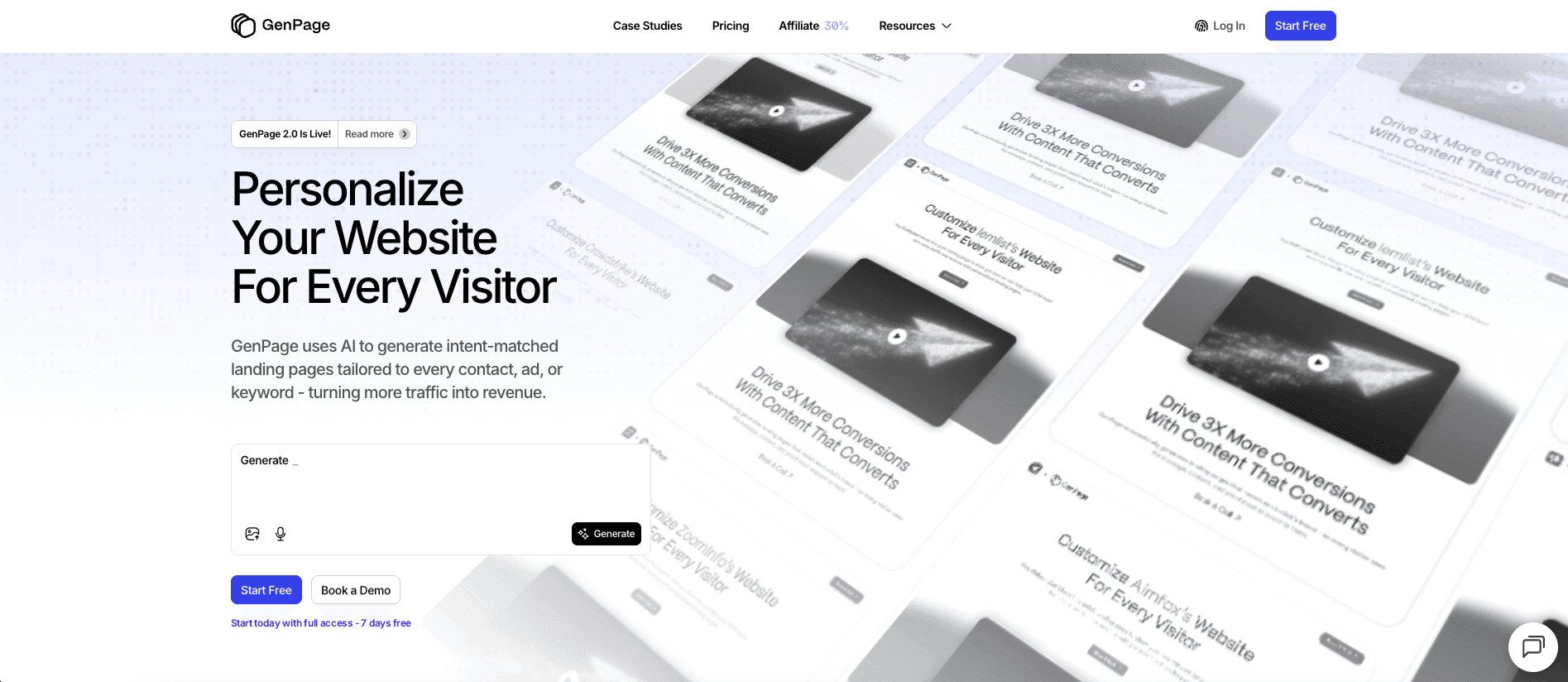
GenPage is built for B2B sales and marketing teams that need personalized landing pages to work at scale.
The core workflow is simple:
Import your leads or connect your ad campaigns. GenPage enriches each audience, learns your brand, and generates unique personalized landing pages for every prospect, account, keyword group, or campaign audience.
No prompt per lead. No developer. No Webflow CMS setup. No stitching together tools.
Best for
Outbound sales
ABM campaigns
Google Ads landing pages
LinkedIn outreach
Clay-enriched lead lists
Agencies managing multi-client campaigns
B2B teams that need pages live fast
How GenPage works
Connect your lead source or ad account. That can be CSV, Clay, Google Sheets, HeyReach, Zapier, CRM, API, or Google Ads.
GenPage enriches each account and generates a page tailored to that audience. The copy, messaging angle, pain points, CTA, and page structure can change per lead, keyword, or account.
Then your team can publish pages, track engagement, and get real-time alerts when prospects interact.
What makes GenPage different
GenPage is not a traditional landing page builder with AI features added on top.
It is AI-native from the ground up.
That matters because the workflow is not “build one page, duplicate it, and edit variables.” The workflow is “import an audience and generate personalized pages automatically.”
GenPage includes:
Lead list import
Google Ads page generation
AI account research
Brand import
Heatmaps
Session replays
Real-time Slack and email alerts
Agency workspaces
Unlimited users
Native GTM integrations
Self-serve access
Where GenPage is not the right tool
GenPage is not the best fit if your primary goal is:
Enterprise A/B testing on high-traffic websites
Ecommerce product recommendations
Building full-stack apps
Creating pitch decks
Managing a large content hub
Buying intent data to identify target accounts
For those use cases, other tools in this list may be stronger.
Pricing
Free plan, paid plans from $79/mo. Self-serve, no card required.
G2: 4.5/5 | AppSumo: 4.5/5 | Teams using it: 3,000+
2. Clay + Webflow - best DIY workflow for GTM engineers
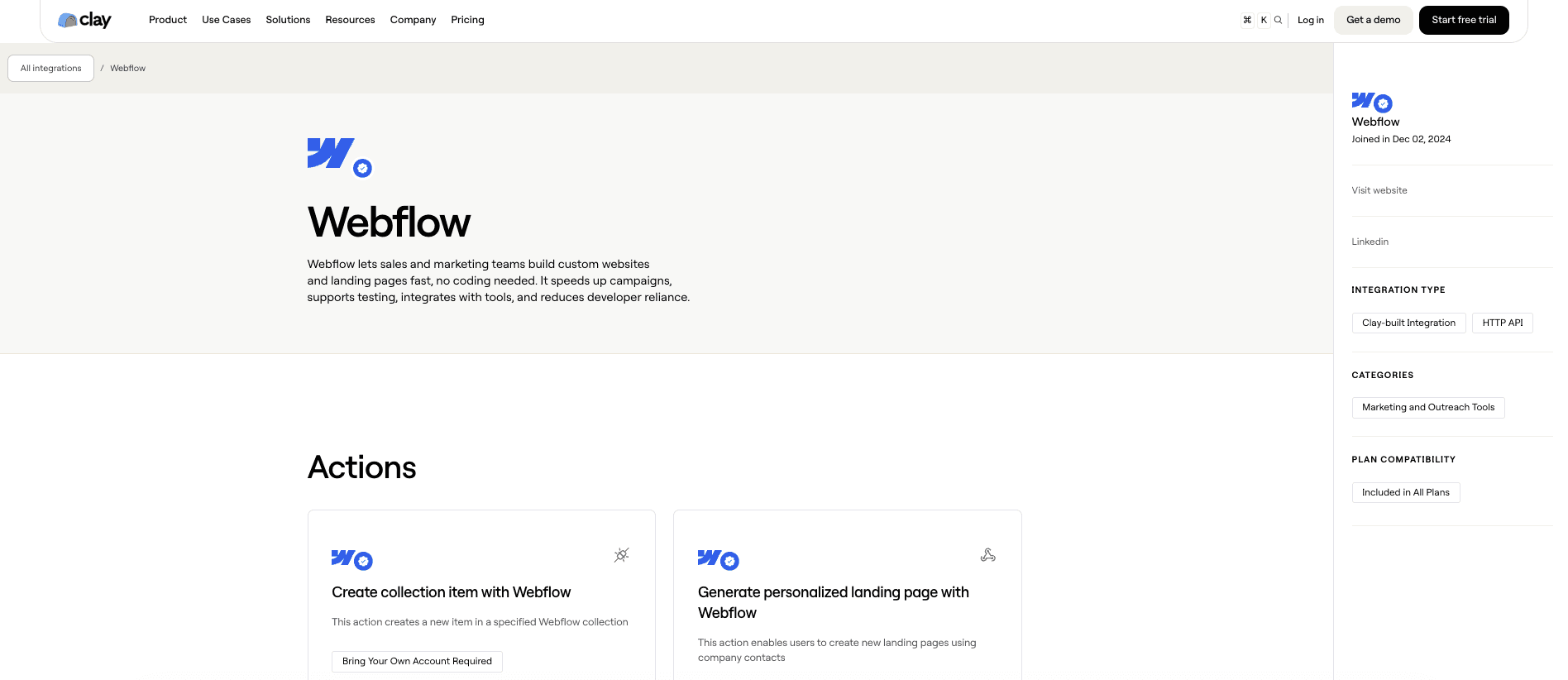
Clay + Webflow is not a single product.
It’s a DIY workflow.
The basic idea is to enrich leads in Clay, push that data into Webflow CMS, and generate dynamic personalized pages from CMS records.
When it works, it can be powerful. Clay gives you deep enrichment flexibility. Webflow gives you full design control. A technical GTM team can build a custom personalization engine this way.
Best for
GTM engineers
Technical marketers
Teams already using Clay heavily
Teams with Webflow developers
Custom personalization workflows
Teams that want full CMS and design control
Where it works well
Clay + Webflow makes sense if you already have the technical resources to build and maintain the workflow.
You can enrich leads in Clay, map variables into Webflow, and create CMS-driven pages that feel personalized.
For teams with a GTM engineer, Webflow developer, and designer, this can be a legitimate approach.
Where it breaks down
The issue is maintenance.
You need to manage:
Clay tables
Webflow CMS schema
API connections
Conditional logic
Analytics setup
Tracking scripts
CMS field mismatches
Rate limits
Page publishing
QA
Design consistency
If something breaks, you’re debugging across multiple tools.
That’s fine for technical teams. It’s not ideal for sales and marketing teams that want to launch campaigns independently.
Pricing
Clay + Webflow typically starts around $200+/month and credit costs can climb up significantly before analytics, development time, and design resources.
Want the full comparison? Read our detailed Clay + Webflow vs GenPage breakdown for pricing, features, use cases, and honest best-fit guidance.
3. Mutiny - best for enterprise ABM and LinkedIn campaigns
Mutiny is an enterprise ABM personalization platform.
It is strongest for teams running account-based marketing programs where personalized ads, microsites, and account-level engagement matter.
Best for
Enterprise ABM
LinkedIn-led account campaigns
High-touch sales motions
Sales and marketing alignment
Focused lists of strategic accounts
Where Mutiny works well
Mutiny is useful if your team is targeting a smaller list of high-value accounts and wants polished, personalized assets for each one.
It can support enterprise account-based campaigns, sales assets, microsites, and LinkedIn ad personalization.
If your ABM motion is high-touch and your budget supports enterprise software, Mutiny is worth evaluating.
Where it falls short
Mutiny is not built for high-volume page generation from a lead list.
If you need hundreds or thousands of pages generated from Clay, CSV, CRM, or Google Ads, the workflow is not as direct.
Key limitations:
No native high-volume lead list generation workflow
Limited Google Ads use case
No heatmaps or session replays
Enterprise features locked behind high pricing
More focused on account-level ABM than per-prospect page generation
Pricing
Mutiny has a limited free tier and business plans, but the meaningful features typically sit behind $30,000+/year contracts.
Want the full comparison? Read our detailed Mutiny vs GenPage breakdown for pricing, features, use cases, and honest best-fit guidance.
4. Uberflip - best for content hubs and digital sales rooms
Uberflip is a content experience platform.
It helps teams organize existing content - ebooks, whitepapers, case studies, blog posts, videos - into personalized hubs, streams, and digital sales rooms.
Best for
Content hubs
Digital sales rooms
Enterprise content libraries
ABM content curation
Buyer self-service journeys
Where Uberflip works well
Uberflip makes sense if you already have a large content library and want to package that content into curated experiences for different accounts, industries, or buyer journeys.
It is built for teams that want prospects to browse relevant content, not necessarily receive a unique AI-generated landing page.
Where it falls short
Uberflip personalizes by curating existing assets.
GenPage personalizes by generating the page itself.
That distinction matters.
If you need a page written for a specific prospect, account, Google Ads keyword, or outbound campaign, Uberflip is not the direct fit.
Key limitations:
Requires existing content
Not built for lead list page generation
No native Google Ads keyword-level page generation
Enterprise pricing
Content curation rather than AI page generation
Pricing
Uberflip is enterprise-priced, with median contracts around $27,500/year.
Want the full comparison? Read our detailed Uberflip vs GenPage breakdown for pricing, features, use cases, and honest best-fit guidance.
5. Userled - best for high-touch LinkedIn ABM
Userled is an enterprise ABM platform focused on personalized LinkedIn ads and microsites for target accounts.
Best for
LinkedIn-led ABM
Enterprise target account campaigns
High-touch named account plays
Coordinated ad and microsite experiences
Strategic account lists
Where Userled works well
Userled makes sense if your ABM strategy centers on a tight list of high-value accounts and LinkedIn is the main channel.
It can help coordinate personalized LinkedIn ads and account-specific microsites, which is useful for enterprise teams running deeply orchestrated ABM plays.
Where it falls short
Userled is not built for every GTM team.
If your motion includes outbound, Google Ads, Clay lead lists, agencies, or high-volume page generation, the workflow is narrower than GenPage.
Key limitations:
LinkedIn-focused
No Google Ads landing page generation
Enterprise sales-led pricing
Less suited for high-volume outbound lists
No built-in heatmaps or session replays
Pricing
Userled uses custom pricing, with average plans around $25,000/year.
Want the full comparison? Read our detailed Userled vs GenPage breakdown for pricing, features, use cases, and honest best-fit guidance.
6. Gamma - best for one-off pages, decks, and proposals
Gamma is an AI content creation tool for presentations, documents, and one-off webpages.
It is fast, polished, and useful when you need a single asset created quickly.
Best for
Pitch decks
Internal presentations
Client proposals
One-off webpages
Browser-based content
Solo creators and small teams
Where Gamma works well
Gamma is good when the output is one polished piece of content.
If you need a deck, proposal, or quick webpage, Gamma can generate something attractive fast.
Where it falls short
Gamma is not built for personalized landing pages at scale.
There is no native lead list import, no Clay or HeyReach workflow, no Google Ads connection, no per-prospect tracking, and no campaign infrastructure.
You can make one page for one prospect.
But if you need 500 unique personalized pages from a lead list, Gamma becomes manual very quickly. You can also use Gamma's API, but that requires a Pro subscription, technical knowledge, and resources to maintain the workflow.
Key limitations:
One piece of content at a time
No lead list import
No Google Ads workflow
No native GTM integrations
Basic view analytics only
Limited brand system control
Designs can feel templatized at volume
Pricing
Gamma has a free plan and paid plans from $8/month to $90/month. It is affordable for solo use, but per-seat pricing and credits can become expensive at business scale.
Want the full comparison? Read our detailed Gamma vs GenPage breakdown for pricing, features, use cases, and honest best-fit guidance.
7. Claude - best for general AI writing and ideation
Claude is one of the best general-purpose AI assistants in the world.
It can help write copy, research companies, brainstorm campaigns, analyze competitors, generate code, and support almost any knowledge-work task.
Best for
Writing
Research
Brainstorming
Strategy
Messaging
Campaign ideas
Ad hoc content creation
Where Claude works well
Claude is useful for creating the raw material of a campaign.
It can help with:
Landing page copy
Messaging frameworks
Competitor research
Customer research
Outbound angles
Ad copy
Positioning
Email drafts
Most marketing teams can benefit from using Claude.
Where it falls short
Claude is not a marketing platform.
It does not include:
Lead list import
Google Ads workflows
CRM integrations
Publishing infrastructure
Brand management
Per-prospect tracking
Heatmaps
Session replays
Real-time alerts
Campaign analytics
Claude can help create content. GenPage runs the personalized landing page workflow.
Pricing
Claude Pro starts at $20/month, with higher Max plans for heavier use. For high-volume content and page generation workflows, usage can get expensive quickly.
Want the full comparison? Read our detailed Claude vs GenPage breakdown for pricing, features, use cases, and honest best-fit guidance.
8. Lovable - best for apps, tools, and prototypes
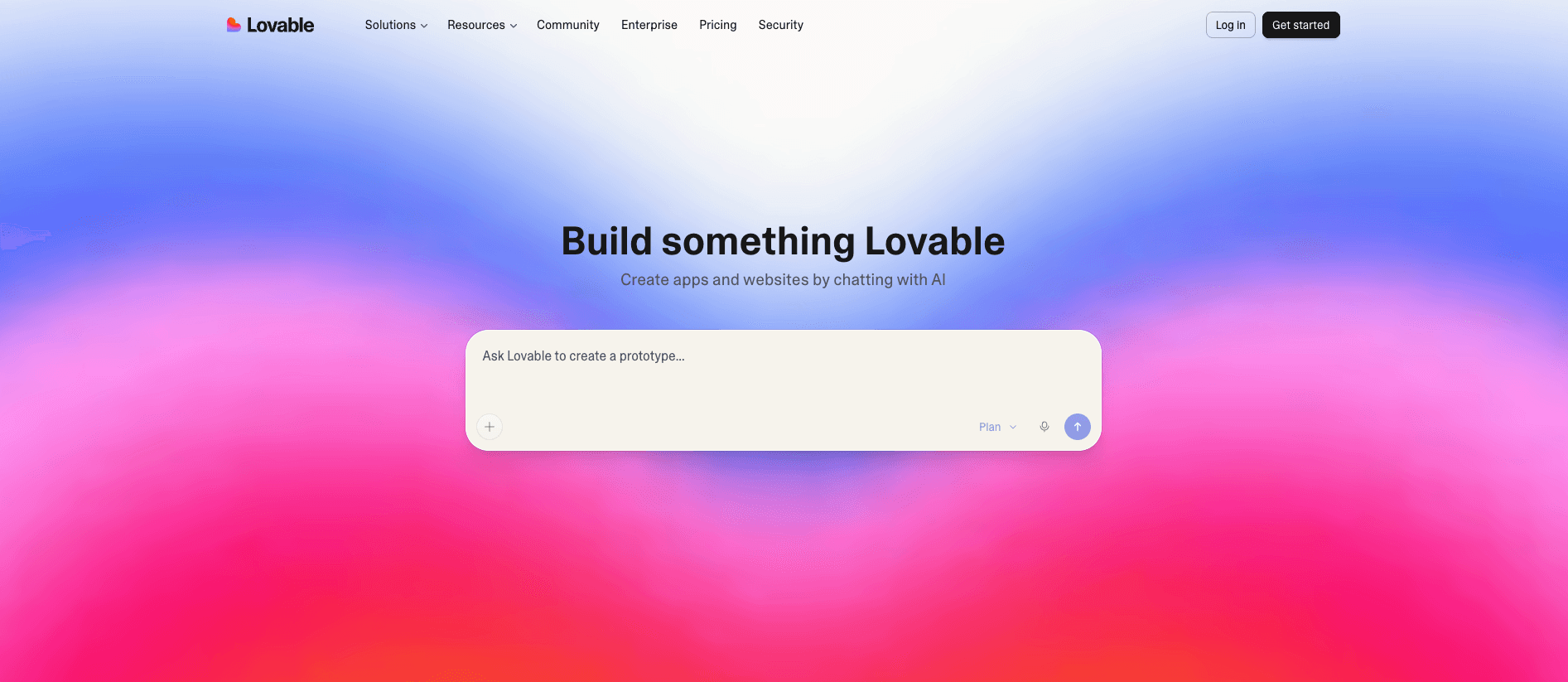
Lovable is a vibe coding platform that generates full-stack apps from natural language prompts.
It can create frontend, backend, database, authentication, and deployment structures from a prompt.
Best for
MVPs
SaaS prototypes
Internal tools
Custom apps
Product ideas
Founders and builders
Where Lovable works well
Lovable is strong when you want to build software.
If you need an app, prototype, internal dashboard, or custom workflow, Lovable can help you get started quickly.
Where it falls short
Lovable can generate landing pages, but it is still a prompt-by-prompt workflow.
Every new personalized page requires you to feed in the audience, brand, messaging, and context again. The pages are not purpose-built for B2B conversion, sales workflows, or marketing campaign operations.
Lovable also does not include native GTM workflows like:
Lead list import
Clay integration
HeyReach integration
Google Ads page generation
Per-prospect analytics
Heatmaps
Session replays
Real-time Slack alerts
Persistent brand system
You can build some of those things yourself.
But then you’re building a marketing platform instead of using one.
Pricing
Lovable starts at $25/month for Pro and $50/month for Business, with credits consumed per AI interaction and separate hosting costs through Lovable Cloud.
Want the full comparison? Read our detailed Lovable vs GenPage breakdown for pricing, features, use cases, and honest best-fit guidance.
9. Unbounce - best for traditional PPC landing pages
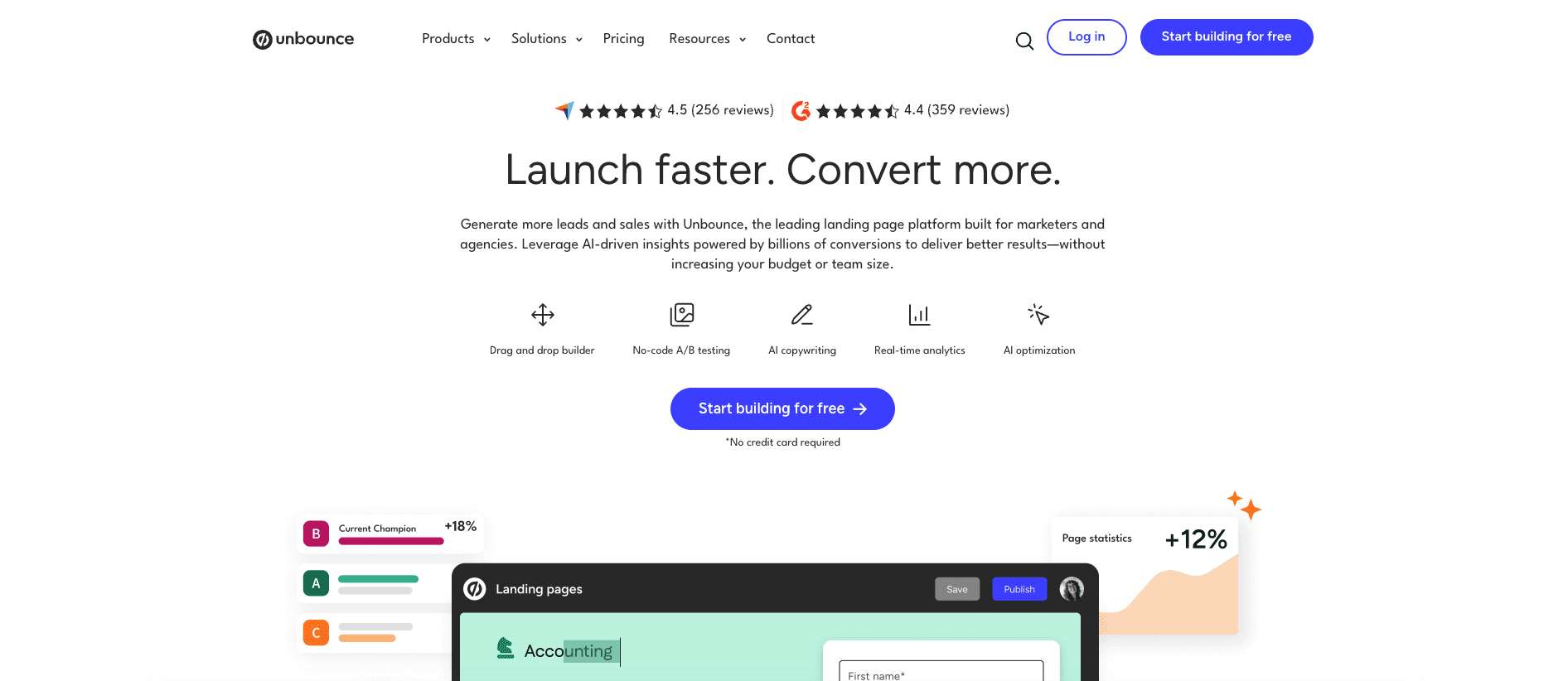
Unbounce is a landing page builder for inbound and paid traffic.
It has been around for a long time and is commonly used by teams running PPC campaigns, A/B tests, and conversion-focused landing pages.
Best for
Traditional PPC landing pages
Manual page building
A/B testing
Dynamic Text Replacement
Inbound lead capture
Conversion optimization
Where Unbounce works well
Unbounce makes sense if you want to manually build and test landing pages for inbound or paid traffic.
It is familiar, flexible, and useful for teams that want a drag-and-drop builder with testing features.
Where it falls short
Unbounce is not built for outbound or ABM page generation.
There is no concept of importing a lead list and generating unique pages per prospect. Personalization is mostly built around Dynamic Text Replacement and traffic optimization rather than AI-generated pages per account or audience.
Key limitations:
Not AI-native (build pages with drag & drop)
No lead list import
No per-prospect pages
No outbound workflow
No real-time named visitor alerts
No full-page AI personalization per account
Visitor and feature caps depending on plan
Pricing
Unbounce starts at $99/month, with more advanced experimentation and optimization features on higher tiers.
Want the full comparison? Read our detailed Unbounce vs GenPage breakdown for pricing, features, use cases, and honest best-fit guidance.
10. Instapage - best for manual PPC workflows
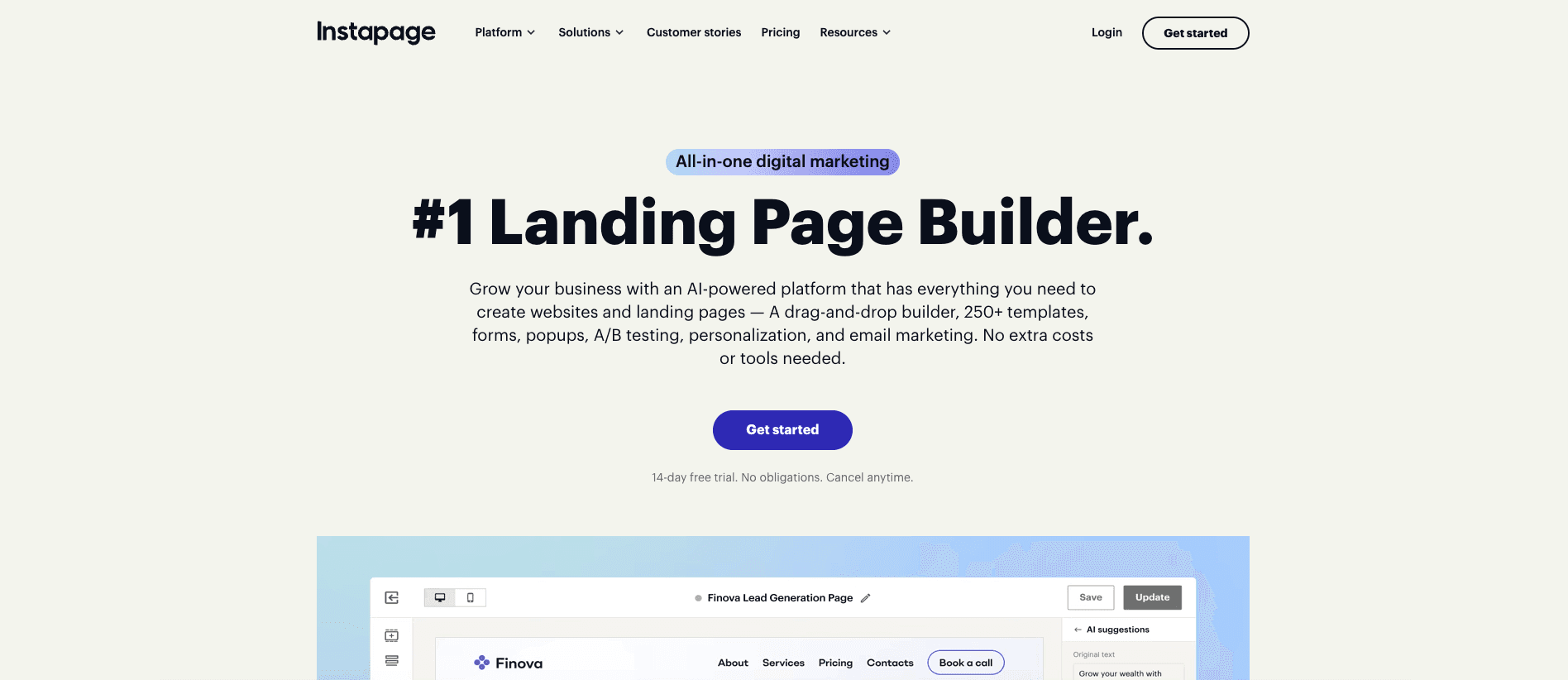
Instapage is a PPC-focused landing page platform with a drag-and-drop builder, AdMap, and experimentation features.
Best for
PPC landing pages
Manual ad-to-page workflows
Traditional paid acquisition teams
A/B testing
AdMap planning
Pixel-perfect page design
Where Instapage works well
Instapage is a good fit for performance marketers who want manual control over page design and ad-to-page matching.
If your workflow is building pages for paid campaigns and testing variants, Instapage can make sense.
Where it falls short
Instapage is not AI-native from the ground up.
The workflow is still mostly manual: build pages, edit variants, manage testing, and use AI for assistance rather than full campaign generation.
Key limitations:
No lead list import
No outbound page generation
No AI-generated page per lead
Personalization features gated by plan
Heatmaps and advanced features often tied to enterprise pricing
You still build and manage pages manually
Pricing
Instapage starts at $99/month, with advanced features and personalization on higher tiers.
Want the full comparison? Read our detailed Instapage vs GenPage breakdown for pricing, features, use cases, and honest best-fit guidance.
11. Dynamic Yield - best for ecommerce personalization
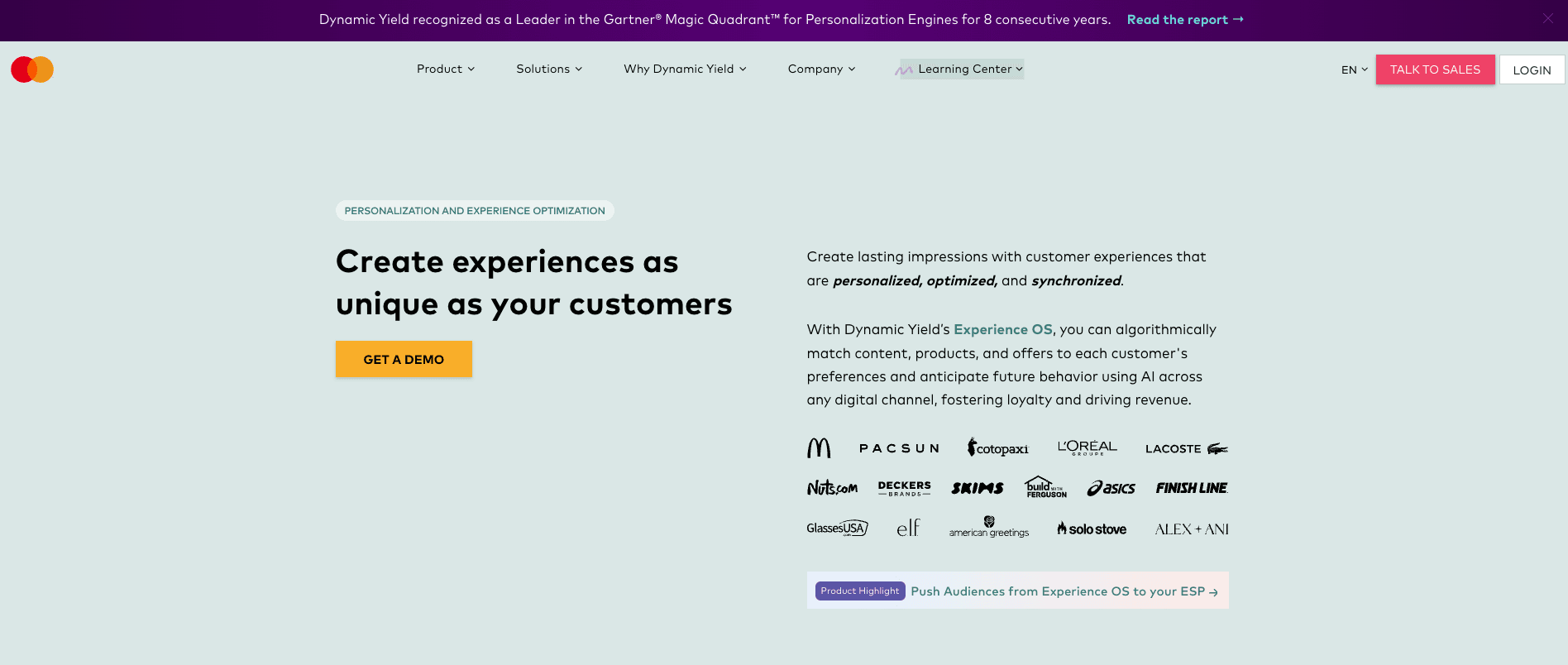
Dynamic Yield by Mastercard is an enterprise ecommerce personalization platform.
It is built for high-traffic B2C websites that want to personalize experiences for anonymous visitors based on behavior.
Best for
Ecommerce personalization
B2C retail
Product recommendations
Behavioral segmentation
High-traffic websites
Enterprise experimentation
Where Dynamic Yield works well
Dynamic Yield is useful if you run a large ecommerce website with millions of visitors and want to personalize based on browsing behavior, purchase history, product affinity, and audience segments.
It is a serious enterprise personalization engine.
Where it falls short
Dynamic Yield is not built for B2B outbound, ABM, or Google Ads landing page generation.
It personalizes existing ecommerce experiences. It does not generate unique landing pages for named prospects, lead lists, or keyword groups.
Key limitations:
B2C ecommerce focus
Enterprise implementation
No lead list import
No per-prospect B2B tracking
No outbound workflow
No Google Ads keyword-level page generation
Expensive and complex for B2B teams
Pricing
Dynamic Yield starts around $35,000/year, with enterprise implementation requirements.
Want the full comparison? Read our detailed Dynamic Yield vs GenPage breakdown for pricing, features, use cases, and honest best-fit guidance.
12. Optimizely - best for enterprise CRO and experimentation
Optimizely is an enterprise Digital Experience Platform with experimentation, personalization, CMS, feature flags, commerce, and analytics.
Best for
Enterprise CRO
A/B testing
Multivariate testing
Website experimentation
Feature experimentation
Large digital experience teams
Where Optimizely works well
Optimizely makes sense for enterprise teams with high traffic, developers, experimentation programs, and a need to optimize existing digital experiences over time.
It is strong at testing, experimentation, and traffic optimization.
Where it falls short
Optimizely optimizes existing experiences for inbound traffic.
GenPage creates personalized pages before the visitor arrives.
That is a very different workflow.
Key limitations:
Not built for outbound page generation
No lead list import
No page per named prospect
No native Google Ads keyword-level page generation
Developer-heavy implementation
Enterprise pricing
Focused on experiments, not campaign-scale page generation
Pricing
Optimizely starts around $36,000/year and can scale far higher depending on modules and deployment.
Want the full comparison? Read our detailed Optimizely vs GenPage breakdown for pricing, features, use cases, and honest best-fit guidance.
13. Demandbase - best for ABM intent intelligence
Demandbase is an enterprise ABM intelligence and orchestration platform.
It helps teams identify in-market accounts, run B2B display ads, personalize website experiences, and coordinate sales and marketing around account signals.
Best for
ABM intent data
Account identification
B2B display advertising
Enterprise ABM orchestration
Sales intelligence
Account scoring
Where Demandbase works well
Demandbase is useful if your main question is: “Which accounts should we target?”
It helps enterprise teams identify in-market accounts, score them, and coordinate ABM programs.
Where it falls short
Demandbase is not a personalized landing page generator.
It can personalize your existing website for identified visitors, but it does not generate a unique landing page per prospect, Google Ads keyword group, or outbound sequence.
Key limitations:
Enterprise implementation
No direct page generation workflow
No self-serve access
No per-prospect heatmaps
No landing page generation from a lead list
Expensive if landing pages are your primary need
Pricing
Demandbase contracts are custom, with median contracts around $65,000/year and multi-month implementation.
Want the full comparison? Read our detailed Demandbase vs GenPage breakdown for pricing, features, use cases, and honest best-fit guidance.
Best tools by channel
Best personalized landing pages for Google Ads
If your primary use case is Google Ads, the best tool depends on how deep you want the personalization to go.
Traditional tools like Unbounce and Instapage are good for manual PPC landing page creation and A/B testing. They can support paid traffic workflows and keyword-level Dynamic Text Replacement.
But if you want landing pages generated per keyword group, ad group, audience, or campaign intent, GenPage is the stronger fit.
The best Google Ads landing pages should:
Match the keyword intent
Reflect the ad message
Use relevant proof points
Adapt the CTA
Speak to the exact problem searched
Improve message match from ad to page
For Google Ads, personalization should not stop at swapping a keyword in the headline.
The entire page should match the search.
Best personalized landing pages for outbound sales
For outbound, the most important feature is lead list import.
If a tool cannot import a lead list, it cannot scale outbound personalization.
Good outbound landing page software should support:
CSV import
Clay import
CRM import
Google Sheets
HeyReach or LinkedIn workflow
API or Zapier
AI account research
Per-prospect tracking
Real-time alerts
GenPage is the strongest fit here because it was built around this exact workflow.
Import the list. Generate the pages. Send the links. Track every visit.
Best personalized landing pages for LinkedIn outreach
LinkedIn outreach is one of the best channels for personalized landing pages.
A personalized page gives your prospect a reason to click beyond curiosity. It also makes your message feel more relevant because the destination continues the same personal context.
A strong LinkedIn outreach landing page should include:
Company-specific messaging
A relevant use case
A clear reason for reaching out
Industry-specific proof
A soft CTA
A direct booking link
Page tracking for follow-up
GenPage works well for this because it can generate pages from HeyReach, Clay, CRM lists, or CSV exports.
Best personalized landing pages for ABM
ABM landing pages should be more than company logos and first-name tokens.
A good ABM landing page should adapt:
The account narrative
The pain points
The use case
The proof
The CTA
The role-based framing
The industry angle
For enterprise LinkedIn-led ABM, Userled and Mutiny are worth evaluating.
For ABM landing pages at scale across outbound, Google Ads, and lead lists, GenPage is the stronger fit.
Best personalized landing pages for agencies
Agencies need a slightly different feature set.
The most important things are:
Multi-client workspaces
Unlimited users
Fast page generation
Brand management
Client-level analytics
Repeatable campaign workflows
Predictable pricing
GenPage is strong for agencies because it includes agency workspaces, unlimited users, lead imports, heatmaps, alerts, and personalized page generation in one platform.
Dynamic Text Replacement vs AI personalized landing pages
Dynamic Text Replacement changes words on a page based on URL parameters.
For example, if someone searches “landing pages for SaaS,” the page headline might become “Landing Pages for SaaS.”
That can help with message match, but it is limited.
AI personalized landing pages go further.
Instead of swapping a word, the page can change:
Headline
Subheadline
Use case
Pain points
CTA
Proof points
Examples
Page structure
Visual direction
Messaging angle
Dynamic Text Replacement personalizes a variable.
AI personalized landing pages personalize the experience.
Final thoughts
The personalized landing page space is genuinely fragmented, and the right tool depends heavily on your specific use case. A few things we've learned:
Most enterprise ABM platforms (Demandbase, Optimizely, Dynamic Yield) were built for inbound and require significant investment and implementation time. They're powerful for the right team, but the right team is larger and better-resourced than most B2B marketing teams.
The DIY approach (Clay + Webflow) works well for engineers who enjoy owning the stack, but creates an ongoing engineering dependency for marketing.
General-purpose AI creation tools (Gamma, Lovable, Claude Code) are excellent at what they're designed for, which isn't running personalized marketing campaigns at scale.
If your primary need is generating personalized pages for outbound leads, ABM targets, or Google Ads campaigns - and you want to do it without a developer, without a $30,000+ contract, and without months of implementation - that's exactly what we built GenPage for.
GenPage is an AI-native personalized landing page platform. You can start with our free plan, then upgrade for $79/mo. 3,000+ teams use it for outbound, ABM, and Google Ads personalization.
Competitor pricing data sourced from public pricing pages, Vendr transaction benchmarks, and G2 reviews. Enterprise pricing is estimated based on third-party data and may vary. This article was written by the GenPage team in June 2026.
Frequently Asked Questions
What are personalized landing pages?
Personalized landing pages are pages that adapt to a visitor, company, audience segment, ad keyword, or campaign context. In B2B sales and marketing, that often means a unique landing page for each prospect, account, Google Ads keyword group, or ABM target.
What is the best personalized landing page software?
The best personalized landing page software depends on your use case. GenPage is best for AI-generated landing pages per prospect, account, or Google Ads keyword group. Unbounce and Instapage are better for traditional PPC page building. Demandbase and Dynamic Yield are better for enterprise website personalization. Uberflip is better for curated content hubs.
What is the best landing page builder for Google Ads?
For traditional PPC landing pages, Unbounce and Instapage are common options. For AI-generated Google Ads landing pages that match each keyword group, ad group, or audience, GenPage is purpose-built.
Can I create personalized landing pages for LinkedIn outreach?
Yes. You can create a unique page for each LinkedIn prospect or target account, then include that link in your LinkedIn outreach sequence. The best LinkedIn outreach landing pages continue the context from the message and tailor the value proposition to the prospect’s company.
What is the difference between Dynamic Text Replacement and personalized landing pages?
Dynamic Text Replacement swaps words based on a URL parameter. True personalized landing pages change the page’s messaging, pain points, examples, proof, and CTA based on the company, account, audience, or search intent.
Do personalized landing pages work for ABM?
Yes. Personalized landing pages are especially useful for ABM because they let sales and marketing teams tailor messaging, proof, and CTAs to specific accounts, industries, and buying committees.
Do personalized landing pages help with Google Ads Quality Score?
They can. Better message match between the keyword, ad, and landing page can improve relevance, which can support stronger Quality Scores and conversion rates. The biggest advantage comes when the entire landing page matches search intent, not just the headline.
What is the best tool for outbound landing pages?
GenPage is the best fit for outbound landing pages because it can import leads from CSV, Clay, CRM, Google Sheets, HeyReach, Zapier, or API and generate unique personalized pages per prospect automatically.
What is the best tool for ABM landing pages?
For enterprise LinkedIn-led ABM, Userled or Mutiny may be good fits. For AI-generated ABM landing pages at scale across outbound, Google Ads, and named account campaigns, GenPage is purpose-built.
Can Claude or ChatGPT create personalized landing pages?
Claude and ChatGPT can help write landing page copy, brainstorm messaging, and generate page ideas. But they are general AI assistants, not personalized landing page platforms. They do not include lead list imports, publishing, tracking, Google Ads integrations, heatmaps, session replays, or per-prospect alerts.
Can Lovable create personalized landing pages?
Lovable can generate landing pages from prompts, but it is built as an app and product builder. Creating personalized landing pages at scale requires a prompt-by-prompt workflow or custom engineering. GenPage is built specifically to generate on-brand, personalized pages from lead lists and ad campaigns.
Can Gamma create personalized landing pages?
Gamma can create one-off webpages, decks, and proposals. It is useful for individual content creation, but it is not built for campaign-scale personalized landing pages with lead imports, CRM integrations, Google Ads workflows, or per-prospect tracking.
What should a personalized landing page include?
A strong personalized landing page should include a relevant headline, audience-specific messaging, tailored pain points, proof that matches the visitor’s context, a clear CTA, and tracking that tells your team when the visitor engages.
Are personalized landing pages only for enterprise teams?
No. Enterprise teams use personalized landing pages for ABM and website personalization, but modern AI tools make them accessible to startups, agencies, outbound teams, and performance marketers. GenPage has a free plan, paid plans from $79/month, and is self-serve.
How fast can you create personalized landing pages?
With traditional tools, creating personalized landing pages can take hours or days per campaign. With AI-native tools like GenPage, teams can import a lead list or connect an ad account and generate personalized pages in minutes.