

AI removed the cost of building ABM pages. It didn't remove the work that makes them convert.
Two years ago, building a genuinely personalized landing page for a target account meant a designer, a developer, a two-week production cycle, and a per-page cost that only made sense for your top ten accounts.
That constraint is gone. AI can now generate a unique, on-brand, deeply personalized page for every account on your list in minutes.
But here's what I've watched happen repeatedly since: teams get access to AI page generation, run their first campaign, get mediocre results, and conclude that AI pages don't work.
They do work. Our own outreach consistently produces reply rates between 33% and 65% using this exact method, against an industry benchmark of 1 - 10%. These LinkedIn campaigns are now our most profitable acquisition channel internally at GenPage, and effectively the only outbound motion we run. Adriel booked 30% of their VivaTech meetings before the event started using 608 AI-generated ABM pages. Webtouch generated $550K in pipeline running the same play.
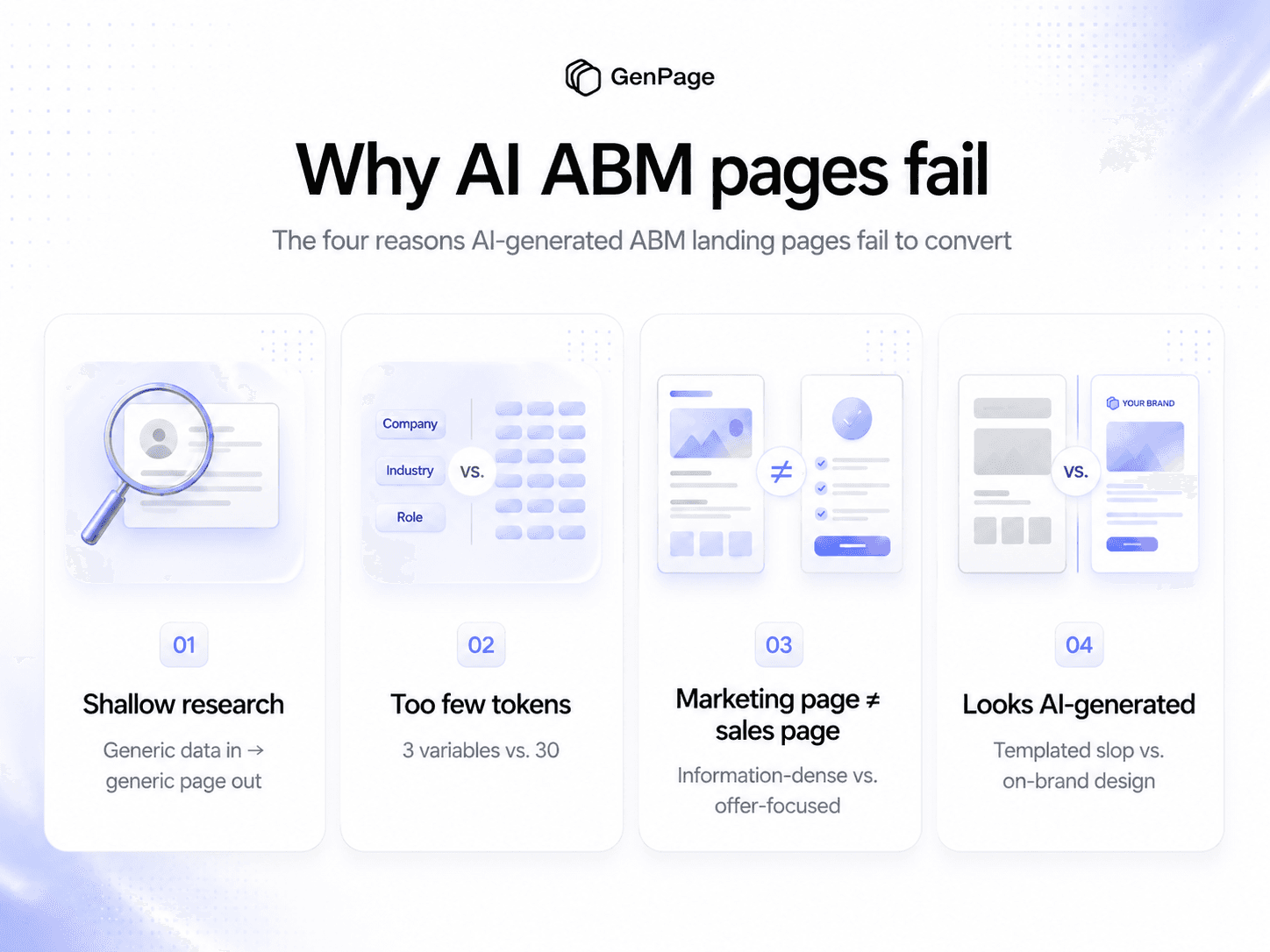
The difference between those results and a failed first campaign isn't the tool. It's four specific things most teams get wrong on their first attempt:
Not enough research feeding the AI. Generic company and prospect data produces generic pages. The AI can only be as specific as the inputs you give it.
Too few personalization tokens. Most teams add three or four variables and call it personalized. Real 1:1 pages have dozens.
Building a marketing page instead of a sales page. This is the most common and most costly mistake - and the one almost nobody talks about.
Shipping something that looks AI-generated. The page needs to look like a handcrafted extension of your website. If it reads as templated or generic, you've undermined the personalization before the prospect has read a word.
This post is the blueprint. What research to run, how deep to personalize, how to structure the page itself, and how to build and ship it - with the specific workflow that produces pages people actually respond to.
Mistake #1: Treating an ABM page like a marketing page
Let's start with the mistake that undermines everything else, because no amount of research or personalization tokens will save a page that's structurally wrong.
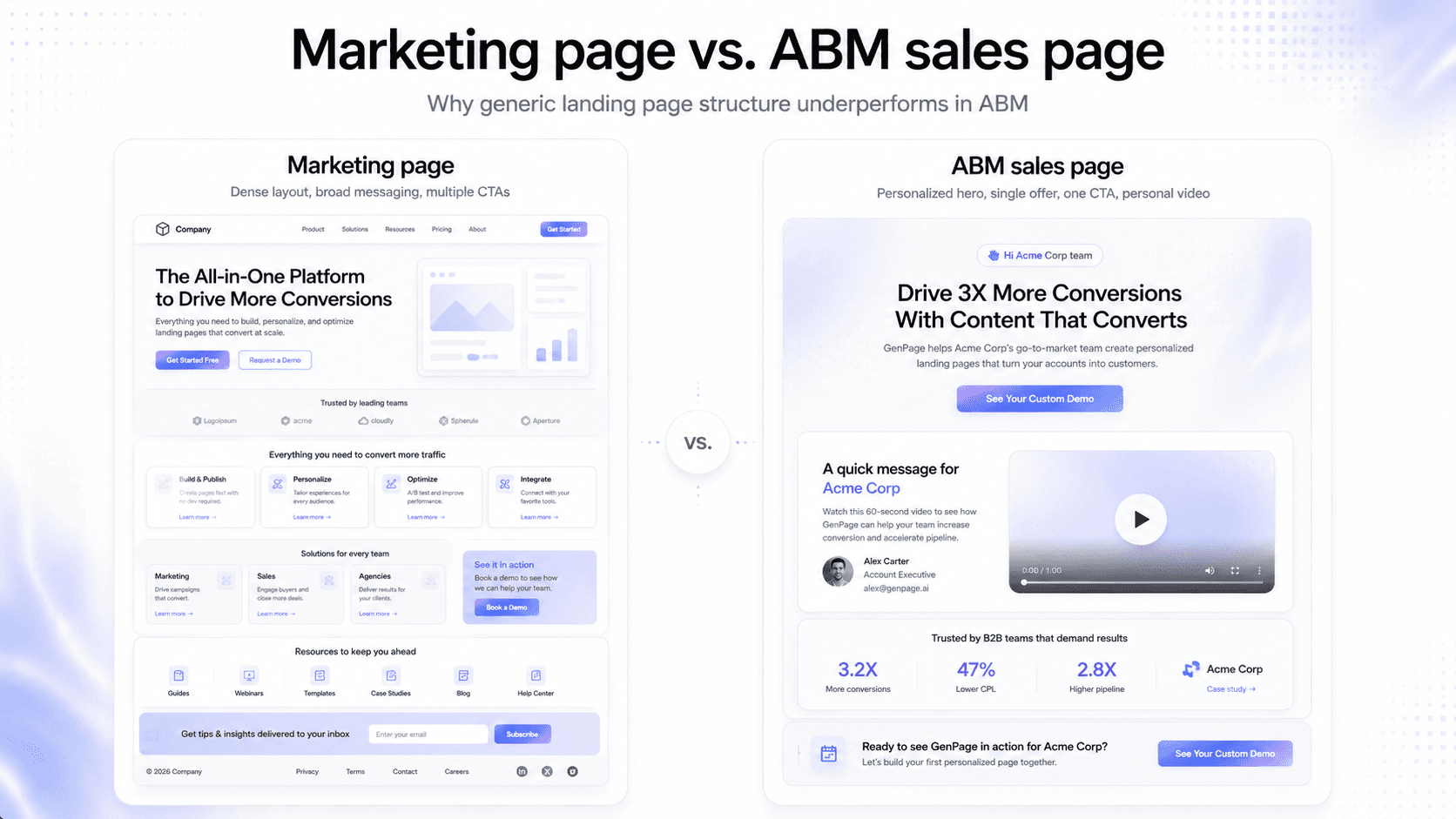
A marketing landing page and a sales landing page are built to achieve completely different things, and they call for completely different structures.
A marketing page is broad and information-heavy. It's designed to inform a wide audience who arrived with varying levels of context. It explains what you do, covers multiple use cases, addresses several personas, and generally tries to be comprehensive because it doesn't know who's reading.
A sales page is a real-estate extension of the offer you made in your sales campaign. It's personable, focused, and exists for one purpose: to convert the specific person who was drawn in by the hook of your sequence. It doesn't need to explain everything. It needs to carry the offer forward and give one interested recipient exactly what they need to say yes.
Most teams building their first ABM pages take their existing marketing page, insert a few personalization tokens, and ship it. The page is still trying to do a marketing page's job - inform broadly - while being sent to a single person who already has context from your outreach message.
The result is a page that's simultaneously too much and not enough. Too much information for someone who just wanted to know if you can solve their specific problem. Not enough directness about the actual offer.
What to do instead: Before you build anything, reframe the page in these terms. This page exists to convert one person who clicked one link after reading one message. What do they need to see to say yes? Cut everything else.
Mistake #2: Leading with a meeting request
This one compounds the structural problem above.
For cold outreach into larger accounts, a meeting request is a heavy first ask. The recipient doesn't know you. They have no evidence you can help them. And you're asking for 30 minutes of their calendar on the basis of a single message and a landing page.
Meeting requests from unknown senders convert poorly regardless of how well-matched the account is. The ask is disproportionate to the trust that's been established.
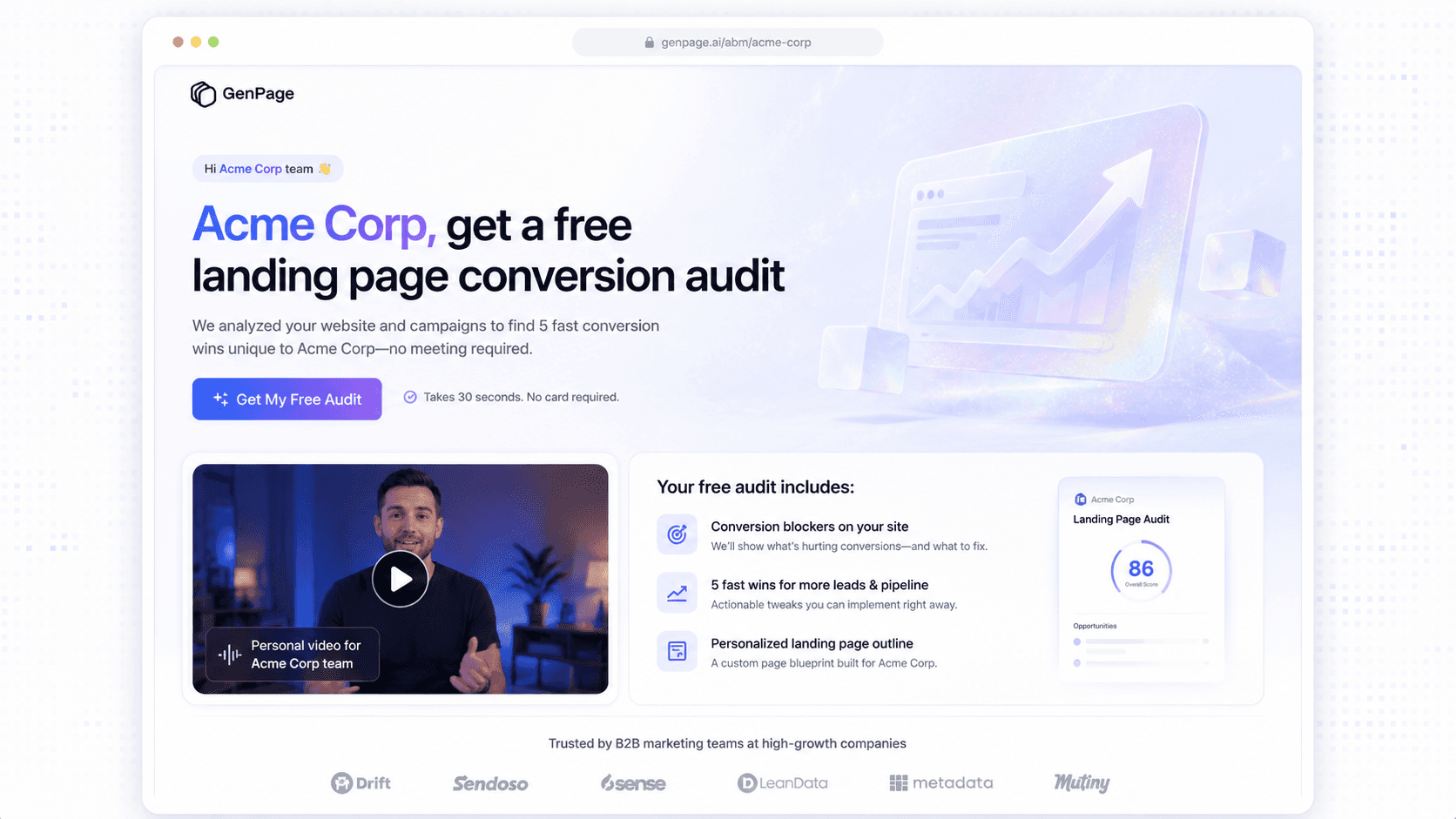
What to do instead: Lead with a high-value, low-friction offer. The meeting becomes the natural next step once value has already been delivered.
Options that work well:
A free resource tailored to their situation: not a generic ebook, but something specific to their company, industry, or the exact problem you identified in your research
A free audit of their current performance in the area you solve for: this doubles as a discovery mechanism
Free implementation of a specific quick win: the highest-conversion version of this, because it delivers value before asking for anything
The offer becomes the reason the page exists. Everything on the page should point at it. And critically, the outreach sequence and the page should carry a single, consistent message pointed at that same offer - not two different pitches that happen to be connected by a link.
Mistake #3: Not feeding the AI enough research
This is the mistake that most directly determines whether your pages feel 1:1 or feel like a template with a company name inserted.
AI-generated personalization is only as good as the data it draws on. If you give the AI a company name, an industry, and a job title, you'll get a page that references a company name, an industry, and a job title. That's not personalization - that's mail merge with better grammar.
Real personalization requires research at two levels: the company and the person.
Company-level research
What you need:
What the company actually does, in their own language from their own website
Recent news: funding, product launches, leadership changes, expansions
Their current positioning and messaging
Public signals about their priorities and initiatives
What they're posting about publicly
Person-level research
What you need:
Their full professional background and career trajectory
Their role, seniority, and what they likely own
What they've been posting about recently
What content they're engaging with
Any public statements about challenges or priorities in their function
The person-level layer is what most teams skip, and it's where the highest-leverage personalization comes from. A page that references what a prospect posted about last week lands fundamentally differently from one that references their company's industry.
How to actually run this research
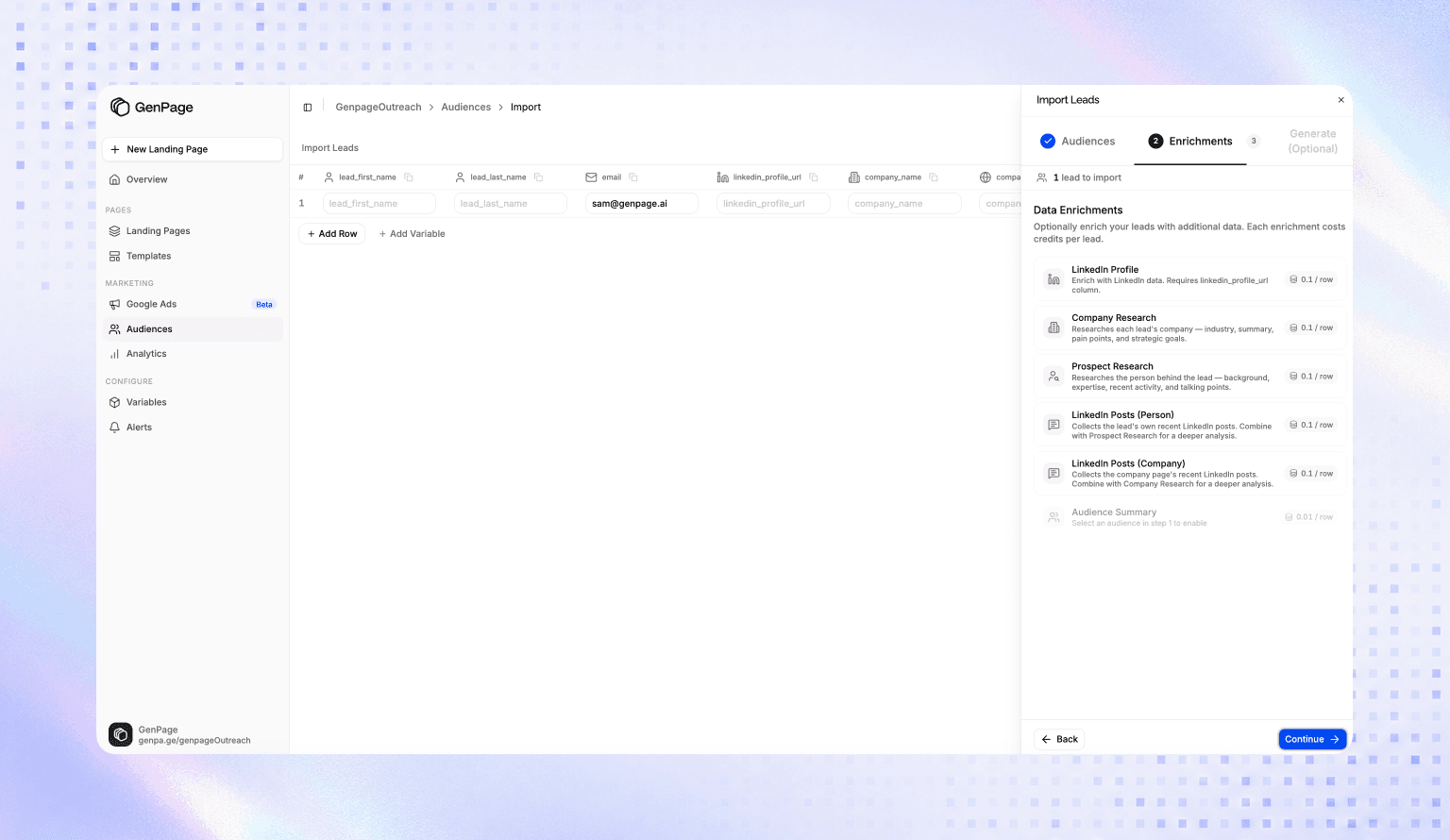
Inside GenPage, this is handled by running enrichments on your imported list. There are five that matter for ABM pages:
LinkedIn Profile: fetches the complete LinkedIn profile of the person, giving you their full professional context, background, and current role details.
Company Research: runs web searches and crawl of the company website, surfacing recent news, what their website says about their positioning, and other public recent information.
Prospect Research: the same web search and crawl process applied to the individual, surfacing their public professional footprint beyond LinkedIn.
LinkedIn Posts (Person): pulls their recent LinkedIn posts, which is the richest source of intent signal available. What someone chose to write about publicly in the last month tells you exactly what's on their mind.
LinkedIn Posts (Company): recent posts from the company page, showing current initiatives, launches, and organizational priorities.
Running all five gives you a genuinely deep picture of both the person's professional digital presence and their company context. That's the input layer that makes AI personalization specific rather than superficial.
The layer beyond enrichment: your own first-party data
If you've interacted with these accounts before - a demo six months ago, a webinar registration, a conversation at an event, a support ticket, an earlier deal that stalled - that history is the most valuable personalization data you have, because nobody else has it.
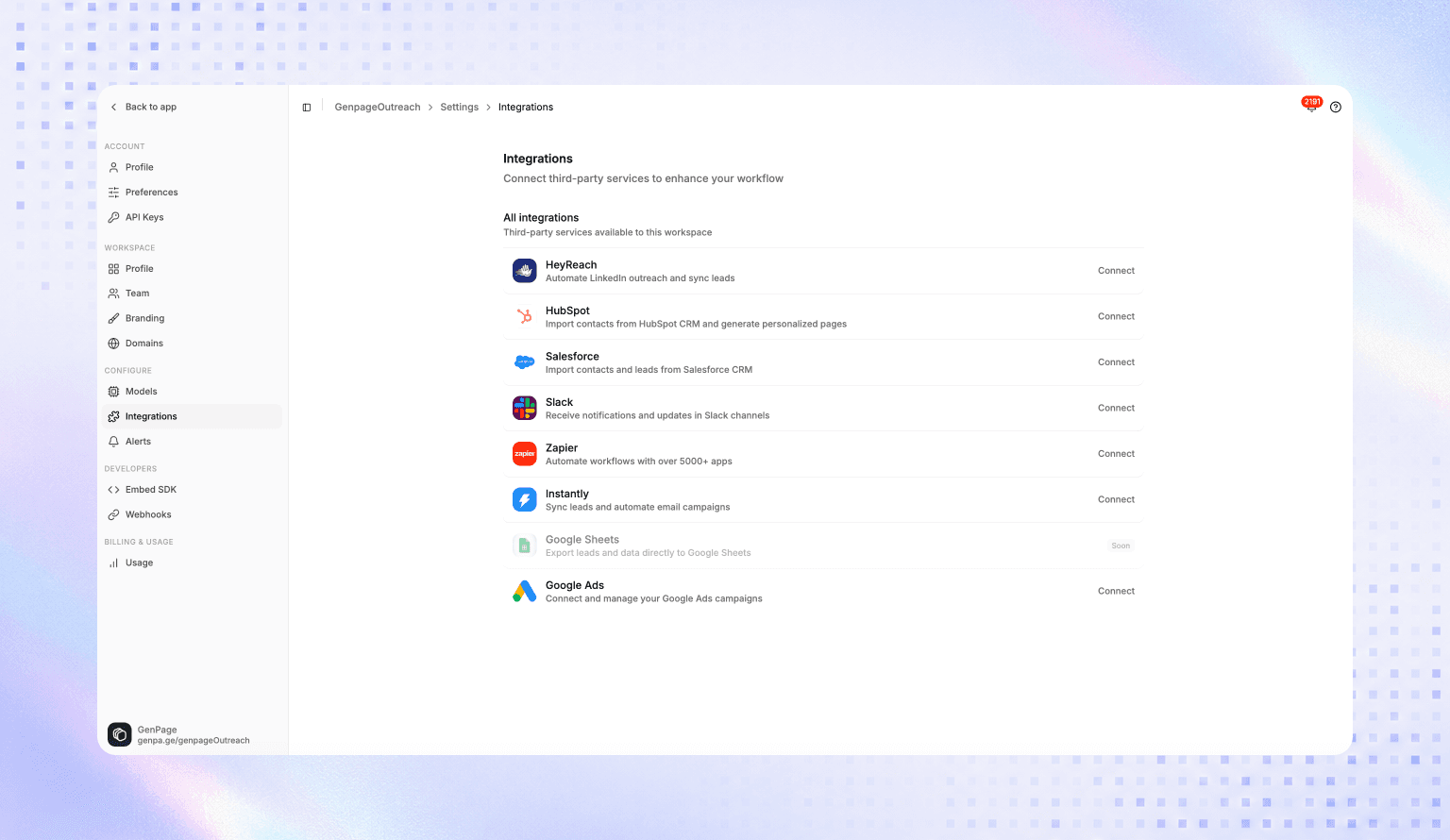
Connecting your CRM (HubSpot, Salesforce) to your page generation workflow means the AI can draw on your actual relationship history, not just public data. A page that references a specific prior conversation is meaningfully different from one built entirely from public research.
Mistake #4: Not enough personalization tokens
Once the research is in place, the second most common failure is under-using it.
Most teams building their first AI-generated ABM pages add three or four personalization variables - company name, industry, maybe a logo, maybe a job title - and consider the page personalized.
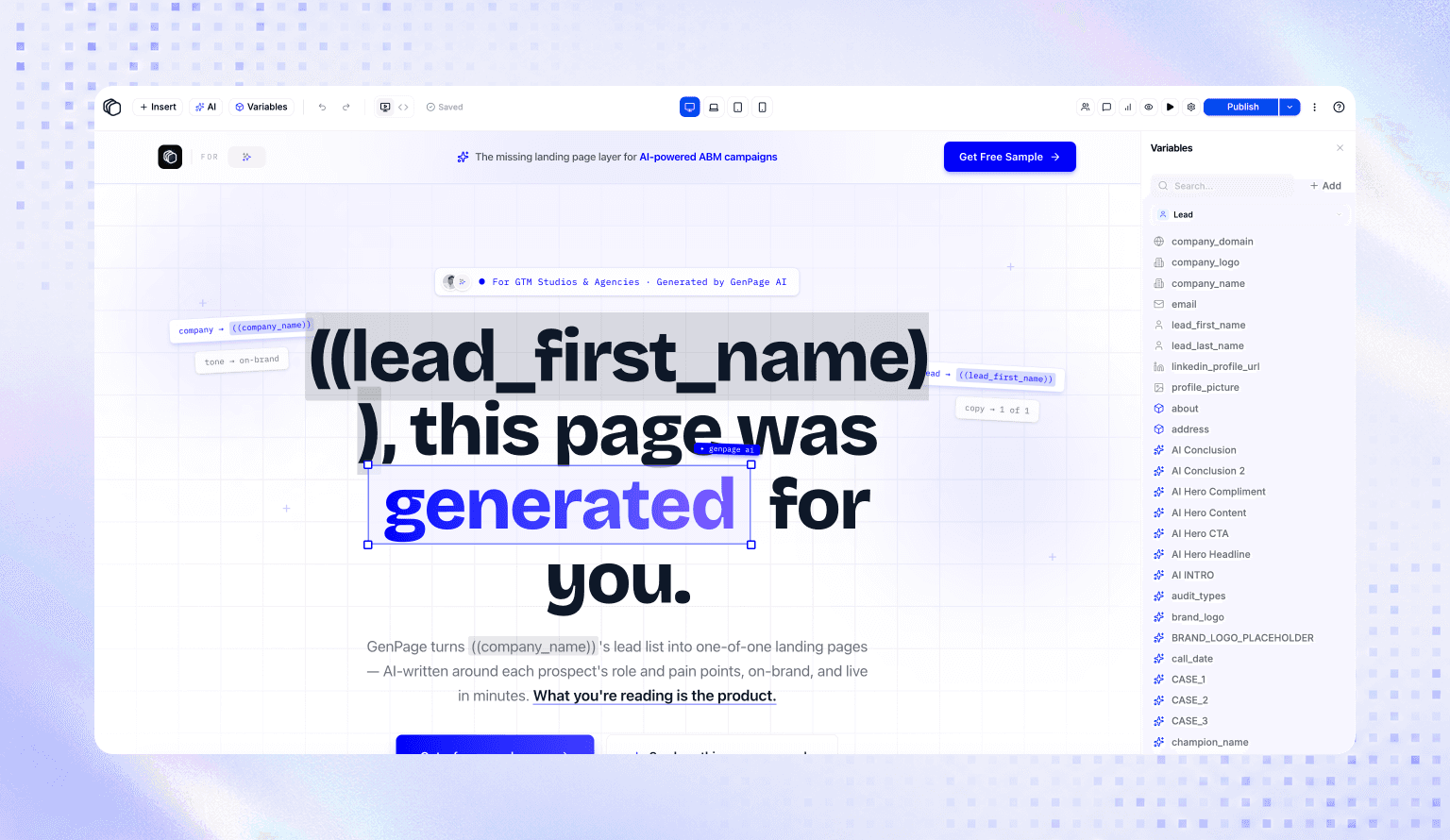
With deep research and AI generation, you can go dramatically further. The gap between a page with four tokens and a page with thirty is the gap between "they know my company name" and "this was built for me."
Elements worth personalizing on a serious ABM page:
Headline (referencing their specific problem or situation)
Subheading (with their company or industry context)
Company logo alongside yours
Hero image or visual relevant to their industry
The problem statement, in the language they use
The specific use case most relevant to their role
Case studies filtered to their industry and company stage
Testimonials from someone in their role
Metrics and proof points relevant to their scale
The offer framing, tied to their specific situation
CTA copy referencing their company
A personal video or note referencing their context
Section ordering, based on what matters most to their persona
Not every page needs all of these. But if you're personalizing fewer than eight to ten elements, you're leaving most of the available lift on the table, and you've done the research work without capturing the return on it.
Mistake #5: Shipping something that looks AI-generated
You can get the research right, the tokens right, and the page structure right - and still lose the prospect in the first two seconds because the page looks like it came out of a prompt.
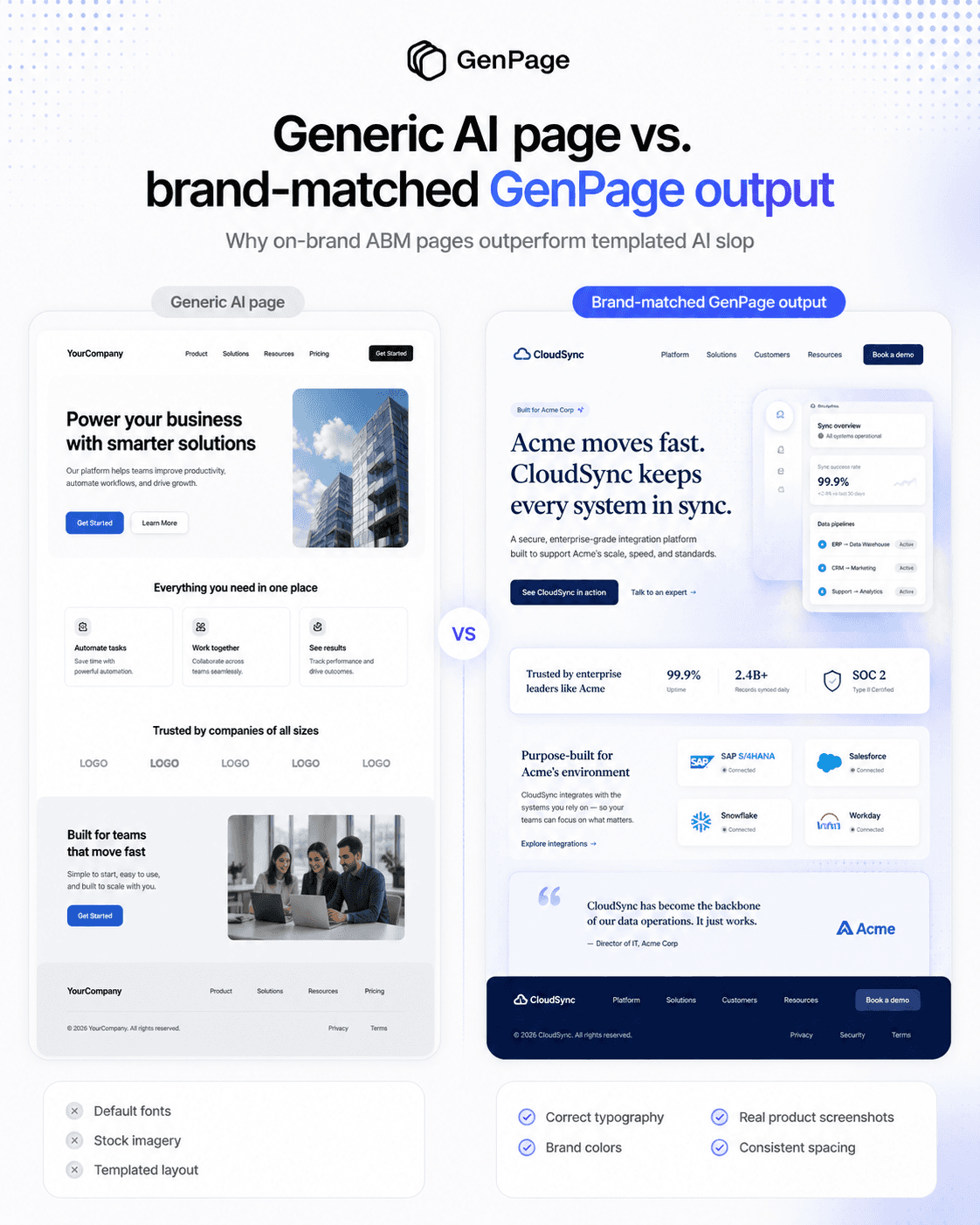
This is the objection I hear most from marketers who are otherwise sold on the concept, and it's a legitimate one. Most AI-generated pages look like AI-generated pages. Generic layouts. Default typography. Stock illustrations. Section spacing that doesn't match anything else you've ever published. The kind of page that's technically fine and immediately forgettable.
In an ABM context, that's more damaging than it would be anywhere else.
Think about what you're actually doing: you've identified a senior person at a target account, researched them properly, written a message that references something specific about their situation, and asked them to click a link. They arrive expecting something considered. If the page looks templated - if it looks like a thing that was generated rather than made - you've contradicted your own premise. The message said "I built this for you." The page says "this was mass-produced."
Design quality isn't decoration here. It's part of the credibility argument.
What good looks like: the page should be indistinguishable from a page your own design team built. Same typography, same color system, same component style, same spacing rhythm as the rest of your site. A prospect landing on it should have no reason to think it was generated at all - it should read as a handcrafted extension of your brand that happens to be about them specifically.
How to get there:
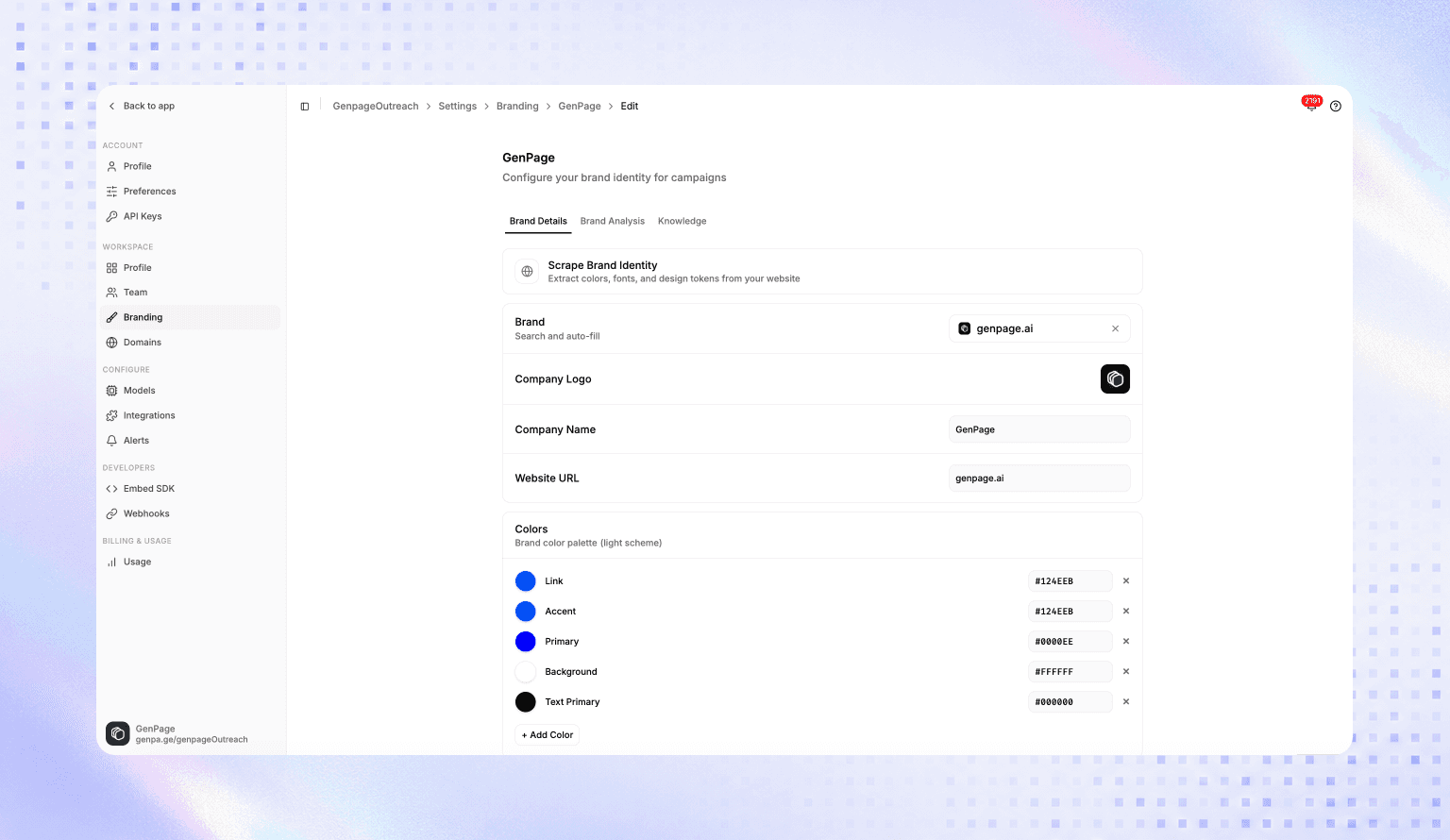
Load your brand properly before you generate anything. GenPage builds a brand profile from your domain - extracting your colors, fonts, and visual language - so generated pages inherit your actual design system rather than defaulting to a generic template. This is the single highest-leverage step for visual quality.
Invest real effort in the base page. Every generated variant inherits its design quality. An hour spent getting the base page genuinely right pays off across every page you generate from it. A mediocre base page produces a hundred mediocre pages.
Use your own assets. Your product screenshots, your photography, your icons, your illustration style. Stock imagery is one of the fastest ways to make a page read as generic.
Check it against your website. Open your homepage and your generated ABM page side by side. If they look like they came from different companies, the brand layer isn't doing its job.
The bar to clear is simple: would you be comfortable if the prospect assumed a designer built this page specifically for them? If yes, ship it. If no, the personalization won't save it.
The blueprint: how to actually build it
With the mistakes covered, here's the workflow.
Step 1: Build your target list on intent, not just ICP
Before any page-building, the list matters. An excellent page delivered to the wrong account still fails.
Three approaches worth considering, in rough order of precision:
Intent-based targeting: the approach we use at GenPage. Identify profiles engaging with problem-aware content on LinkedIn - people posting about the problem you solve, commenting on category discussions, or engaging with competitor content. Scrape those profiles and build the campaign off that signal. These prospects are already thinking about the problem, which changes the entire dynamic of the outreach.
Manual ABM list-building: selecting accounts based on your existing customers and their direct peers. Slower, but high-precision for large accounts where deal value justifies the research time.
Lookalike targeting - using a tool like ocean.io to build a list that mirrors your existing customer base firmographically. Fastest to scale, less precise on timing.
The strongest approach layers intent signals on top of ICP fit rather than choosing between them. ICP tells you who could buy. Intent tells you who's thinking about it right now.
Step 2: Set up your brand profile once
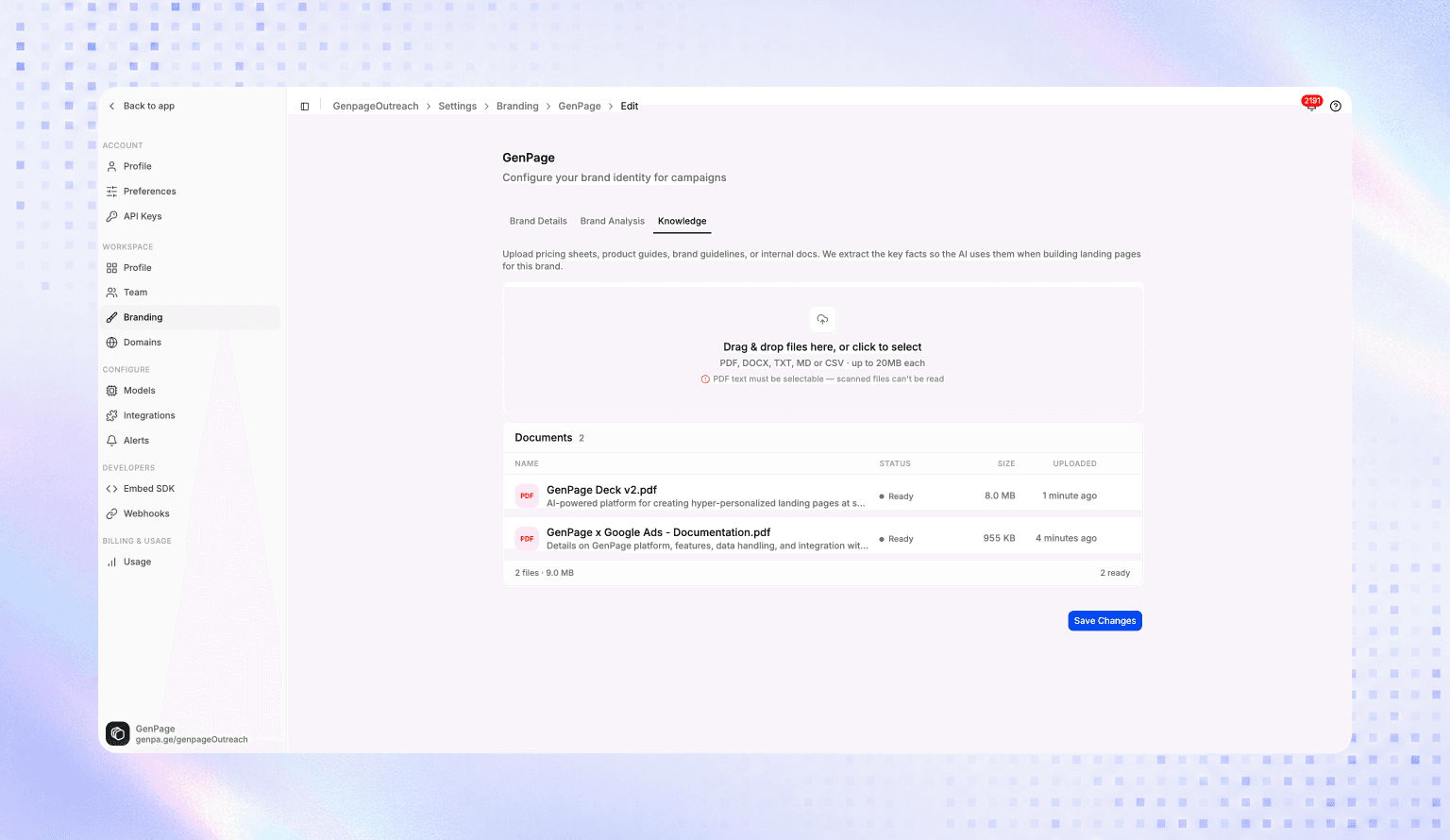
Connect your domain to GenPage. It crawls your site and builds an internal brand profile: your design system, positioning, tone of voice, products, pricing, and value propositions. This becomes the AI's permanent context layer for every page it generates.
Your website is only part of the picture, though. Most of what makes your pitch actually land lives in internal documents that were never published: sales decks, battlecards, objection-handling docs, case study write-ups, positioning frameworks, and product documentation. GenPage includes a knowledge base where you can upload these files directly, so the AI has the full context of how your business actually sells - not just how your marketing site describes it.
This matters because the language your sales team uses in a live deal is usually sharper and more specific than the language on your homepage. Feeding the AI that material means the pages it generates read like your best rep wrote them, not like a summary of your website.
This step matters more than it appears. Without it, every page starts from zero - generic layout, default typography, stock components - and you spend your time correcting brand inconsistencies instead of refining personalization. With it, the AI inherits your actual design system: your colors, your fonts, your spacing, your visual language. The output looks like it belongs on your site from the first draft, not like something generated by a prompt.
Step 3: Build your base sales page around the offer
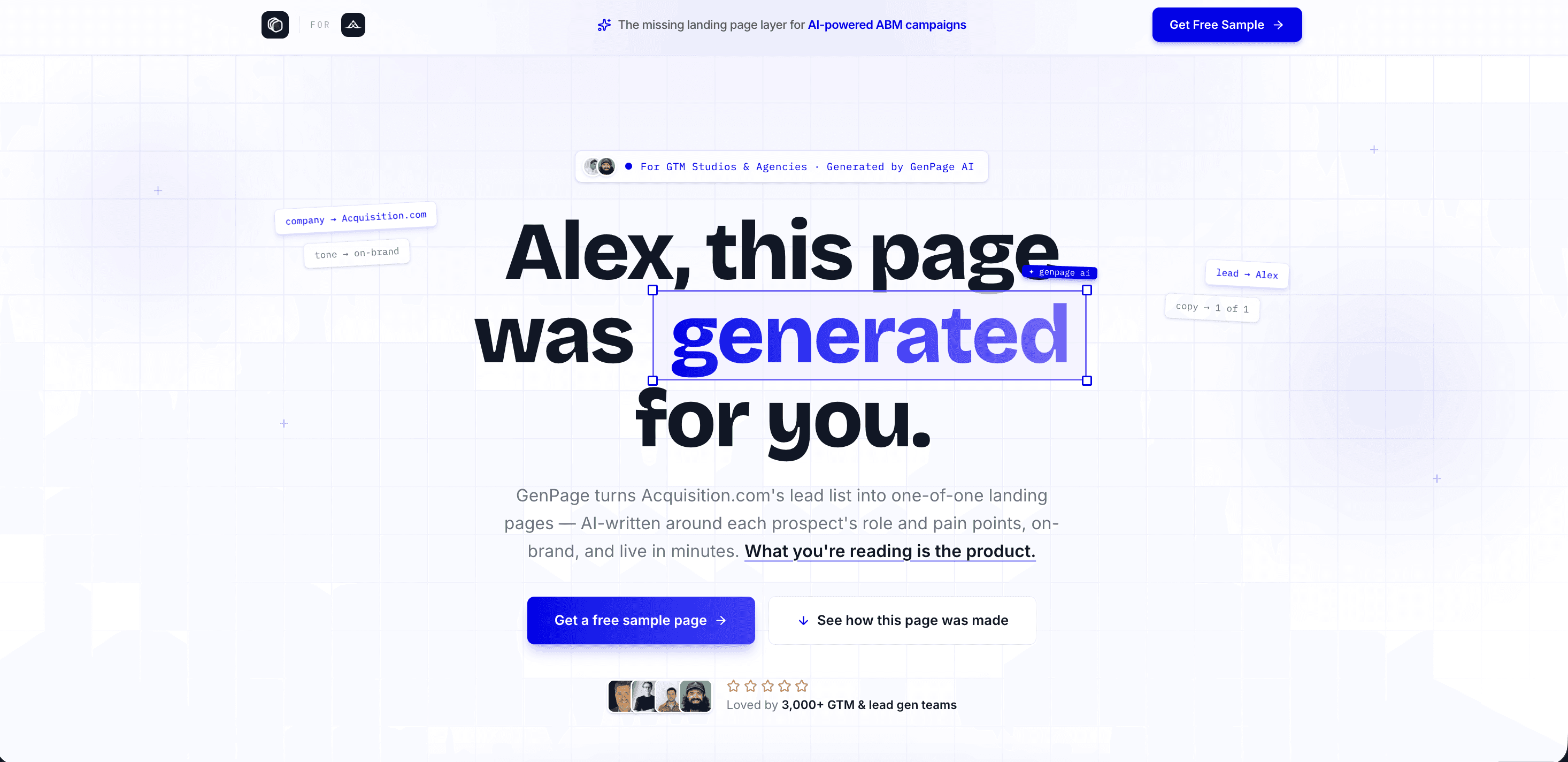
Create the master page - but build it as a sales page, not a marketing page. Structure it around the single offer you defined, with everything else stripped out.
Inside GenPage you can build this from a prompt, replicate an existing page from a URL, upload a design file, or start from a template. Because the brand profile is loaded, the output matches your design and voice immediately.
Spend real time here. This is the highest-leverage hour in the whole workflow, because every page you generate inherits the base page's design quality. Get the typography, spacing, and visual hierarchy genuinely right - to the standard you'd hold a page you were publishing on your own site - and a hundred generated variants will all clear that bar. Ship a base page that's "good enough," and you've mass-produced "good enough." Replicating one of your existing high-performing pages from a URL is often the fastest route to a base page that already looks unmistakably like you.
The structure that works:
Personalized hero - their problem, in their language, with a clear offer
Personal video or note - a short Loom from the seller framing problem → solution
Brief problem statement - demonstrating you understand their specific situation
The offer, explained - what they get, what it involves, why it's worth their time
Relevant proof - one or two case studies from genuinely similar companies
Single CTA - accepting the offer, not booking a meeting
No navigation. No competing CTAs. No comprehensive product overview.
To see the whole page, visit this link: GenPage ABM Landing Page Template
Step 4: Run your enrichments
Import your list and run all relevant enrichments - LinkedIn Profile, Company Research, Prospect Research, LinkedIn Posts (Person), and LinkedIn Posts (Company). Connect your CRM if you have relationship history with any of these accounts.
This is the step teams skip when they're in a hurry, and it's the step that determines whether the output is genuinely personalized or superficially personalized. Don't skip it.
Step 5: Let the AI identify personalization opportunities, then go deeper
Run GenPage's AI agent on your base page. It analyzes the structure and flags the elements with the highest personalization potential: headline, subheading, hero copy, case study selection, CTA.
Then go beyond what it flags. Review the enrichment data for your first few accounts manually and ask: what else could this page reference that would make it unmistakably built for this person? Their recent post. Their company's latest launch. A challenge specific to their stage. Add those as variables.
The AI handles the generation. Your judgment determines the depth.

Step 6: Generate and publish at scale
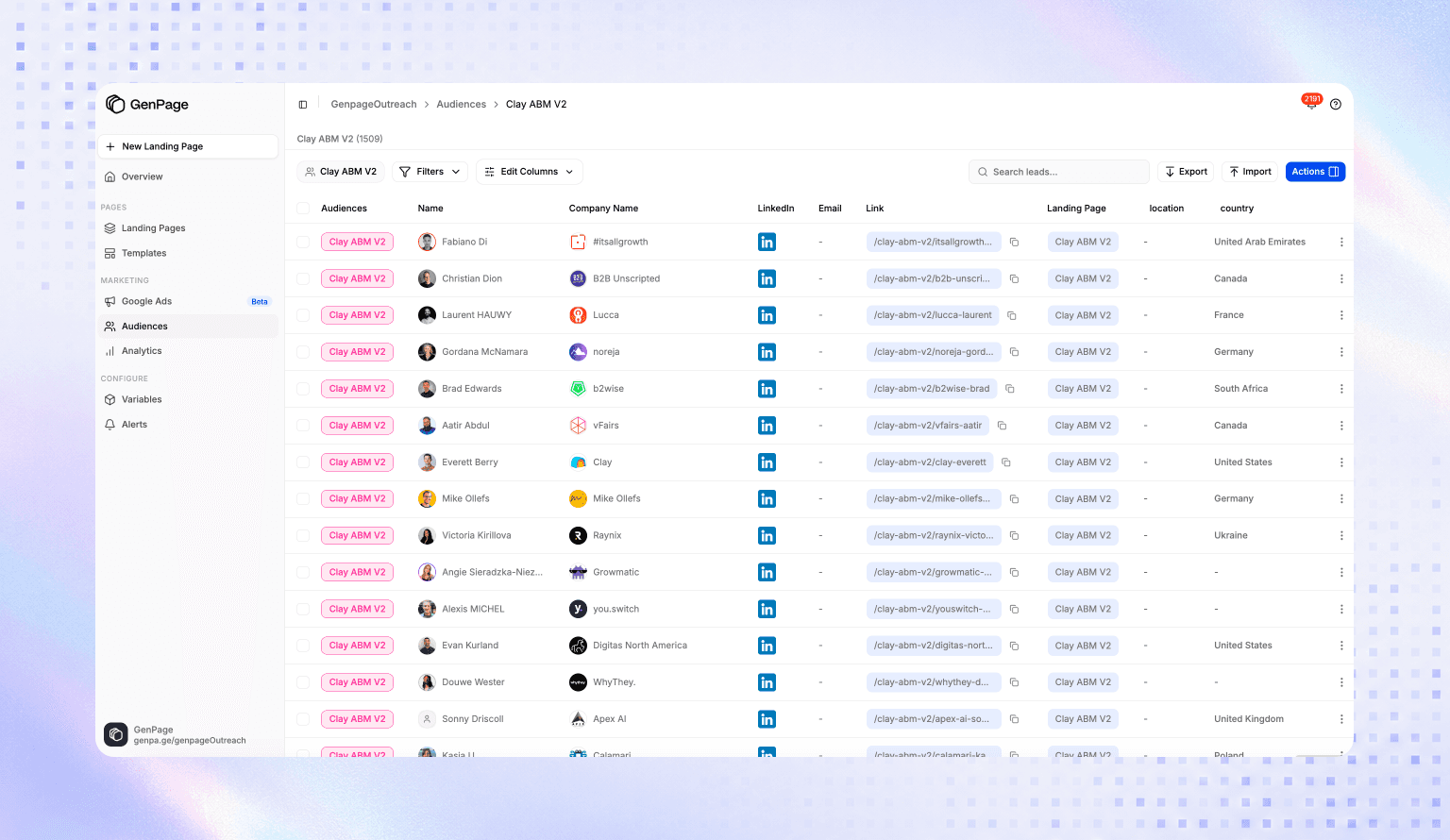
With variables defined and enrichments run, GenPage generates a unique page for every account on your list, drawing simultaneously on your brand profile, the base page structure, and the full research profile for each prospect.
For a list of 100 accounts, this takes minutes.
Publish as a subfolder on your domain via the GenPage SDK (yourdomain.com/lp/account-name) or on a dedicated subdomain. Pages render as native pages on your site.
Step 7: Build the sequence around the page
The page doesn't work in isolation. The sales outreach sequence structure that performs best:
Open with a strong hook: reference the intent signal or research finding that prompted the outreach. No pitch.
Ask if they'd like to see the page: "I put together something specific for [Company] - want me to send it over?" This is a foot-in-the-door move. A prospect who says yes has made a micro-commitment and arrives at the page already invested.
Send the page once they opt in.
Follow with legitimacy-building material: case studies, resources, proof points. Each touch earns the next rather than requesting the meeting cold.
LinkedIn has been converting better than email in our recent campaigns, but multichannel outperforms any single channel. The recommended structure is LinkedIn as the primary channel with email and phone reinforcing it.
Running this exact sequence, our own outreach consistently achieves reply rates between 33% and 53% on LinkedIn - against an industry benchmark of 1–10% for cold outreach. The difference isn't the messaging. It's the combination of reaching people already thinking about the problem, and giving them a destination built around that exact context.

Step 8: Track engagement and follow up on signal
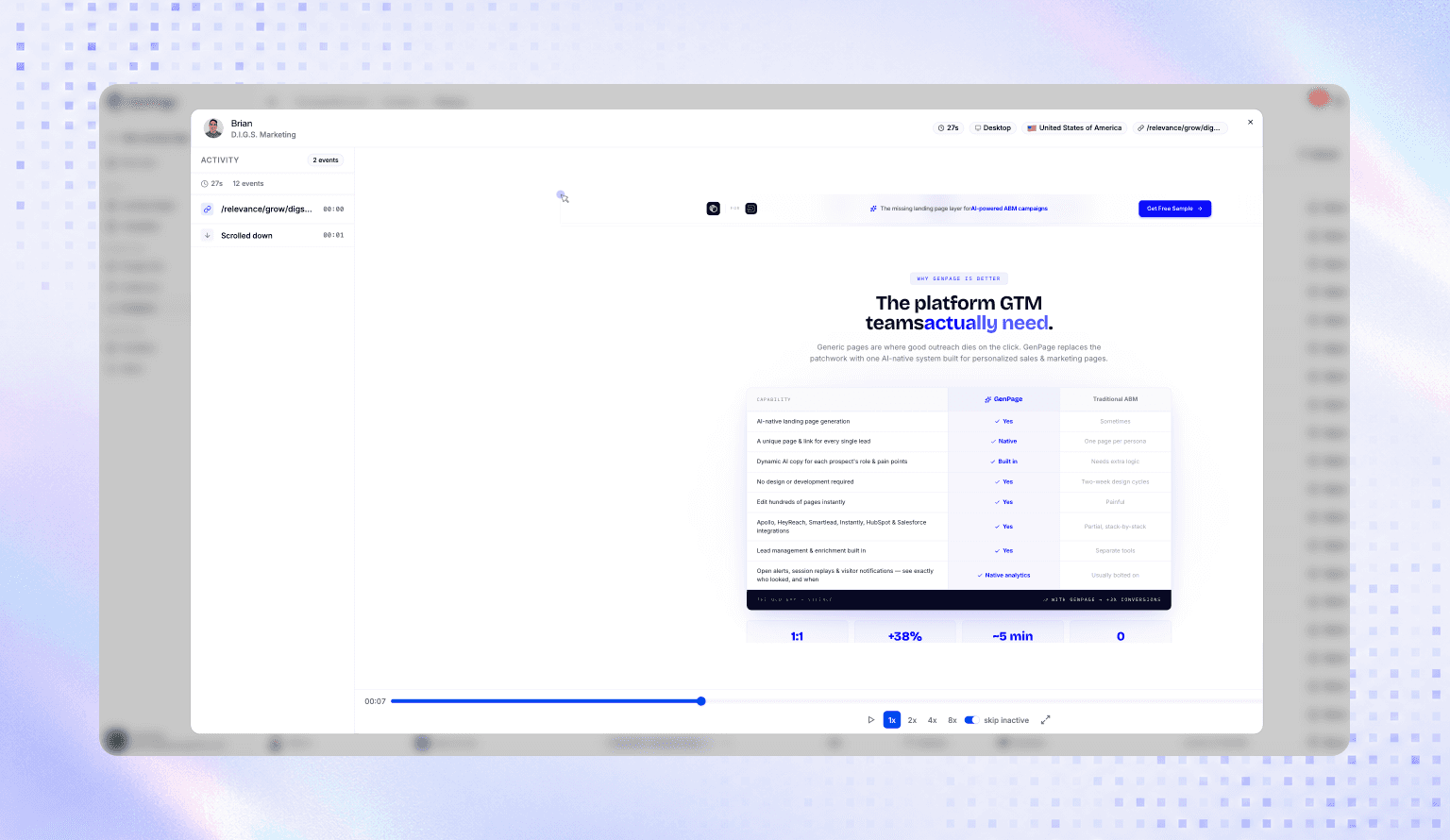
Every page generates behavioral data: who visited, how long they stayed, which sections they read, whether they clicked. GenPage provides heatmaps, session replays, and real-time alerts per prospect.
Use this to time your follow-up. A prospect who just spent four minutes on their page and watched the video is in a completely different state from one who hasn't opened it. Following up within hours of a visit - while the context is fresh - converts materially better than a fixed-schedule drip.
A real example: our Clay ABM campaign
Everything above is the method. Here's what it looks like executed end to end, using one of our own campaigns.
These LinkedIn campaigns are now our most profitable acquisition channel internally at GenPage. It's effectively the only outbound motion we run right now - which should tell you something about how it performs relative to the alternatives we've tested.
The intent signal
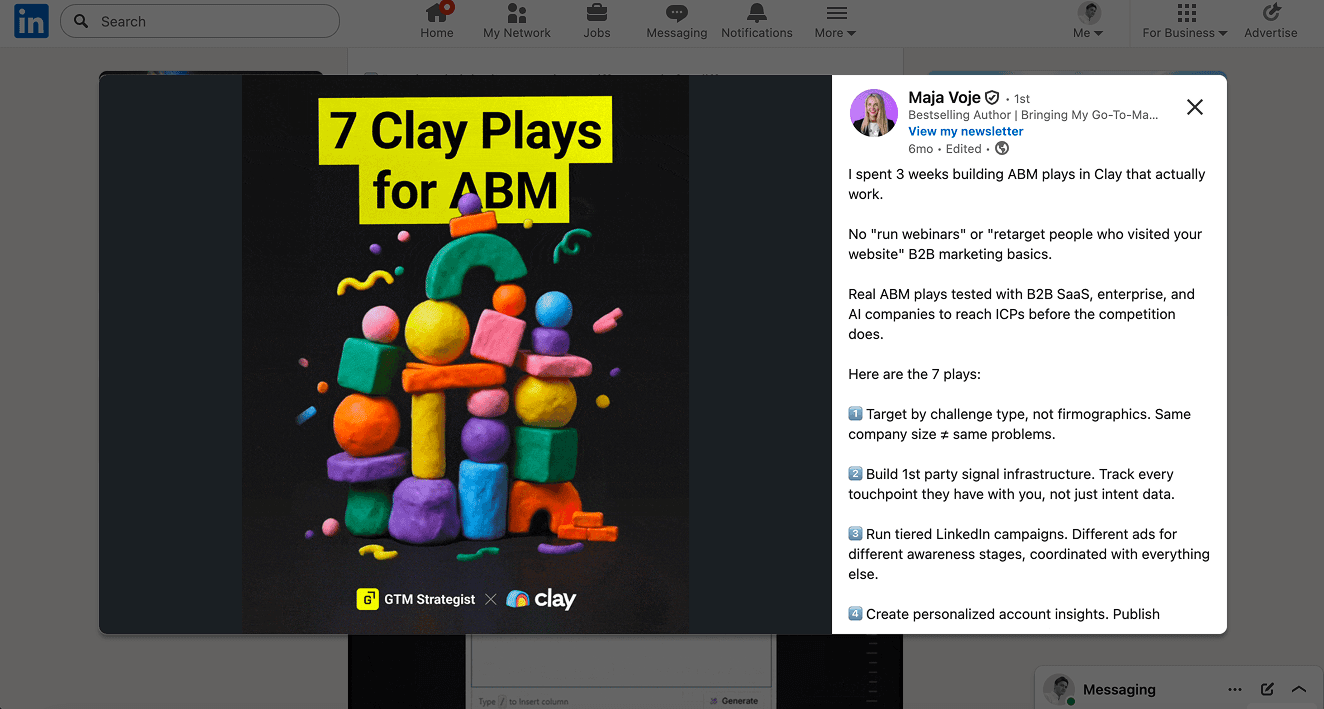
Leaders in Clay's GTM creator network published sets of ABM resources and guides, and a number of people requested them in the comments. That request is a genuinely strong intent signal - it tells you two things at once: this person is actively thinking about ABM right now, and they're already in the Clay ecosystem.
That second part mattered specifically for us. GenPage has a native Clay integration, so anyone already using Clay is someone for whom our product slots directly into an existing workflow rather than requiring them to change how they work.
We didn't scrape at volume. We browse LinkedIn as part of the job anyway, and we list relevant posts as we see them. It keeps us informed about what our market is talking about, and it produces a target list built on real, current signal rather than a static ICP filter.
The segmentation
From that pool, we segmented down to our actual ICP: GTM and ABM agencies and teams in the small to mid-market range.
This is the step that separates a signal-based list from a scraped list. Intent alone isn't enough: a Fortune 500 enterprise ABM team requesting the same resource is a different buyer with a different sales cycle and different needs. Layering ICP fit on top of the intent signal produces a list where both the timing and the fit are right.
The offer
Here's where the sales-page thinking from earlier becomes concrete.
We didn't ask for a meeting. The offer was: we'll build your first landing page template for your business, free, ready to use in your GenPage workspace so you can test it yourself.
That's a high-value, low-friction offer that does several things simultaneously. It delivers value before asking for anything. It requires no commitment beyond saying yes. It gets the prospect into the product with a real asset built for their business. And it makes the meeting a natural next step rather than a cold ask.
The page
The page carried the full offer. The outreach message was deliberately short - enough to convey the hook and grab attention, nothing more. The page did the actual work:
What GenPage does, in more detail
Specifically how the Clay integration works, since every person on this list was a Clay user
The free landing page template offer, explained clearly
A single CTA to accept it
The message earns the click. The page converts.
The delivery
We sent through HeyReach - short, direct LinkedIn messages carrying the offer and pointing to the page.
Low volume by design. This isn't spray and pray. When your list is built on genuine intent signal and segmented to a real ICP, you don't need thousands of sends. You need the right several hundred.
The results
Across three campaigns run on this method:
Campaign | Connection rate | Reply rate | Sent |
|---|---|---|---|
Webflow Clay v2 | 58% | 53% | 84 |
Clay ABM | 56% | 37% | 993 |
Clay ABM N2 | 57% | 33% | 1,093 |
Reply rates between 33% and 53%, against an industry benchmark of 1 - 10% for cold LinkedIn outreach. Connection acceptance consistently in the mid-to-high 50s.
Worth noting the pattern in that data: the smallest campaign produced the highest reply rate. That's not a coincidence, it's the trade-off inherent to this method. As volume increases, the average precision of the intent signal decreases, and reply rates compress. The 53% campaign was tightly targeted. The 1,000+ campaigns were broader.
If you're choosing between reach and precision, the data says precision wins on rate - but volume still wins on absolute replies. Run both, and know which one you're optimizing for.
Why it worked
Every element of the method shows up in this campaign:
Real intent signal: people actively requesting ABM resources, not a static ICP list.
ICP segmentation on top of intent: GTM and ABM teams in small to mid-market, not everyone who raised a hand.
Research that mattered: knowing every person was a Clay user let us lead with the integration angle, which is far more specific than a generic product pitch.
A sales page, not a marketing page: the page existed to convert the specific people the sequence brought in, built around one offer.
A low-friction offer: a free landing page template built for their business, not a meeting request.
Short outreach, substantive page: the message grabbed attention; the page carried the offer.
None of it required a design team or a development sprint. It required a real signal, real research, and a page built for one specific conversation.
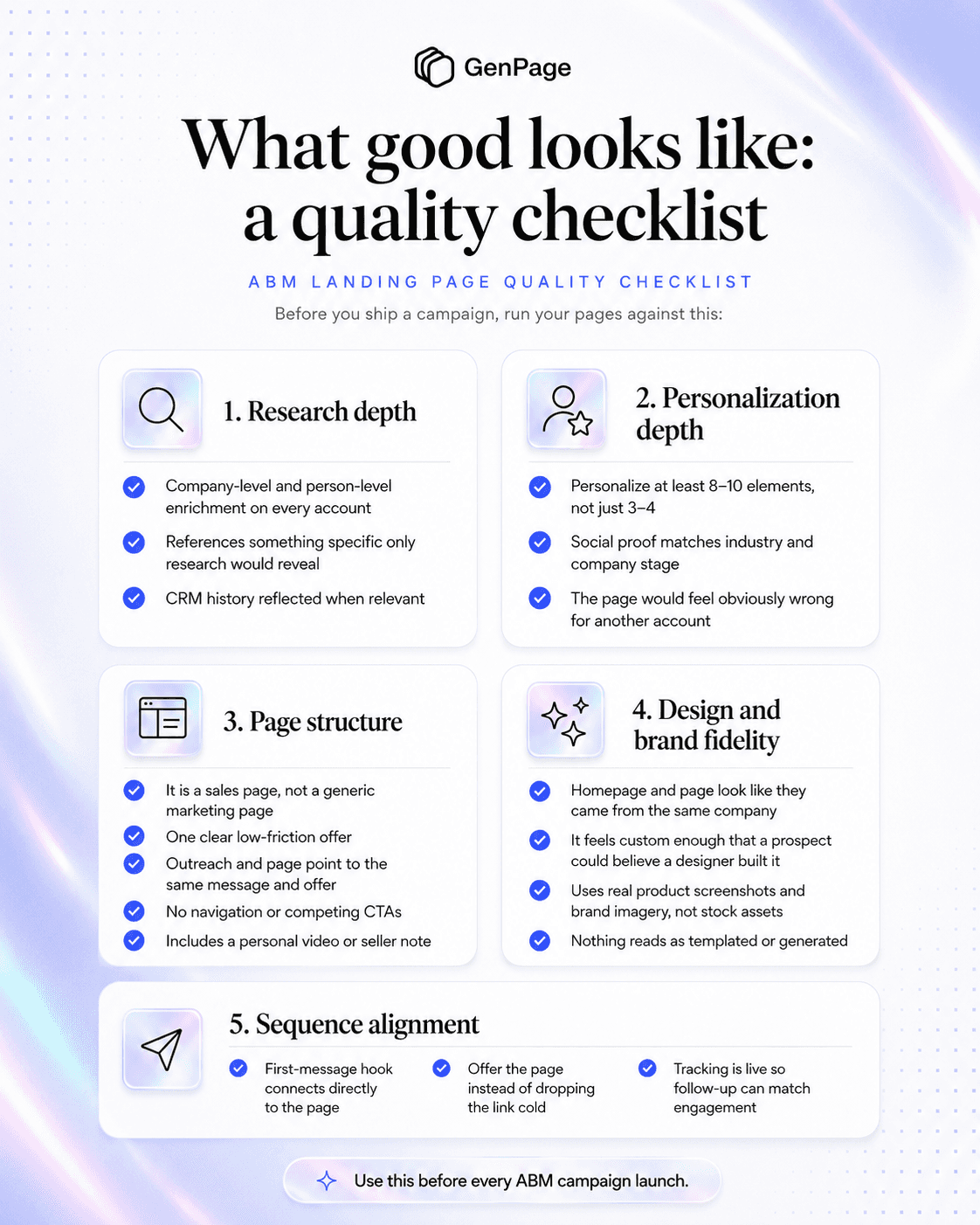
What good looks like: a quality checklist
Before you ship a campaign, run your pages against this:
Research depth
Have you run company-level and person-level enrichments or do you have first-party data to leverage for on every account?
Does the page reference something specific that you couldn't have known without doing research?
If you have CRM history with this account, is it reflected on the page?
Personalization depth
Are you personalizing at least eight to ten elements, not three or four?
Does the social proof match their industry and company stage?
Would this page be obviously wrong if sent to a different account? (If it would still work fine, it isn't personalized enough.)
Page structure
Is this a sales page or a marketing page? Be honest.
Is there a single, clear offer - and is it low-friction?
Does the outreach message and the page carry the same message and point at the same offer?
Have you removed the navigation and all competing CTAs?
Is there a personal video or note from the seller?
Design and brand fidelity
Open your homepage and this page side by side. Do they look like they came from the same company?
Would you be comfortable if the prospect assumed a designer built this specifically for them?
Are you using your own product screenshots and imagery rather than stock assets?
Does anything on the page read as templated or generated?
Sequence alignment
Does the hook in your first message connect directly to what's on the page?
Are you offering the page rather than dropping the link cold?
Do you have tracking live so you can time follow-up to engagement?
The results this produces
When the research is deep, the personalization is thorough, and the page is built as a sales asset rather than a marketing asset, the outcomes are consistent:
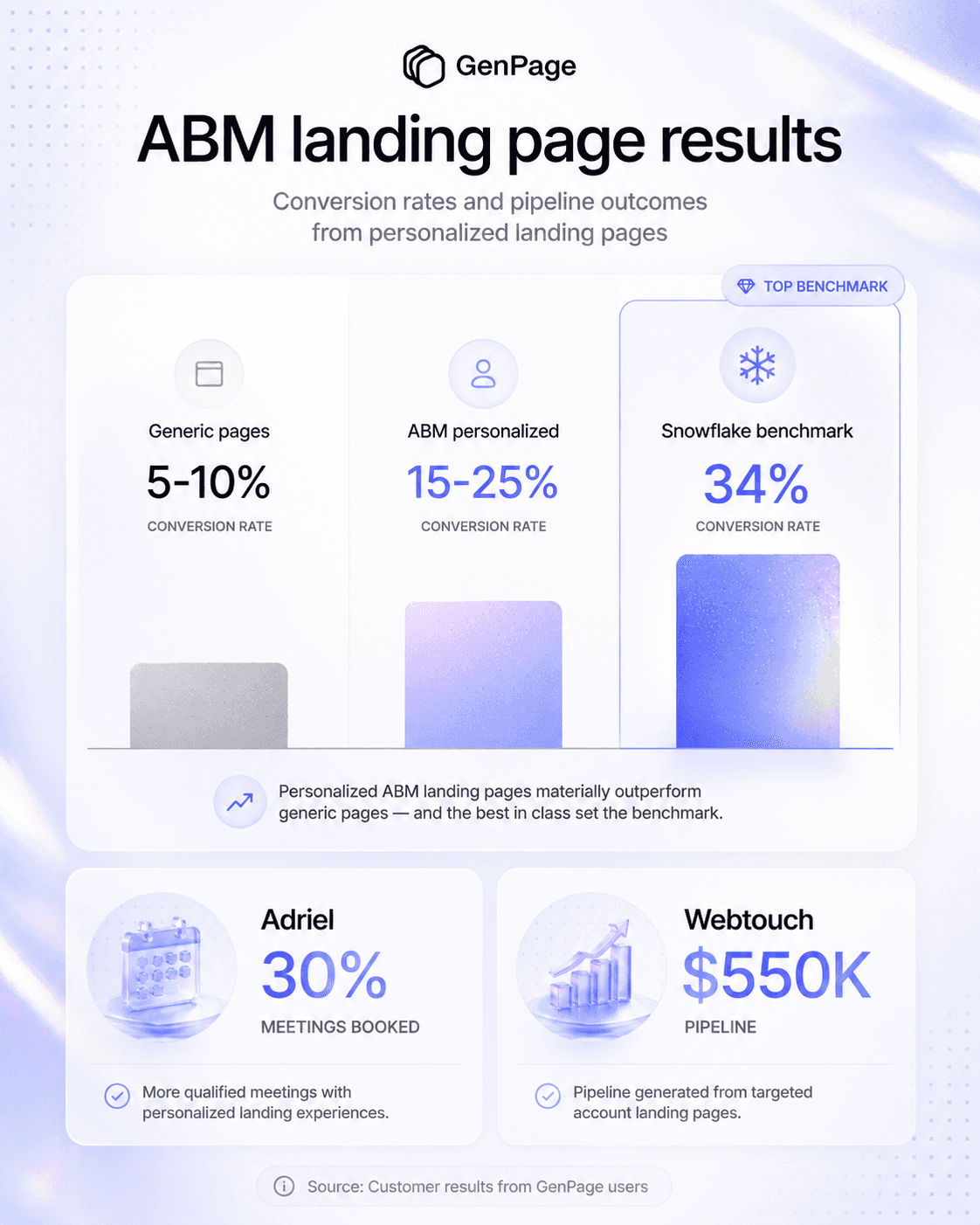
ABM-personalized landing pages convert at 15–25% compared to 5–10% for generic pages — a 2–3x lift.
Snowflake reported personalized pages converting at 34% versus 11% for generic, alongside 80% higher ACV.
Adriel generated 608 personalized pages for VivaTech attendees and booked 30% of their meetings before the event started, with a 36% reply rate.
Webtouch generated $550,000 in pipeline and a 30% reply rate across 6,678 emails using personalized pages with embedded company-specific video.
None of these required a design team, a development sprint, or a six-figure platform contract. They required good research, deep personalization, and a page built to convert one specific person.
Conclusion
The barrier to building excellent ABM landing pages used to be production cost. Design time, development time, and the resource math that made 1:1 pages viable only for your top handful of accounts.
That barrier is gone. Anyone can generate a hundred pages this afternoon. What separates the campaigns that convert from the ones that don't is no longer budget or production capacity, it's the work most teams skip because AI makes it feel optional.
Run real research at both the company and person level. Use it fully by personalizing ten or more elements rather than three. Build a sales page around a single low-friction offer, not a marketing page with tokens inserted. Structure the sequence so the page is offered rather than dropped. Track engagement and follow up on signal.
And make it beautiful. This is the part teams underrate most. A page can be perfectly researched and deeply personalized and still fail because it looks like it came out of a prompt: generic layout, default fonts, stock imagery, the visual signature of something mass-produced. You're sending this to a senior person at an account you care about. It needs to look like a handcrafted extension of your website, not AI slop with their company name inserted. If the prospect could plausibly assume a designer built it for them, you've cleared the bar.
That's the blueprint. AI removed the cost. Everything above is the work.
Ready to build your first AI-generated ABM page? Start free today and have personalized pages running in your next campaign before the week is out.
Frequently Asked Questions
Can AI really build 1:1 personalized landing pages?
Yes, but the quality depends entirely on the research feeding it. AI generation with shallow inputs (company name, industry, job title) produces pages that feel like mail merge. AI generation with deep enrichment - full LinkedIn profiles, company research, recent posts, and CRM history - produces pages that read as if they were researched and written individually. The tool determines the speed; the research determines the quality.
What research do you need to build a good ABM landing page?
You need both company-level and person-level research. At the company level: what they do in their own words, recent news, current positioning, and public initiatives. At the person level: their full professional profile, their role and what they own, and critically, what they've been posting about and engaging with recently. In GenPage, this is handled through five enrichments: LinkedIn Profile, Company Research, Prospect Research, LinkedIn Posts (Person), and LinkedIn Posts (Company). If you have CRM history with the account, that first-party data is the most valuable input of all.
How many personalization variables should an ABM landing page have?
Most teams use three or four and stop there. A serious 1:1 page personalizes eight to fifteen elements or more - headline, subheading, logo, hero visual, problem statement, use case, case study selection, testimonial, metrics, offer framing, CTA copy, and often a personal video. The test: if the page would still work fine sent to a completely different account, it isn't personalized enough.
What's the difference between a marketing landing page and an ABM sales landing page?
A marketing page is broad and information-heavy, designed to inform a wide audience with varying context. An ABM sales page is a real-estate extension of the offer made in your outreach - focused, personable, and built to convert one specific person who arrived with context from your message. Marketing pages explain everything; sales pages carry the offer forward and give the recipient exactly what they need to say yes. Most failed ABM pages are marketing pages with a few tokens inserted.
Should an ABM landing page ask for a meeting?
Usually not as the primary CTA in cold outreach. A meeting request is a heavy first ask for someone who doesn't know you and has no evidence you can help. Leading with a high-value, low-friction offer - a tailored resource, a free audit, or implementation of a specific quick win - converts better, with the meeting becoming the natural next step once value has been delivered.
How long does it take to build ABM landing pages with AI?
Once your brand profile and base page are set up, generating personalized pages for a list of 100 accounts takes minutes. The initial setup - connecting your domain, building the brand profile, creating the base sales page, and defining your personalization variables - typically takes a few hours. The research enrichment runs automatically on import. Compared to a traditional design-development workflow of two to three weeks per page, the difference is structural rather than incremental.
How do you stop AI-generated landing pages from looking generic?
Load your brand before you generate anything. GenPage builds a brand profile from your domain - extracting your colors, typography, and visual language - so every generated page inherits your actual design system rather than a default template. Beyond that: invest real effort in the base page, since every variant inherits its design quality; use your own product screenshots and imagery instead of stock assets; and check the finished page side by side with your homepage. If they look like they came from different companies, the brand layer isn't doing its job. The bar to clear is whether a prospect would assume a designer built the page specifically for them.
Do I need a developer to build AI-generated ABM landing pages?
No. Platforms like GenPage are built for marketers and sales teams to work independently. You can build a base page from a prompt, a URL, a design file, or a template, run enrichments, define personalization variables, and publish to your own domain - all without engineering involvement. This removes the production bottleneck that historically limited ABM personalization to a handful of top accounts.
What's the best way to build a target account list for ABM pages?
Layer intent signals on top of ICP fit rather than choosing between them. ICP tells you who could buy; intent tells you who's thinking about the problem right now. The most effective approach we've found is identifying people engaging with problem-aware content on LinkedIn - posting about the problem, commenting on category discussions, or engaging with competitor content - and building the campaign from that signal. Manual ABM list-building and lookalike targeting via tools like ocean.io are also viable, particularly for large accounts where deal value justifies the research time.


